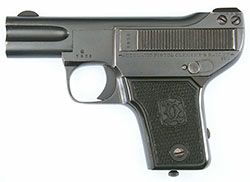
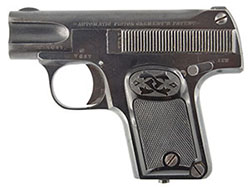
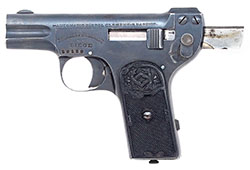
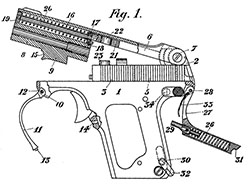
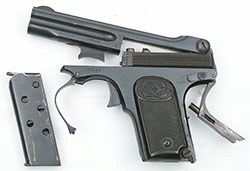
by Ed Buffaloe, Bill Chase,Dr. Stefan Klein, and Dr. Dirk Ziesing
About 48 minutes to read.
Historical Background
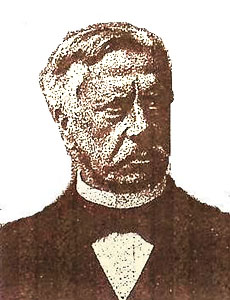
Charles Clément
Charles Philibert Joseph Clément was born on 16 May 1846 in Dour, Belgium and died on 13 May 1913 in Liège, three days short of his 67th birthday. Between 1883 and 1912 he filed 35
patents in Belgium for various revolvers, pistols, and rifles, as well as 14 utility models and trade names. We know that he became a senator in the Belgian legislature and was knighted by
the Belgian king (Knight of the Order of Leopold).
In 1870 Clément was married to Jeanne Marie Flore Vignoul (1847 – 1871). In 1883 the widower married Marie Joséphine Eve Dolmans, born in 1855. The couple already had a son born in 1876.
Clément partnered with Alexandre Fagnus in 1879. Their guns were typically marked FAGNUS A. & C. CLEMENT. The partners manufactured double-action six-shot pin-fire and rim-fire revolvers in 7 mm, 9 mm, and
12 mm, marked “Guardian American Model of 1878”, the smaller guns having a folding trigger.
Clément started his own business in 1883 to make various center-fire revolvers, including a Velodog revolver with an internal hammer and a safety lever, a larger eight-shot Velodog with an
external hammer, a postman’s revolver apparently made for the Belgian postal service, a patented six-shot top-break revolver, and a mini-Bulldog revolver with folding trigger and a button safety.
He also manufactured a replica of the 1851 Colt cap and ball revolver. Typically, his guns were marked C. CLÉMENT over LIEGE. According to Alain Daubresse, in his book Les armuriers Liègeois, he made export revolvers marked “The English Bullock” and “The American Settler,”
and others simply marked with his interlaced CC monogram with one letter reversed. Between 1883 and 1895 Clément also manufactured double-barrel shotguns in both hammer and hammerless
versions, and Clément is said to have manufactured shotguns for the U.S. retailer J. T. Randall.
According to John Walter in his Dictionary of Guns and Gunmakers, a gunmaker by the name of Charles Clement is listed in London directories for 1890 and 1891 at 63 Queen Victoria Street
who is likely the Belgian Charles Philibert Clément, though there is no firm proof. A Charles Clement of Liege is listed in the Official Catalogue of the World’s Columbian Exposition, 1893,
as an exhibitor in the categories of military small arms and sporting firearms.
In May 1902 the Waffenzeitung reported that the Clément factory in Liege, with 250 employees, was destroyed by fire. The damage was estimated at 300,000 Belgian Francs. Depending on the
method of calculation, this is the equivalent of somewhere between 2 and 3.5 million dollars in today’s money. This fire may have marked the end of one phase of his business and the beginning
of a new one, as we will see below.
Alain Daubresse reports that “at the end of his life CLEMENT sold his revolver manufacture department to NEUMANN Bros, and focused only on semi-automatic pistols.” He does not
provide a date for this sale.
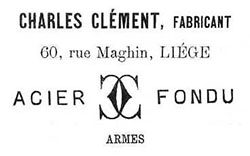
Belgian Trademark No. 1134 5 March 1903 Acier Fondu = Forged Steel
A book on the former industrial zones of Liège states that Charles Clément owned three lots at 105, 106, and 108 rue Cadastre from 1901 until 1907. These lots included a steam
engine with transmission, buildings, shop, sheds, a forge, and outbuildings at 108 rue Cadastre; a house, yard, and outbuildings at 106 rue Cadastre; and a house, yard, and outbuildings with more than 100 acres of land at 105 rue
Cadastre. All of these properties were sold in September of 1907 to Henri Heuse-Riga, whose primary business was making Damascus barrels. Clément’s patents list his address as
either 37 or 39 rue Cheri. A trademark card dated 5 March 1903 lists his business address as 60 rue Maghin, Liège.
On 27 September 1902 Julien Warnant-Creon was granted Belgian patent number 165988 for a “Pistolet à répétition” (see patents below). Julien Warnant was a brother of Jean Warnant, who is
most famous for his design of the ingenious revolver lock consisting of only four components. The first Belgian patent dates from 1874, and many subsequent revolvers were based on it, e. g. the
British Kaufmanns and the Swiss army revolvers.
Both Warnant brothers also had an interest in self-loading pistols. Jean Warnant later designed the self-loading pistol which was manufactured by Nicholas Pieper, the design for which Pieper also sold to Steyr and which became known as the 1908 Steyr-Pieper. After Julien married he changed his name to Warnant-Créon.
On 31 October 1902 Julien Warnant signed a contract to sell all rights to his new patent to Charles Clément for the sum of 8,000 Belgian Francs. He provided detailed drawings of the design, as
well as a working model of the pistol. In addition, he agreed to transfer all future improvements to the pistol to Clément. So we see that after Clément’s gun factory burned to the ground in the Spring
of 1902, in the Fall of the same year he bought the Warnant patent with the intention of manufacturing self-loading pistols.
Charles Clément died in May of 1913 and, just before the end of the year, his widow, Joséphine, in conjunction with Victor Loiselet, filed a patent for a method of barrel retention. Within three
weeks they filed a second patent for a mechanism to lock the transfer bar when the magazine is empty. Victor Loiselet was an artillery colonel active in late 1914 in the defense of Liège against
the Germans. In particular, he was responsible for destroying bridges. In 1915, he was head of the group of Belgian armorers who went to Birmingham and began gun production in exile there. In
1919, he returned to Belgium and became director of the Manufacture d'Armes de l'Etat. Loiselet died in 1923 as a retired major-general.
Clément’s company name officially existed until 1954 when it was taken over by Neumann Frères. But these two companies had connections early on. For example, Neumann had purchased
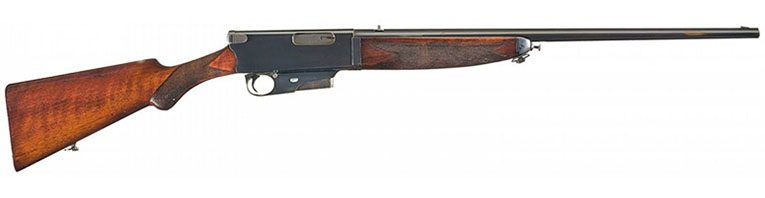
Clément’s revolver business, and in 1910, the Clément-Neumann self-loading carbine was the result of a joint-venture between the two companies. Likewise, Neumann and Warnant also had
business connections going back to 1887 or ‘88. So, we see that Belgian gunmakers were sometimes partners as well as competitors.
Clement-Neumann Semi-automatic Carbine - Model 1910
The Clément Patents
In researching Belgian patents, we have learned that patents were granted without examination in Belgium. Each patent file is accompanied by an affidavit that states:
This patent is granted to him without prior examination, at his own risk and peril, without any guarantee of the reality, the novelty or merit of the invention, or the accuracy of the
description, and without prejudice to the rights of third parties.
The process typically took only a few days or weeks, whereas in other countries the patent had to be examined and approved and the process often took months or years.
Clement Automatic Pistol Patents in Order by Date of Filing
Date Filed
Country
Patent Number
Date Granted
Patentee
Model
27 Sep 1902
Belgium
165988
15 Oct 1902
Julien Warnant-Créon
1903
5 Mar 1903
Great Britain
1903-5180
18 Jun 1903
Charles Philibert Clément
1903
3 Apr 1903
United States
786099
28 Mar 1905
Charles Philibert Clément
1903
23 July 1903
Belgium
171695
17 Aug 1903
Julien Warnant-Créon
1903
29 Apr 1905
Belgium
184363
15 May 1905
C. Clément
1903
27 July 1906
Belgium
193924
16 Aug 1906
C. P. Clément
1907
31 July 1906
Austria
28005
1 Nov 1906
Charles Ph. Clément
1907
28 Aug 1906
Belgium
194518
15 Sep 1906
C. P. Clément
1907
13 Apr 1907
Belgium
199496
30 Apr 1907
C. P. Clément
1907
12 Jun 1907
Great Britain
1907-13623
9 Jan 1908
Charles Philibert Clement
1907
24 Jun 1907
United States
885436
21 Apr 1908
Charles Philibert Clément
1907
12 Jul 1907
Germany
212735
9 Aug 1909
Ch. Ph. Clément
1907
27 Jul 1907
Austria
33467
1 Feb 1908
Charles Philibert Clément
1907
17 Sep 1907
Belgium
202749
30 Sep 1907
Charles Ph. Clément
1907
7 Jan 1908
Belgium
205326
31 Jan 1908
Charles Ph. Clément
1908
18 Nov 1908
Belgium
212168
30 Nov 1908
C. P. Clément
1909
28 Jun 1909
Great Britain
1909-14996
24 Feb 1910
Charles Philibert Clément
1909
9 Jun 1909
United States
941749
30 Nov 1909
Russell Wiles
-
20 Jul 1909
United States
970307
13 Sep 1910
Charles Philibert Clément
1909
6 Mar 1912
Belgium
243839
15 Mar 1912
Charles Ph. Clément
1912
13 Jul 1912
Belgium
249442
30 Sep 1912
Charles Ph. Clément
1912
9 Jan 1913
Germany
294811
26 Oct 1916
Charles Ph. Clément
1912
27 Dec 1913
Belgium
263467
31 Dec 1913
Joséphine Clément & Victor Loiselet
1913
17 Jan 1914
Belgium
264039
31 Jan 1914
Joséphine Clément & Victor Loiselet
1914
11 May 1914
Austria
81743
15 Aug 1915
Joséphine Clément & Victor Loiselet
1914
11 May 1914
Great Britain
1914-11534
29 Oct 1914
Joséphine Clément & Victor Loiselet
1914
11 May 1914
Great Britain
1914-18190
15 Apr 1915
Joséphine Clément & Victor Loiselet
1914
Clément’s contract with Warnant stipulated that Clément would have the right to take out foreign patents on the invention, which he did, and that any improvements to the invention by Warnant
would become Clément’s property without further compensation. The contract also stipulated that for the 20-year patent period Warnant would not create or manufacture any kind of similar
automatic pistol that would compete with Clément’s pistol. We have no evidence of Warnant’s further involvement in subsequent patents filed by Clément, though the possibility cannot be discounted.
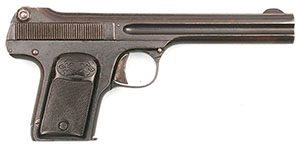
The Model 1902 Clément in 7.65mm (.32 caliber)
This early design saw limited production. We have chosen to refer to it as the Model 1902, after the date on Warnant’s original patent. It is a distinctly different pistol from the later guns in 5mm.
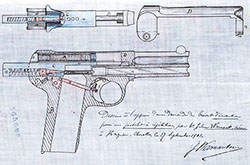
Belgian Patent 165988
Belgian Patent 165988
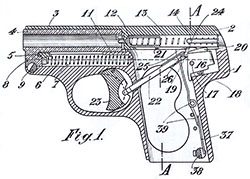
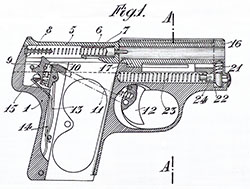
Warnant’s initial patent describes a striker-fired self-loading pistol with a barrel that screws into the frame or receiver. A rectangular reciprocating breech-block or bolt rides in the
frame and is covered by a receiver housing which contains the recoil spring above the barrel. A conventional transfer bar connects the trigger and sear. Behind the trigger is a spring
-loaded release mechanism which, as the patent says, “...after having moved the connecting rod 4, rises a little, following the rotating movement of the trigger 5.” This is not a true
disconnector in the sense that it does not prevent the gun from firing when the breech block is out of battery, but it does require the trigger to be released and squeezed again for the next shot.
Clement filed and was granted similar but less detailed patents in Great Britain (1903-5180) and the United States (786099).
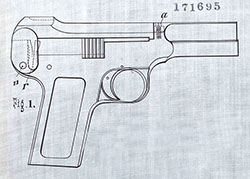
Belgian Patent 171695
Belgian Patent 171695
This patent, filed by Julien Warnant in 1903, represents an attempt to salvage his original design. The patent drawing shows a gun much like the one in the previous patent but with
the upper receiver housing no longer held captive by the barrel, instead fixed by a screw at the front. This enables the housing to be removed without removing the barrel. Two V-shaped
springs, one on either side of the frame at the rear, help buffer recoil from the reciprocating bolt.
The Original 1902 Design
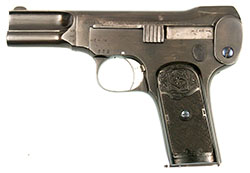
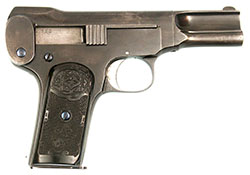
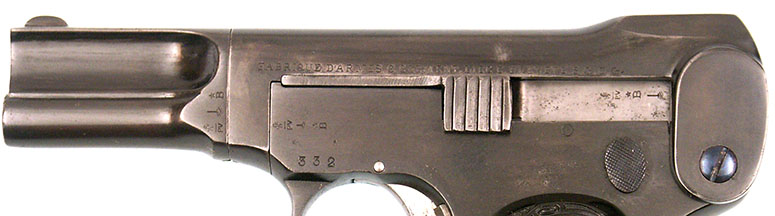
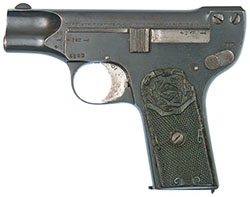
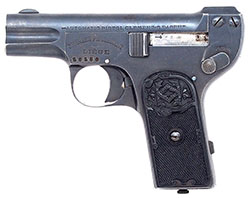
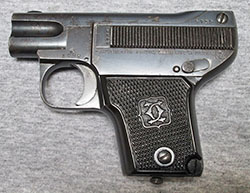
Clément Model 1902 - SN 332 in 7.65 mm (.32 caliber)
We have documented three early Clément pistols chambered for the 7.65mm Browning (.32 ACP) cartridge. Serial number 143 is in the collection of the British Royal Armouries; serial
number 332 is in the collection of Bill Chase; and a third appears in Jaroslav Lugs’ Firearms Past and Present—we presume this third gun is somewhere in Europe, and we do not
know the serial number at the time of writing. There may be other examples that we have not been able to document. These early guns are identical to the design shown in Warnant’s first
patent (see above patent number 165988). Hogg refers to the gun as being “...an intermediate stage between the 1903 and 1907 designs.” But from an examination of the patents, as well
as the serial numbers, this is clearly the primary, not a secondary, design.
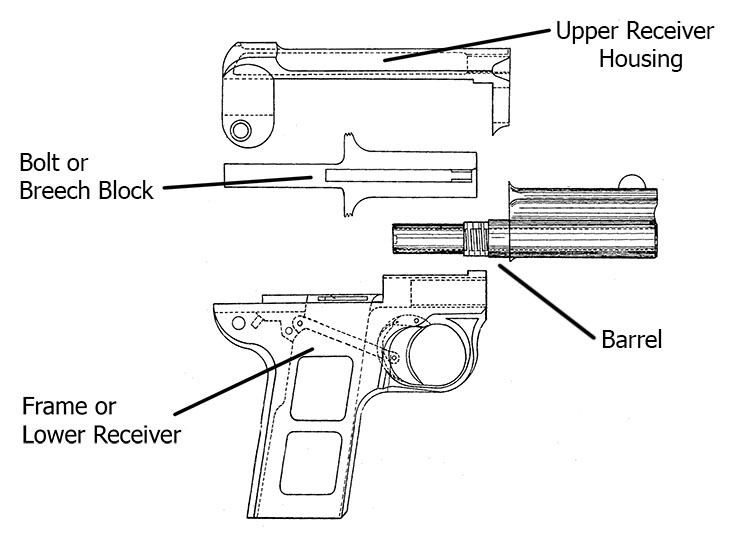
The Model 1902 is striker-fired and is made in four main parts: a frame, a barrel that screws into the frame, a reciprocating bolt or breech block with an internal extractor and a captive recoil
spring held in place by a screw at the front, and a housing that covers the bolt and recoil spring. The reciprocating bolt has an extension on either side, flared outward and serrated, that allows it
to be cocked and to chamber a cartridge. The rear portion of the upper housing is split so the bolt can move through it. The upper housing has a hole at the front, through which the barrel is attached,
and is fixed to the frame by a screw at the rear.
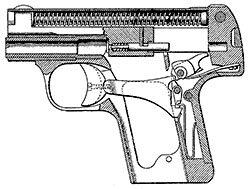
Rearranged patent drawing to illustrate the primary components of the Model 1902.
The transfer bar is internal and runs from the trigger to the sear on the left side of the magazine. A small spring-loaded lever on the back of the trigger moves the transfer bar to the rear, then rises
past it as the trigger continues to rotate, effectively disconnecting the trigger from the transfer bar until the trigger is released. The trigger is tensioned by a small flat spring. The ejector is press-fit
into two holes in the left side of the frame. A checkered safety button is pushed out from the right side to block the transfer bar. To release the safety one merely presses down on the oval button on the left side.
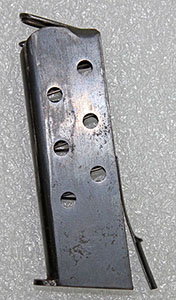
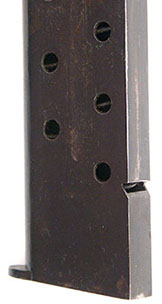
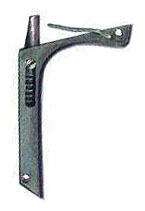
Serial number 143, which is in the British Royal Armouries collection, has the magazine catch on the rear of the magazine itself, but serial number 332 has the catch built into the grip frame. It is a
checkered lever that one squeezes toward the front of the gun to release the magazine, similar to the one on the Model 1899 FN Browning. The magazine baseplate extends beyond the front of the grip frame to assist in removal.
Early M1902 Magazine from SN 143
Warnant’s second patent (see above, Belgian patent 171695) shows a redesigned upper receiver or recoil spring housing which can be removed without first removing the barrel. This would allow the barrel
to be cleaned without removing it from the frame. The design also features additional V-shaped shock-absorbing springs at the rear of the frame, indicating that excessive recoil was already recognized as a
problem. We have yet to document a pistol with these features.
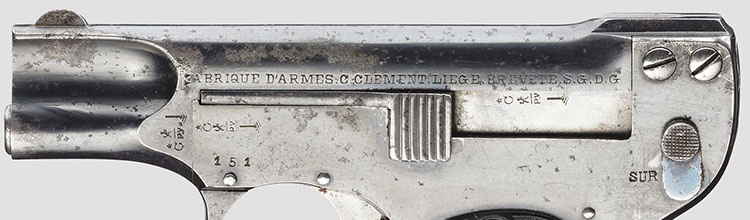
All known examples are marked on the left side of the upper receiver housing in upper-case serif characters as follows:
FABRIQUE D’ARMES C. CLEMENT. LIEGE BREVETE S.G.D.G.
The “Breveté S.G.D.G.” is a standard marking which reads in full “breveté sans garantie du gouvernement,” meaning “patented without
government guarantee”. The finish is rust blue with the bolt and trigger left unblued or “in the white.” The serial number is visible on the left side just above the bow of
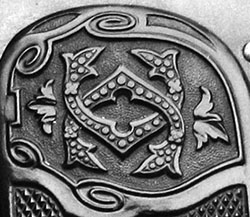
the trigger guard, and on the right side of the bolt on serial number 332, through the ejection port. There is no caliber marking. The grip plates are of checkered hard rubber with the Clement CC
monogram at the top, turned vertically.
Early Clément CC Monogram
Why Clément did not pursue production of the Model 1902 is a matter for speculation. However, in disassembling serial number 332 we noticed that the heavy screw at the rear of the
gun has been distorted by the powerful recoil. Clearly, the bolt is too light and the recoil spring is not powerful enough to withstand the forces generated, which is almost certainly why
Warnant filed his second patent with the buffer springs at the rear, and is likely the reason why Clément ultimately turned to the 5mm cartridge. Since we know that there is a serial number
332, we have to admit the possibility that Clément made as many as 350 of these pistols. But if so, the question remains, what happened to them? We can only document three in existence today. One possibility is that
they essentially self-destructed due to the extreme recoil forces produced by a light bolt and an inadequate recoil spring. It is also possible that Clément only made 10 or 20 of these guns, and
quickly realized the design was not feasible. Warnant’s second patent was not filed until 23 July 1903, so it is clear that they were still trying to solve recoil issues more than eight months after
Clément bought Warnant’s first patent.
The Model 1903 Clément
We have been unable to locate any instruction manuals, parts lists, parts diagrams, or exploded views for the Model 1903. There are no patents that show the exact design of the Model 1903.
Clearly the design saw considerable evolution after the Warnant patents were filed. We do have brief instructions for cleaning and loading from an early advertisement. The Model 1903 designation was not bestowed until the Model 1907 appeared, but has been used for many years now.
We do not know exactly when production began, as we have no datable advertisements before October of 1906. Production may not have begun until the second half of 1903, but firm evidence is lacking.
The Type I Model 1903 in 5mm Clément
Clément M1903 Type I - 5mm - SN 1080
M1903 Type I Partly Field Stripped
The Type I Model 1903 is smaller than the Model 1902, and is chambered for what was known in its day as the 5mm Charola y Anitua cartridge, but which later became known as the 5mm
Clement. It appears that Alexander Stucki, in his 2001 article in Schweizer Waffen-Magazin entitled “Clement-Pistole Modell 1903,” may have been the first to point out that when the 5mm
Clément pistol came on the market in 1903 it was the smallest self-loading pistol in the world.
In this design, not pictured in any patent, the front of the recoil spring housing forms a shroud that fits over the barrel. The portion of the recoil spring housing above the barrel is pinched
such that the front of the recoil spring is anchored just behind this pinched area. The oval area at the rear of the recoil spring housing of the Model 1902 has been eliminated in the Type I
Model 1903. The frame has a split post at the rear through which the bolt moves. Two screws at the rear connect the frame with the upper receiver housing and anchor the rear of the recoil spring guide rod.
The trigger and lockwork are the same as that of the Model 1902, with a small flat spring to tension the trigger. The rear sight is a simple V-shaped groove at the rear of the upper housing. The
front sight is a low-profile half-moon shape. The safety lever has a checkered round gripping surface, and blocks the rear of the sear when engaged, preventing any movement of the sear and
effectively locking the bolt. The safety lever also serves to lock the bolt open when turned upward to the safe position.
The external extractor is screwed into the right side of the bolt. The striker and its spring are captive in the bolt. The striker has a tail on it that serves as a cocked indicator. Like the Model
1902, the transfer bar is internal and runs from the trigger to the sear on the left side of the magazine. The ejector is press-fit into two holes in the left side of the frame.
Markings and serial number location are similar to those of the Model 1902 in 7.65mm. The safety lever positions are marked in French, FEU (Fire) and SUR (Safe). The finish is rust blue with the
trigger and bolt left “in the white” and the safety lever in nitrate blue.
The 5mm Clément Cartridge
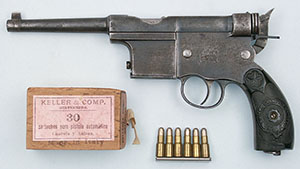
5mm Charola y Anitua Pistol - SN 2007
On 13 October 1898 Ignacio Charola registered a Spanish patent for a locked breech semi-automatic pistol with external similarities to the C96 Mauser
design. This pistol was manufactured by the firm Charola y Anitua of Eibar, Spain, and was chambered for a bottle-necked and slightly tapered 5mm cartridge
that looked somewhat like a miniature 7.63mm Mauser cartridge. Late manufacture of some parts for the Charola pistol took place in Liege, so the 5mm
cartridge became known to Liege gunmakers, including Charles Clément, who decided to chamber his Model 1903 pistol for it. There were few choices for such a small pistol.
Clément’s
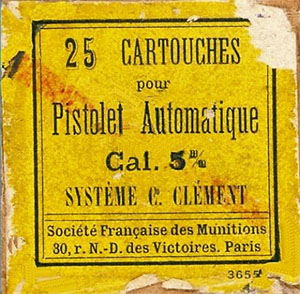
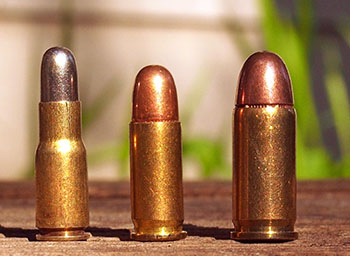
S.F.M. 5mm Clement Cartridges
pistols were better received than the Charola pistols, and so the cartridge has become known as the 5mm Clement, though it has also
been referred to as the 5mm Charola-Anitua, the D.W.M. 484, the G. Roth #730 (5.2 x 17), and the 5mm Selbstlade-Pistolen.
The early cartridges were likely produced by Keller & Company of Hirtenberg, Austria. Other known headstamps include C.R.B. Liege (Cartoucherie
Russo-Belge), D.W.M. (Deutsche Waffen und Munitionsfabriken), G.R. (George Roth & Co.), and S.F.M. (Société Française des Munitions). Unmarked
cartridge cases are also known. White and Munhall list bullet weights from 28 to 36 grains with a nickel-jacketed round-nose bullet, and a single 35.5 grain
half-jacketed bullet with a soft nose.
The only ballistics data we have on the cartridge is from D.W.M., which reported that the 36
grain bullet had a muzzle velocity of 1030 fps from a 2.716 inch barrel, which would have resulted in a
5
mm 6.35
mm 7.65 mm
Clement
Browning Browning
muzzle energy of about 80 foot-pounds. This compares favorably with a typical 6.35mm cartridge, which with a 50 grain bullet and a muzzle velocity of 754 fps from a 3.149
inch barrel generates a muzzle energy of about 63 foot-pounds. We have also examined a C.R.B. cartridge which has a 28 grain brass- or copper-jacketed bullet over 1 grain of fine
smokeless powder, but we do not have chronograph data available for it.
The 5mm bullet is said to be unstable in flight, tending to tumble, which might have contributed to its effectiveness for self-defense though
perhaps not to its accuracy. The cartridge was listed by DWM until 1938. Bastié points out that it was still listed in the Fiocchi catalog for December 1961.
We have noted a few early grip plates of checkered horn with the Clément entwined CC monogram turned vertically, but most guns have checkered hard rubber grip plates with the same design. The
serial number is stamped on the left side of the frame, on the right side of the bolt, and on the bottom of the barrel.
There are three variants of the Type I M1903.
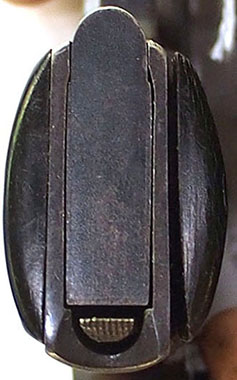
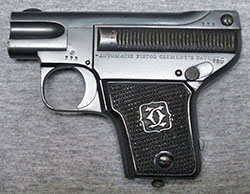
Type I First Variant: The first variant has a magazine release like the one on the Model 1902
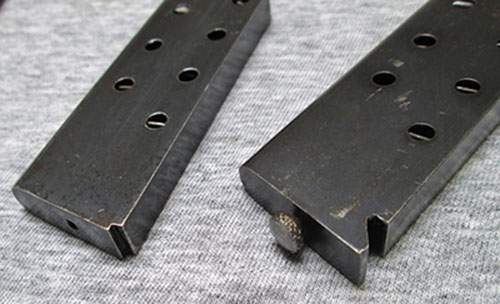
serial number 332, with a small checkered lever that must be squeezed toward the front of the gun (reminiscent of the Model 1899/1900 FN Browning). A concave area is milled at the rear of the frame base to allow the thumb to access the release lever. The magazine has seven holes on either
side for viewing cartridges, and the cut on the back where the release holds it is approximately one inch from the magazine base. The baseplate on the magazine extends beyond the front of the grip
frame to aid in removal, and the front of the grip frame is cut to allow for this extended baseplate. This first variant extends at least through serial number 1140.
The early guns, up to at least serial number 975, have a trigger guard that is machined separately, fitted into a slot at the front of the grip frame, and pinned to the frame above the bow of the trigger
guard. The pin is visible just beneath the serial number on the left side. Later guns have the trigger guard integral with the frame.
M1903 Type I - 1st Variant
M1903 Type I - 2nd Variant
M1903 Type I - 3rd Variant
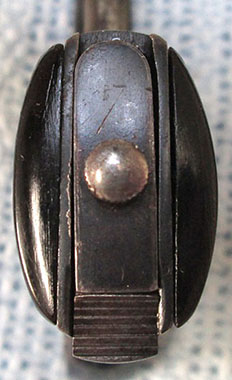
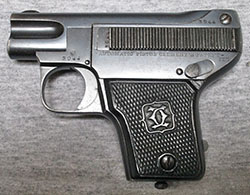
Type I Second Variant: On the second variant, beginning somewhere around serial number 1200,
the magazine release becomes a slightly concave serrated sliding button that is pushed to the rear to release the magazine. The magazine still has seven cartridge-viewing holes on either side, but
the cut on the back where the release holds it is right where the baseplate meets the back of the magazine. The extended baseplate is eliminated and the magazine has a knob on the bottom to
assist in removal. The second variant extends only to about serial number 1300, making it very scarce. It appears that this variant only lasted until existing frames were used up and production
could be transitioned to the third variant.
On the left is the First Variant magazine with extended baseplate and no knob. In the middle is the Second
Variant magazine (missing the knob, but with a hole for it). On the right is the Third Variant magazine. Clearly, magazines are NOT interchangeable.
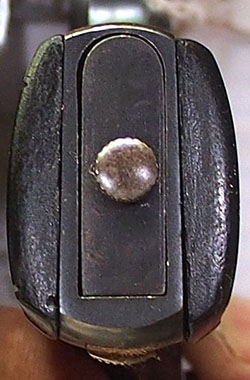
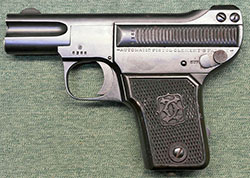
Type I Third Variant: The third variant has the magazine release mounted on the back of the grip
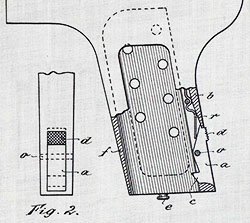
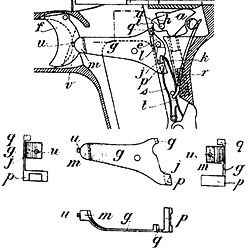
strap, as shown in the 1905 Belgian patent 184363. It consists of a pivoting lever, tensioned by a flat spring, with a square checkered button at the top. The magazine has the cut in the rear enlarged
and moved up slightly from the magazine base. The base of the grip frame is no longer cut to allow for the baseplate extension at the front of the magazine. The third variant begins at least by serial
number 1331 and runs only up to about serial number 1650, where Type I production ends.
Belgian Patent 184363
Belgian Patent 184363
This patent, filed by Clément in April of 1905, is for a magazine release mounted on the back of the grip frame. Warnant’s patents do not detail the early magazine release
design. We have not found evidence that this patent was filed outside of Belgium.
The patent date for the magazine release on the back of the grip strap, 29 April 1905, enables us date the variants and get some idea of production numbers. Up to the end of April 1905
possibly only about 1500 Type I Model 1903 pistols had been made. Please contact us if you have a gun with a serial number in this range that might help us more
precisely determine when the Type I ended and the Type II began.*
The Type II Model 1903
M1903 Clément - Type II - SN 10150 - 6.35mm (.25 caliber)
The Type II Model 1903 begins at approximately serial number 1500 and is characterized by a redesigned upper receiver housing that eliminates the pinched area at the front of the gun,
allowing the recoil spring and its guide rod to extend the full length of the gun. In fact, the forward end of the guide rod protrudes through a hole at the front of the housing, above the barrel.
The early recoil spring, extending only over the breech block and chamber of the barrel, was insufficient. Powerful recoil forces acting on the light breech block/bolt necessitated a
longer and more powerful recoil spring. The earliest gun we have noted of this type is serial number 1677. Judging by the serial numbers and patent date, this change likely took place before the end of 1905.
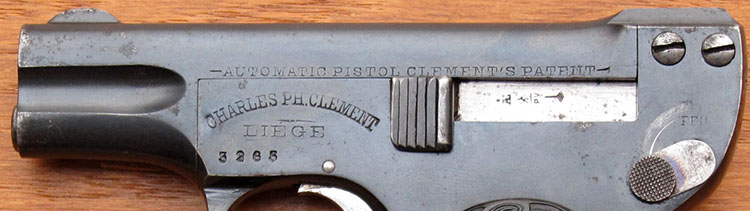
Early markings remain the same as the Type I, as does the finish. Somewhere between serial number 2389 and 2400 the inscription on the upper receiver housing was changed to read:
- AUTOMATIC PISTOL CLEMENT’S PATENT -
and an additional inscription was added to the left side of the frame:
CHARLES PH. CLEMENT LIÈGE
The top line of this inscription arcs in a curve over the city name.
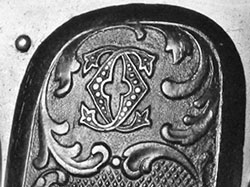
Grip plates are checkered hard rubber with the Clément entwined CC logo turned vertically at the
top. Toward the end of production, in the 10,000 series range, we begin to see grip plates with a horizontal CC monogram, though early grip plates continue to be used.
Late Clément CC Monogram
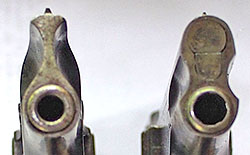
Early 5 mm on left. Late 6.35 mm on right.
Other than the change in the inscription and grip plates, the two main variants of the Model 1903 Type II differ only in their caliber. However, the caliber is not indicated on either variant,
so the two are virtually indistinguishable. (The best way to test for caliber is to disassemble the gun, or lock the bolt open, and see if a 6.35mm Browning or .25 ACP cartridge will chamber.)
We know that serial number 8776 is chambered in 5mm, and that serial number 8831 is chambered in 6.35mm. Please contact us if you have a pistol in this serial number range and can verify the caliber.*
We have observed some late 5mm pistols that were retailed by Manufrance (SN 7786 and 8138). These guns are marked on top of the upper housing in all capital sans-serif characters:
MANUFACTURE FRANÇAISE D’ARMES ET CYCLES-SAINT-ETIENNE.
The 1906 FN Browning was the first gun ever chambered for
the 6.35mm Browning cartridge, and it was first marketed in July of 1906. We know from a brief review in the American Hardware Magazine of 10 April 1907 that the “.25 calibre” (6
.35mm) version of the Model 1903 Clément was already available, so Charles Clément must have decided to switch to the new Browning cartridge almost as soon as it appeared. No later Clément
pistols were chambered for the 5mm cartridge.
Production must have been increased in the 1905 to 1907 period, as we estimate that approximately 7000 5mm pistols were made in about two years time. Then, after the 6.35mm
version was introduced, probably sometime late in 1906 or early in 1907, approximately 2300 pistols were made in the new caliber before production switched to the Model 1907. It is possible
that production of the Model 1903 and Model 1907 overlapped, or that Model 1903 pistols were still being assembled from parts when the Model 1907 began production.
The Models 1907 and 1908 Clément
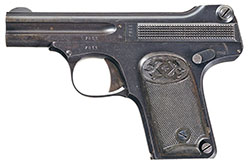
In 1907, Clément introduced a new self-loading pistol as a redesigned pattern of his 1903 Model.
The first three patents for this model were filed in July and August of 1906, so the gun was in the design stages well before 1907. The first two patents for the Model 1907 show a gun of the same
size and with virtually the same frame as the Model 1903, but with redesigned bolt and lockwork. By 1907 the patents begin to show a gun reduced in overall size from the Model 1903.
Belgian Patent 193924
Austrian Patent 28005
This patent was filed by Clément in July of 1906. It shows a gun with the same external shape as the Model 1903 Clément and which retains the fixed barrel threaded into the frame, but which
has a redesigned reciprocating bolt or breech block. The new bolt is stirrup-shaped. It has a rectangular breech block at its front, which contains the firing pin and internal extractor, and a
rectangular opening at its rear to accommodate the hammer. Above the breech block, a rod stretches toward the front of the gun to attach the bolt to the recoil spring, which sits above the
barrel and bolt. The opening at the rear of the bolt fits around a rectangular post at the rear of the frame. This design makes it easier to cock the gun by grasping
serrations on the side of the bolt. The new design allows the gun to have an internal hammer. The powerful hammer spring also helps absorb recoil from the reciprocating bolt. The upper receiver
housing, which holds the bolt in the frame and houses the recoil spring, also incorporates a shroud which fits around the barrel at the front. This patent was also filed in Austria in July of 1906 (patent number 28005).
Belgian Patent 194518
Austrian Patent 33467 - composite patent drawing to show lockwork
This patent was filed by Clément in August of 1906, and covers the redesign of the lockwork necessitated by the new internal hammer. The patent illustrates but does not describe a coil
spring and plunger in the rear of the grip frame which tension the hammer. The magazine release, sear, and trigger and transfer bar are tensioned by flat springs also in the rear of the
grip frame. The transfer bar has two branches at its rear. The upper branch engages the hammer and the lower branch engages the sear. When the gun is fired the lower branch trips the sear,
releasing the hammer. As the hammer falls it forces the upper branch of the transfer bar down, causing the lower branch to disengage from the sear. The transfer bar cannot move up again
until the hammer is cocked and the trigger is released. As in the earlier Model 1903, there is no mechanism to prevent the gun from firing when the bolt is out of
battery, but the bolt must be far enough forward to allow the hammer to fall and the trigger must be released and squeezed again before another shot can be fired.
Subsequent foreign patents essentially combine elements of this Belgian patent with the previous Belgian patent, hence covering the redesigned breech block as well as the redesigned lockwork.
These patents include British patent 13623 of June 1907, U.S. patent 885436 of June 1907, German patent 212735 of July 1907, and Austrian patent 33467 of July 1907. These later foreign patents
show a gun with a shortened grip frame (reducing the magazine capacity from 7 to 6).
Belgian Patent 199496
This patent was filed by Clément in April of 1907 as an addendum to patent number 193924 of 27 July 1906. It covers the design of the ejector, which essentially consists of a square bar with a
circular lug on the rear end. This lug fits into a hole in the frame. The ejector bar lies flat on top of the frame and rests in a groove on the underside of the bolt, which holds it in place. This patent is
the first one to show the shortened and tapered grip frame which appeared on the Model 1907.
The breech block or bolt (Belgian patent 193924) is redesigned to fit around the rear post of the frame instead of through it. The solid bolt on the Model 1903 requires a striker-fired
mechanism, but the open center portion of the Model 1907 bolt allows for an internal hammer. The internal hammer and its spring help retard the blowback action of the bolt. The firing
pin and internal extractor are retained in the breech block. The breech block cannot be locked open.
The trigger mechanism (Belgian Patent 194518) is also redesigned to work with the internal hammer. As the hammer begins to fall it pushes the transfer bar down, disconnecting it from the
sear. Only when the hammer is fully cocked again can the transfer bar reconnect with the sear. The hammer is tensioned by a spring and plunger fitted into a hole in the rear grip strap. The method of
disassembly remains the same as that of the Model 1903, although the 6.35mm Model 1907 has only a single screw instead of two. The 7.65mm Model 1907 retains the two-screw design.
Instead of the press-fit ejector of the Model 1903, the Model 1907 has a square metal bar with a circular lug at the rear (described in Belgian patent 199496). This lug fits into a hole
in the rear post of the frame and the metal bar simply rests on the left side of the frame and is held in place by a slot in the reciprocating bolt. The manual safety locks the sear but not the
bolt, though the gun cannot be cocked with the safety on.
The Model 1907 was offered in calibers 6.35 mm (.25 ACP) and 7.65 mm (.32 ACP). The 7.65 mm version was closer in size to the Model 1903, with a longer barrel and grip frame than
the 6.35 mm version. The magazine capacity went from 7 on the Model 1903 to 6 on the Model 1907.
According to Gerhard Schönbauer, the Model 1907 did not sell well and thus Clément produced it only for a short period of time. It may be that competition from the 1906 FN Browning was a
challenge. The lowest serial number we have recorded is 545, and the highest is 7424. However, we do not find any 7.65mm guns until approximately serial number 5000, and virtually all the late
guns are in 7.65mm. Thus, it is likely that Clément started with the 6.35mm model and later produced both calibers with consecutive serial numbers.
We find the first advertisement for the Model 1907 in the German magazine Waffenschmied of 10
July 1907, where it is listed as the “Modell 1906”, but by 10 October 1907 the advertisement is
changed to read “Modell 1907”. A comparison of advertising dates with patent filing dates leads us to believe that production of the 6.35mm Model 1907 likely did not begin until June or July of
1907 and lasted only until the end of the year. Production of the 7.65mm version may have lasted into 1908.
We have documented at least three distinct variants of the Model 1907. However, there is no sharp
serial number bound which distinguishes the variants; variants overlap when it comes to different calibers, and there is also a serial number overlap with the Model 1908. In any case, the Models
1907 and 1908 are essentially the same pistol with largely external changes. We might consider designating the Model 1908 as a Model 1907 Type II if the model nomenclature were not already firmly established.
The Model 1907 bolt has a significantly enlarged gripping surface on both sides. The redesigned bolt addresses two issues with the 1903: first, the Model 1903 gripping surfaces are
awkward to grasp, making the gun difficult to cock; second, the redesigned bolt on the Model 1907 allows for an internal hammer which also helps retard recoil.
The serrated gripping surface on the First Variant Model 1907 has a convex shape. The magazine release is located on the backstrap. We find this variant in 6.35mm caliber in the serial
number range up to appoximately 2000 (last First Variant 6.35mm Model 1907 observed has SN 1935). The numbering of the 7.65mm models starts at approximately SN 5000 and ends at SN 7300
(the last First Variant 7.65mm Model 1907 observed has SN 7218).
The Model 1907 is marked on the left side of the frame beneath the serrations in upper-case serif characters as follows:
- AUTOMATIC PISTOL CLEMENT’S PATENT -
The serial number is visible on the left side of the upper receiver housing above the serrations, on
the frame above the trigger and on the breech block left of the serrations. The pistol has no caliber marking. The safety lever positions are marked in French, FEU (Fire) and SUR (Safe). The finish
is rust blue. A pistol with serial number 5973 is nickel plated, but we cannot be certain it is factory plated as we have found no advertisements for the gun in a nickel finish.
The grip plates are made of checkered hard rubber with the Clement CC monogram in a square cartouche. The magazine retains the knob on the bottom, and has five holes for viewing cartridges.
The magazine release is a small lever on the backstrap of the grip. Schönbauer opines that this position is inconvenient, as one can easily release the loaded magazine while firing.
Around serial number 2000, for the 6.35mm pistols, the convex form of the bolt serrations was flattened. This may have been done to simplify machining, or for aesthetic reasons. The
magazine catch remains at the backstrap. The Second Variant Model 1907 in 7.65mm starts at approximately SN 7218, with SN 7436 as the highest number we have recorded.
Belgian Patent 202749
This patent was filed by Clément in September of 1907, also as an addendum or supplement to patent number 193924 of 27 July 1906. It covers the design of the button release for the magazine
on the lower left side of the grip. This button release is shown but not described in an earlier patent.
With Belgian Patent 202749, Clement removes the magazine catch at the backstrap, redesigning the release as a button on the lower left side of the grip. For the 6.35mm Model this change
appears at approximately serial number 4000 (SN 4268 is the earliest 6.35mm Third Variant Model 1907 observed). We have not recorded 7.65mm variants with the magazine button on the
left grip and, based on known serial numbers, we do not believe that they exist.
We have documented several second variant 7.65mm pistols (SN 7357, 7398, 7424) marked for export, with BELGIUM in upper-case serif characters on the right side.
The Model 1907 appears to have its own serial number range. Serial numbers for the Model 1907 in 6.35mm begin, presumably, at zero and run up to at least 4636. Production in 7.65mm appears to
begin around serial number 5000 and run up to almost 7500. In the high range, most guns produced are in 7.65mm, though we do see occasional guns in 6.35mm. But by this time, 6.35mm production
was transitioning to the Model 1908. Please contact us if you have a serial number in this range.*
Belgian Patent 205326
This patent was filed by Clément in January of 1908, likewise as a supplement to the original 1906 patent (Belgian patent 193924). It covers an alternative design for the hammer spring as well as a
removable backstrap. Instead of being a coil spring with plunger, as shown in the original patent, the design in this patent is for a flat spring attached by a screw mounted to the frame, which
requires a removable backstrap for installation. This is the first appearance of a removable backstrap.
U.S. Patent 941749
U.S. Patent 941749
This patent was filed by Russell Wiles of Chicago in June of 1909 and assigned to Clément. It shows a gun with a fixed barrel and the recoil spring over the barrel. The lockwork is
virtually identical with that shown in Clément’s Belgian patent number 194518, and with the flat hammer spring and removable backstrap shown in Clément’s Belgian Patent 205326. The flat
hammer spring was, however, never adopted in any known production gun.
The Model 1908
Clément M1908 Rear Grip Strap
The major innovation of the Model 1908 Clément is the redesigned backstrap containing the hammer spring, plunger, and a wire spring to tension the safety
lever. The hammer spring and plunger are held captive by a small screw. The backstrap is removable, via two pins, making for easy installation and repair.
The grip itself is no longer slightly conical in shape but now has the front and rear grip straps parallel. The steeper curve of the Model 1908 grip tang is
more ergonomic and allows the hand to sit higher on the gun. The grip plates are checkered hard rubber and have the Clement CC monogram in an oval
cartouche at the top. The magazine is identical to that on the late Model 1907.
The Model 1908 is marked on the left side of the upper receiver housing in upper-case serif characters as follows:
- AUTOMATIC PISTOL CLEMENT’S PATENT –
The serial number is located on the left side on the frame just above the trigger, at the front of the
upper receiver, and on the breech block to the left of the serrations. On most early guns the safety lever positions are marked in French, FEU and SUR; however, most later guns (after serial number
8200) are marked in English, FIRE and SAFE. The finish is rust blue.
Clément M1908 - SN 7037 6.35mm (.25 caliber)
Early guns appear to have blued triggers, but on later guns the trigger is unblued “in the white”. Some guns are marked for export, with BELGIUM stamped on the right side of the frame.
Like its predecessors, the pistol has no caliber marking. The lowest serial number we have observed is 7037, which appears to be a continuation of the Model 1907 serial numbers, with
some overlap between the 1907 and 1908 ranges. The highest serial number we have observed for a Model 1908 is 10960. According to Schönbauer, this model was also made for just a
short period and was replaced within one year by a new design, the Model 1909. However, Clement offered both pistols in parallel at least until December 1909, as an advertisement in Waffenschmied for 25 December 1909 shows.
The Model 1908 was never produced in 7.65mm. Instead, based on serial numbers, it is likely that
production of the Model 1907 in 7.65mm continued in parallel with Model 1908 production, and Model 1909 production began with the 7.65mm version.
Field Strip the Model 1903, 1907, or 1908 Clément
Clément M1903 Locked Open
Remove the Magazine and make sure the chamber is empty.
After verifying the chamber is empty, pull the trigger to uncock the striker on the Model 1903.
Press in on the rear of the bolt to take the strain off the screws, and remove the screw or screws at the rear of the frame.
Draw the upper receiver (recoil spring) housing off the front of the gun.
Lift the bolt and recoil spring assembly out of the frame.
Note: To lock the bolt open on the Model 1903, draw it back and turn the safety lever up.
The Model 1909 Clément
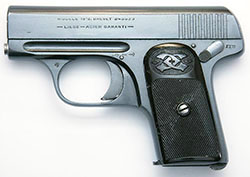
The Belgian patent for the Model 1909 Clément was filed in November of 1908, but the gun was already on the market in January of 1909, as we discover from an advertisement in Waffenschmied, and so it must have been in development for some months prior. The problem that all earlier
Clément pistols have is that they require a screwdriver to field strip. But the Model 1909 can be field stripped with no tools, hence the early advertisement touts the gun as “the safest and most
comfortable for cleaning”.
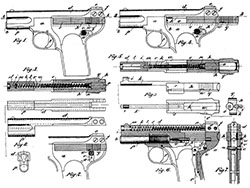
Belgian Patent 212168
U.S. Patent 97037
This patent was filed by Clément in November of 1908. It is listed as a subsidiary patent to the main patent of 27 July 1906, but it represents a major design advance. The patent states:
“The present invention relates to a pistol of the type [i.e., an automatic pistol] and its special purpose is to make its various parts more easily accessible.” The basic design of the Model
1907 has been adapted to simplify disassembly and reassembly.
Clément filed and was granted similar patents in Great Britain (patent number 1909-14996) and the United States (patent number 970307).
The Model 1909 Design
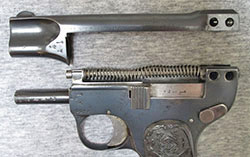
Clément M1909 - SN 10655 7.65mm - field-stripped
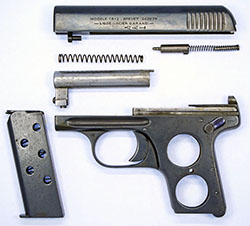
The barrel is now part of the upper receiver housing, which is hinged to the frame by the assembly screw at the rear. The bottom of the barrel has a locking lug on it which is held in
place by an extension of the trigger guard, which is also hinged on a pin on the lower receiver to form a quick release for the barrel. Finally, the backstrap is hinged on a pin at the rear of the
grip tang and held in place by a latch at the bottom of the grip strap (with the exception of some of the early 7.65mm models). The hinged grip strap is not strictly necessary, but does allow
access to the internals of the gun for cleaning and lubrication. The wire spring that tensions the safety lever has been moved to the upper frame from the
removable backstrap. The transfer bar has been redesigned slightly, but functions identically to that in the Model 1908.
The inscription for the Model 1909 is moved to the top of the upper housing. It remains the same as earlier pistols:
- AUTOMATIC PISTOL CLEMENT’S PATENT –
Clément M1909 - 7.65mm - SN 7811 - early model with no latch on backstrap
The grasping surface for the bolt is checkered instead of serrated. Toward the end of production (around serial number 35800) we begin to see triangular-cut serrations again. Serial
number locations remain on the left side on the frame and upper housing and just in front of the checkering on the bolt. The safety markings are in English. The finish is rust blue. Grip
plates are in checkered hard rubber with the Clement CC monogram in an oval cartouche at the top. The 1911 Adolf Frank (ALFA) catalogue lists the Model 1909 as being
available in a nickel finish, and also with mother of pearl grip plates; we have documented one such gun but they appear to be scarce.
The magazine for the Model 1909 is virtually identical to that on the Model 1908, with five holes
on each side for viewing cartridges, but the knob on the bottom has been eliminated and the baseplate is extended toward the front to aid in removal. Most of the 7.65mm guns are stamped MADE IN BELGIUM on the right side of the barrel. Some of the 6.35mm guns are stamped BELGIUM or MADE IN BELGIUM on the right side of the barrel.
There are a few variations. As stated earlier, the early production
Clément M1909 - SN 37186 - with long barrel and German proofs - 6.35mm (.25 caliber)
7.65mm guns do not have the hinged backstrap with a latch at the bottom, up to at least serial number 8371. By serial number 8630 we begin to
see guns that have the latch. Please contact us if you can help refine these figures.* In late production (35000 to 37000 serial number range) we begin to see a number of
6.35mm guns with extra long (117mm) barrels. We have documented five, and there are almost certainly more. We do not observe export marks on these guns with long
barrels, but two of the five have German proofs on the right side instead of Belgian.
The Model 1912 Clément
The Model 1912 represents the abandonment of most of the design characteristics of the earlier Clément Pistols.
Belgian Patent 243839
Belgian Patent 243839
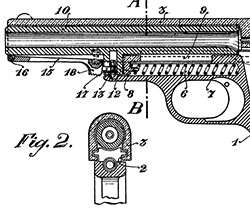
This patent was filed by Clément in March of 1912 and marks a clear departure from his earlier designs. For the first time he places the recoil spring beneath the barrel instead of above it.
Three possible methods of barrel retention are shown. Two feature the barrel retained at the front, one with a button release on the right side, and the other with a hinged trigger guard (like
that on the Model 1909) to release the barrel and slide. The third design shows a spring-loaded plunger that retains the barrel at the rear, released by a lever on the left side. Also
detailed in this patent is a lockwork design that for the first time features a true disconnector that prevents the gun from firing when the slide is out of battery. The
gun shown in the patent is striker-fired. An unusually-shaped wire spring tensions both the magazine release and the sear.
The Model 1912 Designs
There are three distinct types of the Model 1912 in three distinct serial number ranges, each with different design characteristics. We will describe them in the order of the serial numbers.
The Type I Model 1912
Clément M1912 - Type I - SN 13031 7.65mm (.32 caliber)
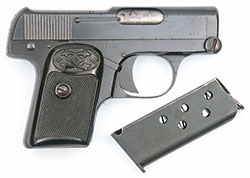
The first type of the Model 1912 is found in 7.65mm Browning (.32 ACP) caliber and is easily recognized by the milled area on each side of the frame above the trigger guard. It is the first
Clément pistol to have the recoil spring beneath the barrel instead of above it, and also the first Clément pistol to have a slide, and to have a true disconnector that prevents operation of
the sear when the slide is out of battery. The disconnector is just to the left of the sear, and when pressed down by the recoiling slide it prevents the transfer bar from reaching the
sear. The gun is striker-fired. The safety lever blocks the sear, when engaged. There is an external transfer bar that runs under the right grip plate.
The ejector on the Model 1912 is removable, like those on the Model 1907, 1908, and 1909,
except the pin is on the bottom and fits into a hole in the top of the frame. On the previous models, it was rarely necessary to remove the bolt because the gun could be cleaned without doing so and
hence the removable ejector was rarely even noticed. But on the Model 1912 the ejector can easily fall off the gun as soon as the slide is removed.
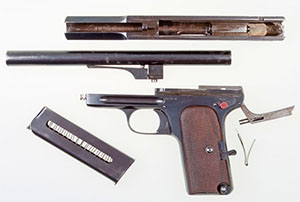
The Model 1912 is unique among the pistols of its day in that the locking mechanism for the barrel
Clément M1912 - Type I - SN 12180 7.65mm (.32 caliber) - field-stripped
and slide is at the front of the barrel instead of the rear. (Some pistols have release mechanisms at the front, but the actual connection between barrel and slide is at the rear.) A T-shaped
lug depends from the front of the barrel, is fitted into an appropriate recess in the front of the frame, and is held in place by a spring-loaded plunger. The plunger on early guns is flat on
the bottom, but is angled on later guns to allow for easier reinsertion of the barrel lug into the frame. Pressing upward on a small button or screw at the front of the barrel lug releases the
plunger and allows quick removal of the barrel and slide. The rear of the barrel simply rests on the upper portion of the frame and is held in place by the slide. The barrel incorporates a
small cartridge guide lug above the chamber.
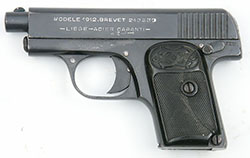
The gun is marked on the left side of the slide in two lines of all-capital sans-serif characters as follows:
MODELE 1912. BREVET 243839 —LIEGE—ACIER GARANTI—
The finish is rust blue. There are 9 plunge-milled flat-bottomed slide serrations at the rear. The
safety lever has a checkered gripping-surface; the safety markings are in French: FEU and SUR.
The serial number is on the right side, above and behind the trigger, and is also stamped on the
bottom of the slide. The last three digits are stamped on the bottom of the barrel. Beneath the serial number on the right side are the maker’s initials: C.P.C. The grip plates are of checkered hard rubber with the Clément CC monogram in an oval cartouche at the top.
The magazine release is a grooved lever at the base of the grip, nearly identical to that on the 1903 Colt or the 1906 FN Browning. The standard box-type magazine holds six cartridges and has five
holes in each side for viewing them. There is no magazine safety.
Serial numbers recorded range from 12077 to 13163. Please contact us if you have one of these guns.*
Belgian Patent 249442
Belgian Patent 249442
This patent was filed by Clément in July of 1912 as an addendum to the previous patent. It details a method of barrel and slide retention that fixes the barrel at the front, with a button
release on the front of the gun. It also details the transfer bar, trigger, and sear. A flat spring tensions the sear and another tensions the manual safety lever. A plunger mechanism trips the
sear but immediately releases it, requiring the trigger to be released and pulled again to move the sear a second time. An identical patent was filed in Germany in 1913 (patent number 294811).
The Type II Model 1912
Clément M1912 - Type II - SN 38341 6.35mm (.25 caliber)
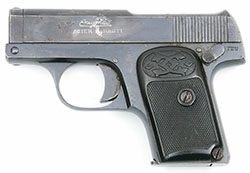
The second type of the Model 1912 is found in 6.35mm Browning (.25 ACP) caliber, and is easily recognized by the flattened area at the rear half of the top of the slide. The design
shows clear influence from the Walman pistol manufactured by the Spanish company F. Arizmendi y Goenaga. The Walman was patented in 1908 and appears in the Adolf Frank (ALFA)
catalogue for 1911 along with the Model 1909 Clément. Like the Type I, this gun also has a slide and barrel that attaches to the frame at the front. The patent for this design (Belgian patent
number 249442) shows the barrel release effected by a lever or button, or alternatively by a pivoting trigger guard. The early production guns use a simple screw
on the right side, but later examples show the button on the front, as found in the patent.
This Clément design does not have a true disconnector, but instead has a spring and plunger
Clément M1912 - Type II- SN 37914 6.35mm (.25 caliber) - marked ‘Enigma’
release mechanism that trips the sear one time when the trigger is pulled and requires the trigger to be released and pulled
again for a second shot. The transfer bar, like that on the Type I, runs under the right grip plate. The manual safety locks the sear. There are 17 triangular-cut serrations on the slide. The
magazine holds 6 cartridges and has 5 holes on each side for viewing them.
The finish and grip plates are the same as on the Type I, but the magazine release is a button on the lower corner of the left grip
(like the Models 8 and 9). The slide inscription on some of these pistols is identical to that on the Type I:
MODELE 1912. BREVET 243839 —LIEGE—ACIER GARANTI—
Others are marked in serif characters:
AUTOMATIC PISTOL CLEMENT’S PATENT ACIER GARANTI
Or:
AUTOMATIC PISTOL CLEMENT’S PATENT
BEST STEEL ACIER GARANTI
In addition, some guns are marked “Fulgor” in script on the left side of the frame above the bow of
the trigger guard. Fulgor is Latin for “flash” or “lightning”. We have observed two specimens
marked “Enigma” in script on the left side of the slide with ACIER GARANTI (Guaranteed Steel) beneath.
The earliest serial number we have recorded for the Type II is 36403, and the highest is 39493. Please contact us if you have one of these guns.*
Clément M1912 - Type III - SN 40780 6.35mm (.25 caliber) - marked ‘Fulgor’
The Type III Model 1912
The third type of the Model 1912 is found in 6.35mm Browning (.25 ACP) caliber. It is nearly identical to the Type I, retaining
the nine flat-bottomed slide serrations, except that it is slightly smaller in all dimensions, does not have milled grooves on either side of the frame, and has a button magazine release on
the lower left grip. Two observed specimens have barrels that extend past the front of the slide. Most observed specimens are marked the same as the Types I and II:
MODELE 1912. BREVET 243839 —LIEGE—ACIER GARANTI—
though one observed specimen is unmarked. One specimen is marked “Fulgor” on the frame and five are marked “Enigma.”
The earliest serial number we have recorded for the Type III is 39685, and the highest is 45282. Please contact us if you have one of these guns.*
The Model 1914 Clément
The Model 1914 is likely a prototype for a gun that was never manufactured commercially. The
last time one was sold it was listed as a Model 1912, primarily due to its resemblance to the Type I Model 1912, with the milled groove on the frame. However, the patents clearly indicate a
manufacture date in late 1913 or early 1914, and internally the gun is quite different from the Model 1912. We know of two examples: serial number 6, shown here, and serial number 13, both
in private collections. There may well be a few others. It has been suggested that the Model 1914, and possibly some late Model 1912 pistols, may have been made by Neumann Frères, with which
Clément had had a long-standing business relationship, but there is no firm evidence. An advertisement from the 1920’s states that Neumann Frères is the successor to Clément and lists Clément’s old address at 39 Rue Chéri, which leads us to believe that Clément’s factory may have
continued in operation long after his death, likely under Neumann’s management.
Belgian Patent 263467
German Patent 294812
This patent was filed by Clément’s widow, Joséphine, and Victor Loiselet in December of 1913. The patent is for a method of barrel retention with an under-barrel release button.
It also describes the internal hammer and sear mechanism with a lobe on the transfer bar that forces the bar downward and out of contact with the sear when the trigger is all the way to the
rear. As in several previous patents, there is no mechanism to prevent the gun from being fired when the slide is out of battery, but the design requires that the trigger be released and pressed
again in order to fire another cartridge. The patent also describes a mechanism that locks the slide and the trigger when
the magazine is empty. When a full magazine is inserted the mechanism releases the slide lock so the slide can close and chamber the first cartridge in the new magazine.
A simplified version of this patent was also filed in Austria (patent number 81743), Germany (patent number 294812), and Great Britain (patent number 1914-11534), leaving out the
description of the lockwork, hammer, and transfer bar release mechanism.
Belgian Patent 264039
This patent was filed by Clément’s widow, Joséphine, and Victor Loiselet in January of 1914 as
an addendum to the previous patent. It is for a mechanism that locks the transfer bar when the magazine is empty.
This patent was also filed in Great Britain (patent number 1914-18190).
The Model 1914 Design
Clément M1914 - SN 6 - 9mm Browning Long
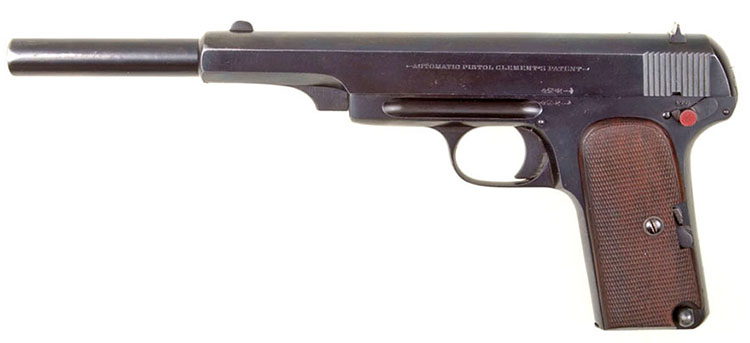
The Model 1914 Clément is chambered for the 9mm Browning Long cartridge. It has an internal
hammer tensioned by a coil spring and plunger built into the backstrap of the grip. The grip backstrap is hinged on a pin and swivels outward just like that of the Model 1909. A lever about
30mm up from the base of the grip, on the left side, locks the backstrap in place. The magazine release, which also serves as a small lanyard ring, is at the base of the left grip. There is an
external transfer bar that runs under the right grip plate. The transfer bar has a semi-circular lobe on its upper edge, which forces it down and out of contact with the sear as the trigger moves to the
rear, requiring the trigger to be released and pulled again for the subsequent shot. The manual safety locks the hammer and the slide. The slide lock mechanism shown in the Belgian patent is not
implemented in this example.
Clément M1914 - SN 6 - Field-stripped
The finish is rust blue, and the grip plates are of checkered wood. The magazine has a long slot on either side for viewing cartridges. The slide extends several
inches past the front of the frame, and on its underside, just in front of the frame is a button which, when pressed, retracts a small plunger in the lug on the bottom of the
barrel and allows the barrel and slide to be removed from the frame. The barrel itself extends several inches beyond the front of the slide. The grip is cut for a
shoulder stock. We know that serial number 13 has a shoulder stock, but we do not have photographs of it at this time. Please contact us if you can provide photographs of the shoulder stock.*
Markings are similar to those on many of Clément’s earlier pistols. The gun is marked on the left side of the slide in all-capital serif characters:
- AUTOMATIC PISTOL CLEMENT’S PATENT -
and on the right side of the frame, “C.P.C.” The serial number is stamped on the base of the grip and
on the base of the magazine.
The cartridge chosen, the size of the weapon, the lanyard ring, and the shoulder stock all add up to
a pistol designed for military use—plus we must take into consideration Loiselot’s military
connections. We have been unable to identify a military trial that the gun might have been intended for, but in any case the war intervened in August of 1914 and that was apparently the end of the
story for this pistol.
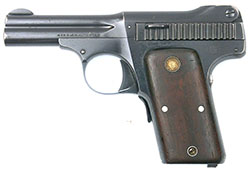
The Smith & Wesson .35 Caliber Auto Pistol of 1913
In 1909 Joseph H. Wesson, son of Daniel B. Wesson, bought the rights to Clément’s patents. He seems to have started with the design of the
Model 1909 Clément in 7.65mm and quickly began to file a series of patents that represent improvements to that design. It is not our intention to go into any great
detail here, other than to note that Wesson’s primary improvements consisted of a grip-safety and a mechanism to disconnect the bolt from the recoil spring
so that the gun could be cocked with relatively little effort.
Smith & Wesson Model 1913 - SN 558
He retained the hinged trigger guard but not the hinged backstrap, and chose to chamber the pistol for a proprietary .35 caliber
cartridge. The pistol became known, informally, as the Model 1913, after its first year of production, and by 1922
about 8350 of them had been made. At that point the pistol was redesigned and chambered for the .32 ACP cartridge,
but the new version did not sell well either. The .32 model was discontinued in 1937 with only 957 made. The Smith
& Wesson auto pistol was exquisitely crafted, but was considerably more expensive than similar guns made by competing companies.
* If you have photographs or information to share, please write to [email protected].
Selected Photographs Use the arrows at the bottom of each page to navigate to additional photographs.
Bastié, Jean-Pierre. “Un pistolet Clément.” La Gazette des armes, no. 300, June 1999.
Calvó, Juan L. & Méruelo, Hector J. Spanish Handguns 1875s-1950s, Part Three, Semiautomatics and Automatic Machine
Pistols. www.catalogacionarmas.com. 2013
Cercle Hístorique de Fléron. Ancienne zones industrielles du Pays de Liège: Les usines hydrauliques. 40th
Anniversary Publication: June-September 2000.
Daubresse, Alain. Les armuriers Liègeois a travers leurs réalisations. Alain Daubresse: 2014.
Schroeder, Joseph J. Jr., Editor. Arms of the World 1911: The Fabulous ALFA Catalogue of Arms and the Outdoors. Follett Publishing Company, Chicago: 1972.
Simmons, Donald M. Jr. “Smith & Wesson 35 Auto Pistols: A History for Collectors.” Gun Digest, 1976.
Stucki, Alexander. “Clement-Pistole Modell 1903.” Schweizer Waffen-Magazin. October 2001.
Traister, John E. Antique Guns: The Collector’s Guide. Stoeger Publishing, Accokeek, Maryland: 1994.
Walter, John. Dictionary of Guns and Gunmakers. Greenhill/Stackpole, London/Pennsylvania: 2001.
White, Henry P. and Munhall, Burton D. Pistol and Revolver Cartridges. A.S. Barnes & Co., N.Y.: 1967.
Ziesing, Dr. Dirk. “Selbstladepistole Clément-Warnant Modell 1903: Guter Kauf.” Deutsches Waffen- Journal, July 2011.
There is considerable information about the various Clément pistols thanks mostly to a group of collectors on the luger.gunboards.com forum who have been documenting serial numbers and sharing photographs and information about them for a number of years. In particular, I wish to thank
Vaclav Vriesen, who established the database of Clement serial numbers and has carefully updated it ever since. The database was instrumental in enabling us to estimate
production numbers for the various models.
Special thanks to Vaclav Vriesen, Alexander Stucki, Roland Adam, and Dr. Leonardo Antaris for their assistance and
support. This article would not have been possible without the information they have so generously shared.
Copyright 2018 by Ed Buffaloe. All rights reserved. Click on the pictures to open a larger version in a new window.