Mauser Pistols: 1910, 1914, WTP, HSc
by Ed Buffaloe and Burgess Mason III

Part III: The WTP
The Mauser Model 1910 in 6.35 mm Browning was by any measure a remarkably successful pistol but the 6.35 mm Browning cartridge was originally designed for the smallest of personal protection pistols (known as vest pocket pistols) and, as the end of World War I drew near, the Mauser company decided it was time they manufactured one.
Weaver, Speed, and Schmid, in their book Mauser Pistolen, state: “Instead of designing a new pistol, Mauser simply bought the rights to an existing simple blowback design, with a barrel removal system patented in 1917 by a company owned by a C E Heinzelmann of nearby Plochingen am Neckar...” They reference Hogg and Walter’s Pistols of the World, which states: “Heinzelmann made the Heim pistol, a 6.35mm blowback automatic that externally resembles the Mauser WTP, but internally, is closer to the Browning 1910 with a fixed barrel and a coaxial return spring secured by a muzzle bushing. It carries the company’s name on the slide and appears to have been made for a short time in the early 1930s.” The Heim pistol’s disassembly mechanism is similar to that of the Mauser WTP, but is operated by pulling down on the trigger. The patents for the Heim pistol were filed in 1924 and granted in 1926, and hence postdate the WTP. None bear any relationship to the Mauser vest pocket pistol. If anything, some aspects of the Heim pistol may derive from the Mauser design.
WTP is the abbreviation for Westentaschenpistole, or vest pocket pistol. There are two distinct types of WTP, known as the WTP I and the WTP II. The WTP I was made from 1921 through 1937 or 1938. Most sources state that the WTP II was first made in 1938, though the 1937 Geco catalogue already has it listed. It appears to have been discontinued before the end of 1940 due to Mauser’s need to fulfill military contracts during World War II.
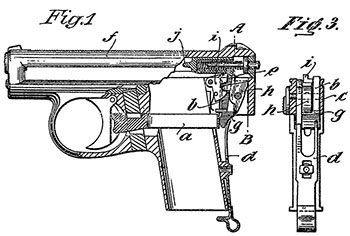
Drawing from Austrian Patent 93959
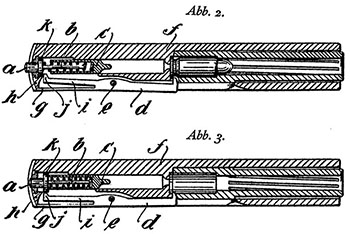
Drawing from German Patent 370907
Klaus-Peter König and Martin Hugo, in their book Taschen Pistolen, state that the WTP was patented in 1918--we assume they mean in Germany--but we have been unable to locate a German patent for this year either. After extensive searching we have found only two patents for the WTP.
- Austrian patent 93959, filed 29 May 1921 and granted 8 March 1923, which covers the disconnector mechanism, but contains a patent drawing which shows the entire mechanism of the WTP. There should be a German patent corresponding to this Austrian patent, but we have been unable to locate it.
- German patent 370907, filed 9 June 1922 and granted 25 August 1923, which covers the cocking indicator mechanism of the WTP. The patent describes it as effectively a loaded chamber indicator.
The guns illustrated in these patents are similar in outline to the unserialled prototype shown on page 147 of Mauser Pistolen and the serial number 1 prototype shown on page 148, which fortuitously has the date 1917 engraved on the slide. Neither of these two early prototypes features the cocking indicator which was patented in 1922. But if there were completed prototypes in 1917, there were almost certainly patents filed in 1917 or 1918. We simply haven’t located them yet.
The Mauser WTP I
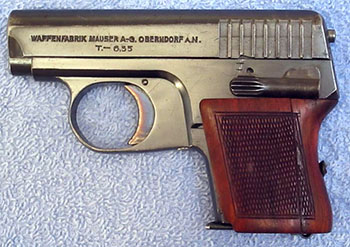
Mauser WTP - SN 19
The barrel has a large lug on the bottom. The front of the lug is drilled to accept the rear of the recoil spring and guide rod, and the bottom of the lug is drilled to accept the takedown catch, which holds the barrel in place in the frame. The cylindrical takedown catch has a cutout that allows the connector bar to move when the catch is up and the barrel is locked in place, but blocks the connector bar when the catch is down and the barrel is unlocked, thus preventing the gun from being fired when the barrel is not securely locked to the frame. The disconnector is a vertical piece that in its up position connects with the sear to allow the gun to be fired, but when depressed (when the slide is out of battery) disconnects from the sear and prevents the gun from being fired. The safety lever on the left side of the gun is positioned for easy use by the thumb of a right-handed shooter. When engaged it locks both the sear and the slide.
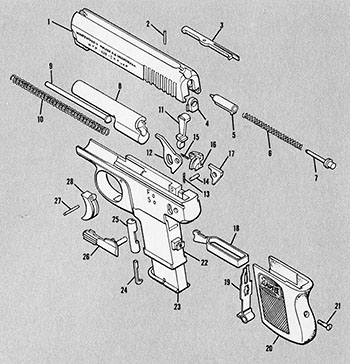
Mauser WTP - Parts Diagram
The extractor is a piece of spring steel that pivots on a pin. The rear portion of the extractor is bifurcated into two parts, one of which serves to lock the cocking indicator button at the rear of the slide when the striker is cocked. This button is not a visual indicator, as it always protrudes from the rear of the gun, but when the gun is cocked the button is locked and cannot be pressed in, whereas when the striker is not cocked the button is easily pressed flush with the rear of the slide. Hence, a quick press of the button will tell the shooter whether the gun is cocked.
The WTP I is finished in a rust blue. The slide has eight flat-bottomed plunge milled serrations on either side. The top of the slide is grooved from front to rear, and tiny front and rear sights are set in the groove. The serial number is on the upper curve of the left side of the slide, just behind the front sight.
Magazines are blued, with a flat rectangular base plate that has a small slot on one side where the bottom of the magazine spring fits to hold the plate in position. There are two vertical slots cut into the left side of the magazine for viewing cartridges. The magazine follower is designed with a flat back that locks the slide open when the last cartridge has been fired. However, the slide closes when the magazine is withdrawn.
WTP I Variants
Variants of the WTP I are largely defined by slide inscription, with a few minor subvariants.
First Variant WTP I: SN 1 - 320 Approximately
The first variant slide inscription is on the left side of the slide in upper-case sans-serif characters, as follows:
WAFFENFABRIK MAUSER A.-G. OBERNDORF A.N.
T - 6,35
This inscription includes only a “T” for “taschen” or pocket pistol, and no patent statement. The left side is unmarked, except for proofs. Many of these early guns were exported, as the market was limited inside Germany after the Great War. Guns marked for export are stamped “Germany” on the right side of the frame.
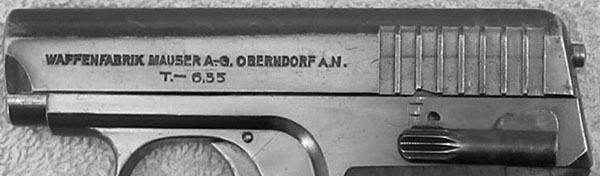
First Variant Mauser WTP
Second Variant WTP I: SN 320 - 31500 Approximately
The second and most common variant of the WTP I has a slide inscription that includes the name “W.T.P” as well as the abbreviation that asserts that the gun is patented both in Germany and abroad:
WAFFENFABRIK MAUSER A.-G. OBERNDORF A.N.
W.T.P. - 6,35 - D.R.P.u.A.P.
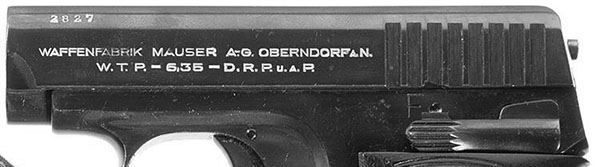
Second Variant Mauser WTP
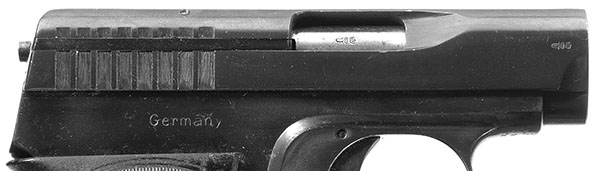
Third Variant WTP I: SN 31500 - 50500 Approximately
The third variant inscription of the WTP I reflects the name change of the company from Waffenfabrik Mauser to Mauser-Werke:
MAUSER-WERKE A.-G. OBERNDORF A.N.
W.T.P. - 6,35 - D.R.P.u.A.P.
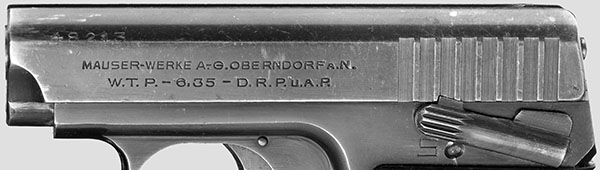
Third Variant Mauser WTP
The subvariants involve the grip screw or screws. Initially, the gun was provided with only a single grip screw at the rear. Eventually the company decided to use two screws, one on each side, but because there was a supply of grips already drilled for the screw at the rear, there was an interim in which some guns had three grip screws. Approximate serial number ranges are as follows:
- One grip screw: SN 1-41000 (first, second, and third variants)
- Three grip screws: SN 41000-42000 (third variant only)
- Two grip screws: SN 42000-50500 (third variant only)
Field Stripping the WTP I
- Make sure the gun is unloaded.
- Pull the trigger and remove the magazine.
- Use the floorplate of the magazine to push in and pull down on the takedown catch.
- Vigorously push the slide forward and off the frame.*
- Push the barrel forward about 5 mm and lift it up and out of the slide.
- When reassembling the gun it may be necessary to depress the ejector and the disconnector in order to move the slide into position on the frame.
* The grip tends to depress the spring which tensions the ejector, making it difficult to remove the slide. This can be remedied by removing the grip before field stripping the gun. If you do not remove the grip you must push the slide off against the pressure of the spring-loaded ejector.
The Mauser WTP II
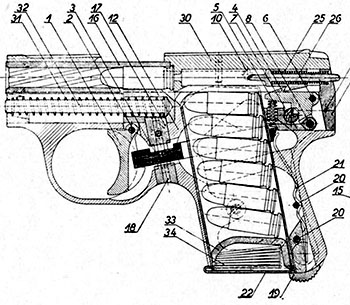
Mauser WTP II Schematic
The trigger bar runs on the right side of the pistol and the disconnector is an upward projection from it. The guide rod of the striker protrudes through a hole in the rear of the frame when the gun is cocked, providing both a visual and tactile indicator. The safety lever runs beneath the left grip and emerges just behind the trigger. The slide does not lock open when the last cartridge is fired. As on the earlier version, the top of the slide is grooved and has tiny sights milled into it.
The blued magazine holds six cartridges and has five staggered witness holes on the left side only. The baseplate has a rounded front with a small slot on the left side where the bottom of the spring is inserted to retain the plate. The baseplate has the Mauser powder barrel logo stamped on it.
The finish is salt blue or nickel. Grip plates are of checkered black or brown plastic, with the Mauser powder barrel logo at the top, and are made by Preßwerk A.G. of Kunstharzartikel, Essen. Brown grip plates are scarce.
There are three main variants of the WTP II.
First Variant WTP II - Serial Number 55000 - 59500 Approximately
The first variant WTP II is defined by its slide inscription in all capital sans-serif characters on the left side of the slide as follows:
MAUSER-WERKE A.-G. OBERNDORF A.N.
Between the inscription and the slide serrations is the Mauser powder barrel logo. The right side of the slide reads:
W.T.P. - 6,35-D.R.P.
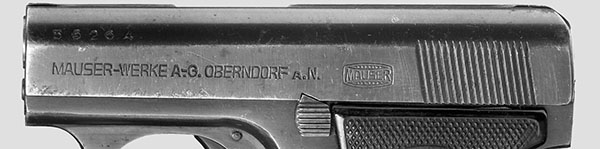
First Variant Mauser WTP II
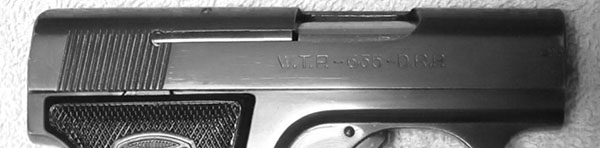
Note that the “D.R.P.” abbreviation stands for “Deutches Reichs Patent” and does not include foreign patents. We are not certain exactly why Mauser was not claiming foreign patent rights for the WTP II.
There are 17 fine triangular-cut serrations at the rear of the slide, angled slightly forward.
Second Variant WTP II - Serial Number 59500 - 69000 Approximately
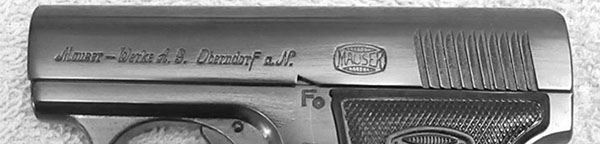
The second variant WTP II is defined by its slide inscription in serif italic characters with script capitals. The left side reads:
Mauser-Werke A.G. Oberndorf a.N.
As in the previous variant, the left side inscription is followed by the Mauser powder barrel logo. The right side of the slide reads:
W.T.P. - 6,35 - D.R.P.
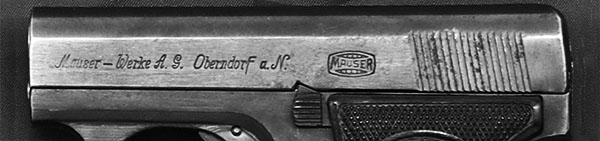
Second Variant Mauser WTP II
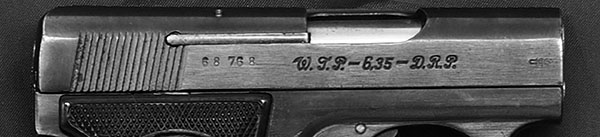
The first 1100 or so guns have the serial number on the left side of the slide, just behind the front sight, making for a rather scarce sub-variant. After approximately serial number 60600 the serial number is moved to the right side of the slide just beneath the extractor. (Please write to us if you can help us refine these serial number ranges.*)
Third Variant WTP II - Serial Number 69000 - 76700 Approximately
This variant is defined by its 11 broad triangular-cut slide serrations, angled slightly forward. This variant retains the slide inscription of the previous variant. The only two sub-variants are defined by the proof marks on the right side of the slide. The crown-over-crown-over-U commercial proof was used until mid-January 1940, when the Nazi eagle-over-N proof came into use. The eagle-over-N proof is found on the WTP II from serial number 75500-76700, approximately.
Third Variant Mauser WTP II
Fourth Variant WTP II: French Production (Post-War)
Fourth Variant WTP II
French Production
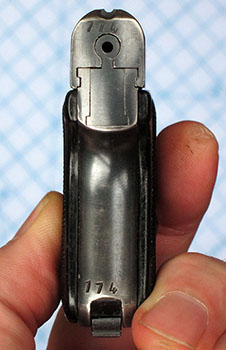
Our current best estimate is that the French assembled approximately 1100 WTP II pistols from existing parts. These pistols are identical to the third variant except that they have no proof marks and the serial numbers are stamped on the rear of the slide and the grip strap. (Please write to us if you can provide further information about French production pistols.*)
Field Stripping the WTP II
- Make sure the gun is unloaded.
- Pull the trigger and remove the magazine.
- Use the floorplate of the magazine to push in and pull down on the takedown catch.
- Vigorously push the slide forward and off the frame.
- Push the barrel forward about 5 mm and lift it up and out of the slide.
Selected Photographs
Click on the link for a specific photograph.
Use the arrows at the bottom of each page to navigate to additional photographs.
Parts Diagram for the Mauser WTP
First Variant Mauser WTP
Second Variant Mauser WTP
Third Variant Mauser WTP
Schematic for the Mauser WTP II
First Variant Mauser WTP II
Second Variant Mauser WTP II
Third Variant Mauser WTP II
Fourth Variant Mauser WTP II
Part I: The Mauser Model 1910
Part II: The Mauser Model 1914
Part IV: The Mauser HSc
* Please email Burgess Mason with photographs, information, or inquiries about Mauser pistols.
References
- Baudino, Mauro; van Vlimmeren, Gerben. Paul Mauser: His Life, Company, and Handgun Development, 1838-1914. Brad Simpson Publishing, Galesburg, Illinois: 2017. www.paul-mauser-archive.com/
- Belford, James N.; Dunlap, Jack. The Mauser Self-Loading Pistol. Borden Publishing Company, California: 1969.
- Bruce, Gordon. The Evolution of Military Automatic Pistols: Self-Loading Pistol Designs of Two World Wars and the Men Who Invented Them. Mobray Publishing, Woonsocket, Rhode Island: 2012.
- Burnham, Alan D. and Theodore, Peter H. The Mauser HSc Pistol. Privately Printed: 2015.
- Clark, James. “Last of the Magnificent Mausers.” Guns & Ammo, March 1965.
- Ezell, Edward C. Handguns of the World. Barnes & Noble, New York: 1981.
- Görtz, Joachim and Sturgess, Geoffrey. The Borchardt & Luger Automatic Pistols: A Technical History for Collectors from C93 to P. 08. Brad Simpson Publishing, Galesburg, Illinois: 2010 and 2011.
- Hoffschmidt, E.J. “Mauser W.T.P. Old Model,” and “Mauser Pocket Pistol 1910,” and “Mauser HSc Pocket Pistol.” NRA Illustrated Firearms Assembly Handbook. 1952-1960.
- Hogg, Ian V. German Handguns. Greenhill Books, London: 2001.
- Hogg, Ian V. and Walter, John. Pistols of the World. Krause Publications, Iola, Wisconsin: 2004.
- Kinard, Jeff. Weapons and Warfare: An Illustrated History of Their Impact. ABC-CLIO, Santa Barbara, California: 2003.
- König, Klaus-Peter and Hugo, Martin. Taschen Pistolen. Motorbuch Verlag, Stuttgart: 1985.
- LaCroix, John. Report to Mauser 1910 Pattern (6.35mm & 7.65mm) Pistol Collectors. Dated 04-03-99.
- Matthews, J. Howard. Firearms Identification. Charles C. Thomas, Springfield Illinois: 1962.
- Maus, L. Donald. History Writ in Steel: German Police Markings 1900-1936. Brad Simpson Publishing, Galesburg, Illinois: 2009.
- Olson, John, Ed. The Famous Automatic Pistols of Europe. Jolex, Paramus, New Jersey: 1976.
- Pender, Roy G. Mauser Pocket Pistols: 1910-1946. Collector’s Press, Houston, Texas: 1971.
- Schroeder, Joseph J. Arms of the World--1911: The Fabulous ALFA Catalogue of Arms and the Outdoors. Follett Publishing Company: Chicago: 1972.
- Schroeder, Joseph J. “The Mauser Model 1906/08 Pistol: Failure or Forerunner?” Gun Collector’s Digest, 5th Edition. DBI Books, Northbrook, Illinois: 1989.
- Smith, W.H.B. Mauser Rifles and Pistols. Military Service Publishing Company: 1946.
- Stewart, James B. “Mauser 6.35mm Pistols.” Gun Digest, 1970.
- Still, Jan C. Axis Pistols, Volume II. Walsworth Publishing, Marceline, Missouri: 1986.
- Weaver, Darrin W.; Speed, John; Schmid, Walter. Mauser Pistolen: Development and Production, 1877-1946. Collector Grade Publications, Cobourg, Ontario: 2008.
- Wilson, R.K. Textbook of Automatic Pistols. Small Arms Technical Publishing Co., Plantersville, South Carolina: 1943.
- Wirnsberger, G. “Gleich und doch ungleich: Mauser Selbstladepistolen Kaliber 6,35”, Deutsches Waffenjournal, October 1989.
Copyright 2017 by Ed Buffaloe and Burgess Mason. All rights reserved.