The High Standard Double-Nine Revolver and Other Western-Style Revolvers
by Ed Buffaloe
About 7 minutes to read.
There isn’t an extended history to High Standard’s revolver line, like there is to their line of semi-automatic target pistols. They didn’t design their first revolver, the Sentinel, until 1955, probably at the behest of Sears, which was a large shareholder
in the company. The Double-Nine, a double-action nine shot Western style revolver, first appeared in 1958. It had an
aluminum frame, a rebounding hammer, and a 5½ inch barrel. They were available in both blue and nickel finish, though I
have seen far fewer in nickel than in blue. Early grips were white or black plastic, and later fake stag was available. A few
rare guns have checkered black plastic grips. Sears sold the gun as the J.C. Higgins Ranger or Model 90, and later also as the
Ranger De Luxe. High Standard also made western style revolvers for Western Auto and Kroydon Arms.
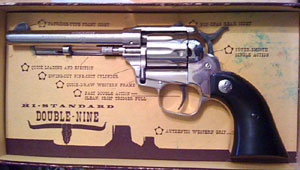
W-100 in Original Box
W-100. The first Double-Nine series was called the W-100.
W-101. After about a year, in early 1959, the ejector rod latch was modified slightly, as was the frame to accommodate it.
W-102. In 1960, for the W-102 series, a return spring was added to the ejector rod. On the earlier models, if you didn’t remember to manually retract the ejector
into the cylinder before closing the cylinder you would put a nasty scratch on the left side of the frame. The “Longhorn,” “Posse,” and “Natchez” models were
first manufactured in 1960, with shipments beginning in September. The Posse did not have the underlug on the barrel to contain the cylinder release. The
“Longhorn” was sold with 4½, 5½, and 9½ inch barrels; the “Posse” had walnut grips and a 3½ inch barrel; and the
“Natchez” featured a birds-head grip and a 4½ inch barrel. Sears also sold versions of the 9½ Longhorn, Natchez, and
Posse. The W-102 series of the Double- Nine was only in production for a few months before it transitioned to the W-103, whereas the W-102 Longhorns were in production for about a year.
W-103. This series appeared arround March of 1961. The changes were mostly internal. The ejector latch housing was stamped instead of machined.
W-104. This series appeared around April of 1962 and featured internal changes only.
W-105. In early 1970, more internal changes were made. The “Hombre,” “Durango,” and “Marshal” models were
introduced. Walnut grips became standard. The Marshall, like the Posse, did not have the underlug on the barrel to hold
the cylinder release. The 1970 Hombre had a 4” barrel, whereas later versions had a 4.5” barrel, as did all the Durangos
. High Standard also made a copy of the Double-Nine from 1971 through early 1975 that was called the NATO 49er. It had the aluminum frame of the W-105 series guns, rather than the steel frame of the W-106.
W-106. The W-106 series was introduced in 1971 and had a steel frame that could handle magnum cartridges,
Pre- High Sierra
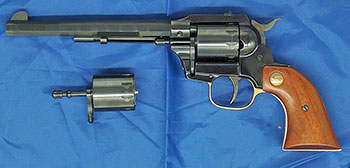
though they were not marked W-106. The first Double-Nines were made with interchangeable cylinders (.22 long rifle and .22 magnum) and were
marked “Convertible.” The firing pin was moved from the hammer to the frame, and the guns were available with an adjustable rear sight. The
“High- Sierra” was introduced in early 1973, with an octagonal barrel, gold plated trigger guard and grip frame, and interchangeable cylinders.
(The earliest version was not marked “High-Sierra” and was produced for less than a year. Some of them came in a box marked Longhorn, but with
an applied sticker that said “Double-Nine Convertible.”) The aluminum-frame W-105 series continued production in parallel with the steel-frame W-106.
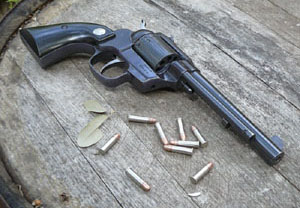
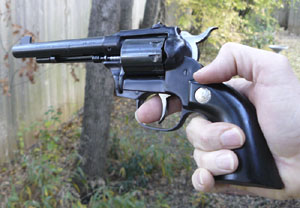
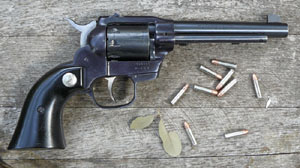
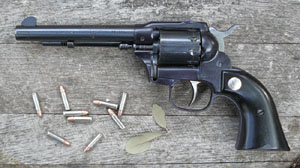
The Double-Nine shown here was the first gun I ever bought. It is a W-104 series, made in 1968. I bought it in 1971 at a
pawn shop in downtown Houston for $39.95--it came with a holster. The gun originally had some really ugly fake-stag plastic grips. I quickly sought out the black grips which have been on the gun ever since.
This is still my favorite .22 pistol. I also own a High Standard semi-auto target pistol, but I can shoot my revolver pretty much
interchangeably with it--they are both equally accurate. My experience with other .22 revolvers has not been as good. For
instance, it can be difficult to find a Ruger Bearcat where all the chambers are accurate. John J. Stimson, Jr. tells me, however
, that the factory acceptance standards for the revolver line was not as high as for the automatic pistol line—the autos were
required to fire tighter groups to pass inspection. High Standard claimed that with the counter-bored cylinder the gun could be
dry fired without damage. I have accidentally dry fired mine a number of times over the years with no noticeable damage to the cylinder or firing pin, though I still do not recommend dry-firing if you can avoid it.
My gun has seen a lot of wear and tear. I foolishly left it in the trunk of my car for quite a while and the cylinder got some rust
on it. Before I took these pictures, I carefully touched up scratches on the frame with Birchwood Casey Aluminum Black and
retouched the cylinder and barrel with Birchwood Casey Super Blue. The old gun looks pretty darned good now!
Double Nine serial numbers were in the same series as the Sentinel through 1971.
Late Model Western Revolver Serial Numbers
1972
M001000 - M009005
1973
M009006 - M027616
1974
M027617 - M043285
1975
M043286 - M055681
1976
M055682 - M070480
1977
M070481 - M70668
1978
M075000 - M076145
1979
M076146 - M078342
1980
M078343 - M079310
1981
M079311 - M082850
1982
M082851 - M086424
1983
M086425 - M088872
1984
M088873 - M090016
M series guns actually began shipping in December of 1971. This data provides the known highest serial number produced in a given year--but the guns were
rarely shipped in serial number order. Production from 1978-1984 was at the East Hartford location. For more detailed information and for earlier revolvers see www.histandard.info.
The J.C. Higgins Ranger
The Ranger was made by High Standard for Sears Roebuck Company from 1958 through 1963, built on the same aluminum
frame as the Double-Nine. The cylinder of the Ranger was fluted in a distinctive pattern and the trigger, hammer, and grip
frame were nickel plated, whereas the rest of the gun had a blued finish. All Rangers were fitted with a 5-1/2 inch barrel.
There were three versions. The first version (Sears ID number 583.990), marked “Ranger” on the barrel, was a W-100 series
gun with no return spring for the cylinder ejector. The second version (Sears ID number 583.991), marked “Ranger” on the
barrel, was a W-101 series gun, which likewise did not have a return spring for the cylinder ejector. The third version (Sears
ID number 583.992), marked “Model 90” on the barrel, was a W-103 series gun with a return spring in the cylinder ejector.
These guns all featured checkered black plastic grips with a medallion showing a saguaro cactus inset with the skull of a steer. The Ranger is a relatively scarce gun.
References
Hi-Standard pistols & Revolvers: 1951-1984, by James Spacek. Self published, Cheshire, Connecticut: 1998. “J.C. Higgins Ranger” by Marcia Mighell. High Standard Collectors’ Association Newsletter,
Vol XVIII, No 2, June 2009.
Catalog Number
Start of Production
Series
Name
Barrel Length
Grips
Notes
9169
Apr. 1958
W-100 to 104
Double Nine
5.5”
Faux Ivory Plastic
Blue Finish - the most commonly found Western revolver
9170
Apr. 1958
W-100 to 106
Double Nine
5.5”
Black Plastic
Nickel Finish - the second most common Western revolver
9171
Sep. 1958
W-100
J.C. Higgins Ranger
5.5”
Black Plastic
Blue Finish - Sears ID 583.990 - scarce
9174
1959
W-101
J.C. Higgins Ranger
5.5”
Black Plastic
Blue Finish - Sears ID 583.991 - relatively scarce
9175
Sep. 1960
W-101 to 103
Double Nine
4.5”
Faux Ivory Plastic
Blue Finish - relatively scarce
9176
Sep. 1960
W-101 to 103
Longhorn
5.5”
Faux Ivory Plastic
Blue Finish - relatively scarce
9177
Sep. 1960
W-101 to 103
Longhorn
9.5”
Faux Ivory Plastic
Blue Finish - relatively scarce
9178
Sep. 1960
W-101 to 104
Longhorn
4.5”
Faux Pearl Plastic
Blue Finish - relatively scarce
9179
Sep. 1960
W-101 to 104
Longhorn
5.5”
Faux Stag Plastic
Blue Finish - relatively common
9180
Sep. 1960
W-101 to 104
Longhorn
9.5”
Walnut
Blue Finish - relatively scarce
9181
Sep. 1960
W-101 to 104
Posse
3.5”
Walnut
Blue Finish - relatively scarce
9182
Sep. 1960
W-101 to 104
Natchez
4.5”
Bird’s Head
Blue Finish - relatively common
9183
Feb. 1961
W-101? to 103
Posse
3.5”
Black Plastic
Blue Finish - scarce (rare if unmarked)
9184
Jan. 1961
W-101 to 103
Buntline Style (Longhorn)
9.5”
Black Plastic
Blue Finish - relatively scarce
9185
1961
W-103
J.C. Higgins Model 90
5.5”
Black Plastic
Blue Finish - Sears ID 583.992 - relatively scarce
9186
Feb. 1961
W101? to 103
Riverboat Style (Natchez)
4.5”
Black Plastic
Blue Finish - very scarce if unmarked
9199
Mar. 1966
W-104
Longhorn - Model 90
9.5”
Walnut
Blue Finish w/ Gold Grip Frame - very scarce
9300
Apr. 1970
W-105 to 106
Hombre
4” & 4.5”
Walnut
Blue Finish - relatively common
9301
Apr. 1970
W-105 to 106
Hombre
4” & 4.5”
Walnut
Nickel Finish - relatively common
9302
Apr. 1970
W-105 to 106
Durango
4.5”
Walnut
Blue Finish w/ Nickel Grip Frame - common
9303
Jan. 1973
W-105 to 106
Durango
4.5”
Walnut
Blue Finish w/ Blue Grip Frame - relatively scarce
9307
Apr. 1971
W-105 to 106
Durango
5.5”
Walnut
Blue Finish w/ Nickel Grip Frame - relatively common