Rheinische Metallwaaren & Maschinenfabrik (RM&M, often abbreviated as “Rheinmetall”) of Sömmerda was an engineering firm founded in 1889 that
primarily made field artillery. In 1901 they purchased Waffenfabrik von Dreyse, a manufacturer of sporting rifles and revolvers which had fallen on hard times. This purchase
provided RM&M entry into the small arms business. According to Ortmeier & Hofmann, the 1907 Dreyse “…was actually supposed to be called the ‘Schmeisser Pistol’,” but at
this time Schmeisser’s name was relatively unknown, whereas Dreyse’s name was universally recognized in the German-speaking world.
It is difficult to find a reliable source of information about Louis Schmeisser. Hans-Joachim Tillig comments that “…patent № 185444, dated 4 January 1906, precisely
documents his departure from Bergmann and his new beginning at Rheinmetall in Sömmerda.” However, to have filed a patent in the first week of January 1906, Schmeisser
must have begun work on the design sometime the previous year, or even earlier. F.W.A. Hobart tells us that Shcmeisser became the chief designer for RM&M in 1902. His last patent
for Bergmann may have been in 1901, so perhaps Hobart is correct.
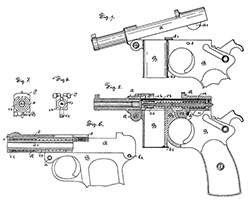
First Patent: As indicated above, on 4 January 1906, RM&M filed German patent № 185411, which was granted on 3 May 1907, for a pistol with barrel and upper receiver housing
hinged at the front of the weapon. Two designs are shown in the patent: one with the magazine in front of the trigger, reminiscent of the Bergmann Simplex which was one of the
last designs Schmeisser worked on for Theodor Bergmann, and the other with the magazine in the grip. A similar patent was filed in the United States on 2 January 1907 (U.S. patent
№ 956430) with Louis Schmeisser listed as the inventor. The U.S. patent provides a more complete description of the mechanism of the version with the magazine in the grip. The
design features a fixed barrel with a concentric recoil spring enclosed in a slide, which attaches to a heavy bolt at the rear, running in a receiver housing above the grip, with the ejection
port on top of the slide. This is clearly not yet the production pistol.
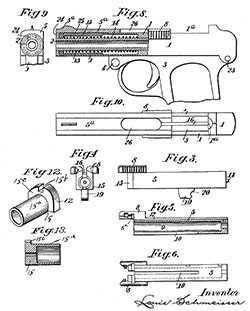
Second Patent: On 21 February 1908, RM&M filed German patent № 209632, which was granted on 15 May 1909. The patent covers the design of a separate breechblock and slide,
joined at the rear by a connecting cap with bayonet lugs, enabling quick disassembly and reassembly without tools. The lockwork shown in the patent drawings is essentially that of
the early Dreyse pistol, but the breech block and slide are quite different from the production Model 1907. No patent claims are made regarding the relatively simple lockwork. It
seems likely that in February 1908, when this patent was filed, the design of the Model 1907 had not yet been finalized.
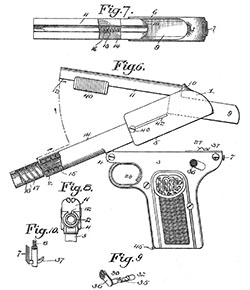
Third Patent: The patent for the production Model 1907 was filed on 1 June 1908, under Louis Schmeisser’s name, in the United States. U.S. Patent № 956431 was granted on 26 April 1910. No
corresponding patent from Germany or any other country has been found. Only the design of the slide, bolt, and upper receiver housing, and their hinging at the front of the frame, are claimed in the patent.
Based on the above information, production of the Dreyse Model 1907 probably did not begin until late1908 or possibly early 1909. Serial number 2661 has Austrian proofs that are dated 1909
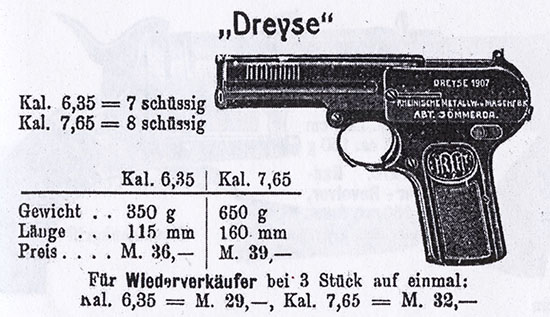
. The author is unaware of any advertisements for the Dreyse pistol prior to 1910, by which time the 6.35mm vest pocket Dreyse was also available. Both pistols are listed in the 1910 Georg Knaak catalog.
From the 1910 Georg Knaak Catalog
The 25 June 1911 issue of the German language magazine Der Waffenschmied (The Gunsmith) has the following entry: “The Rheinische Metallwaren- und Maschinenfabrik, Sömmerda department,
reports the following about its rifle factory branch: The rifle and weapons factory's flagship product, the "Automatic Dreyse Pistol," has had an excellent introduction. The main customers
include the police administrations of larger cities as well as the gendarmerie and police commands of the German federal states. Production of the small model is progressing, and the start of
production of a promising military pistol is also within reach. Rifle barrel sales have remained moderate, reflecting the ongoing sluggish business in the hunting rifle industry.”
Design of the 1907 Dreyse
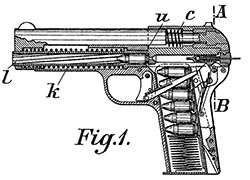
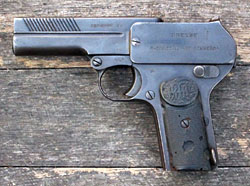
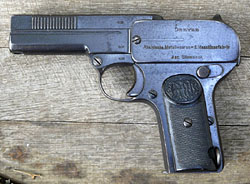
The 1907 Dreyse is a striker-fired unlocked-breech design chambered for the 7.65mm Browning cartridge (.32 ACP). It was strongly influenced by the 1900 Browning, though the Browning has its
recoil spring above the barrel, while the Dreyse has a concentric recoil spring. Nonetheless, the overall shape is similar, as are the grip angle, the magazine release, and the positioning of the
manual safety. Magazines are interchangeable. Both guns have breech blocks that protrude from the rear of the gun during recoil. The only advantage of Schmeisser’s design is that it can be
disassembled without a screwdriver, though it does require a tool to depress the recoil spring bushing. A groove is cut in the floorplate of the magazine for this purpose but is only marginally useful.
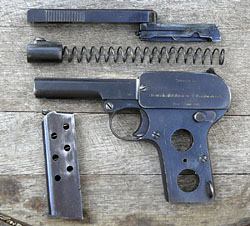
1907 Dreyse Components
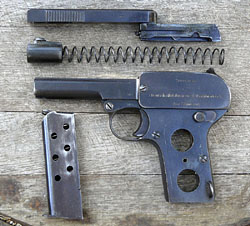
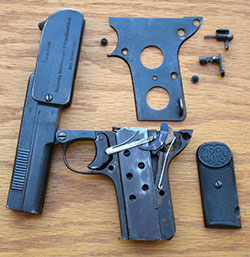
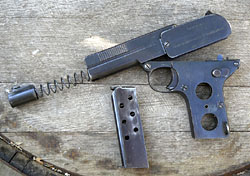
The 1907 Dreyse consists of a frame and lockwork assembly, and a barrel, bolt, and upper receiver housing assembly, hinged at the front. A latch at the rear of the frame slides to the
right to allow the upper housing to pivot, but is blocked if the striker is cocked. Pivoting the upper housing does not allow access to the breech for cleaning; one still has to remove the
barrel bushing and then the slide and breechblock. The Dreyse slide extends about three-quarters of the way across the top of the gun and the breech block depends from it at the rear. The
slide and breech block reciprocate in the upper receiver housing. Because the rear portion of the upper receiver housing is fixed and does not reciprocate, the slide must be
grasped at the front in order to chamber a round—the forward portion of the slide has serrations for this purpose.
The barrel and barrel housing are fixed to the upper receiver housing, and sit beneath the slide. The recoil spring is held in place around the barrel by a collar-like bushing at the front. The
bushing compresses the recoil spring as the slide is drawn to the rear. The breech block contains the striker, extractor, and cocking indicator pin. The indicator pin protrudes from the back of the
breech block when the striker is cocked. The extractor is a flat piece of spring steel with a hook on the end, fitted into a slot on the right side of the bolt. Ejection is to the right through an ejection
port in the right side of the upper receiver housing. The ejector is fitted into the left side of the upper receiver housing and held in place by a screw. This same screw also retains the barrel in the
housing—with the screw removed, the barrel can be unscrewed using a special tool.
1907 Dreyse Lockwork
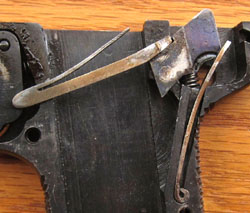
A sideplate on the left grip frame covers the lockwork, which is quite simple. A transfer bar extends, in a cut milled in the sideplate, from the trigger to the sear. In early guns, after the
transfer bar trips the sear, it moves past it and cannot re-engage until the trigger returns, but there is no positive means of preventing the gun from firing when the slide is out of
battery. In later guns, a curved disconnector pivots the transfer bar up so it cannot reach the sear when the slide is out of battery. The manual safety blocks movement of the sear from beneath when engaged.
Hogg states that early guns had a sear which simply released the striker, but that wartime production guns had a modified
sear that forced the striker back a little further before releasing it. This was apparently necessary because some military ammunition had hard primers. The shape of the sear was modified several
times during the course of production.
The serial number is stamped on the top of the breech block (except on a few early guns), just behind the slide, on the frame in front of the magazine well, and beneath the barrel housing. Many
small parts are also stamped with the last two or three digits of the serial number. The highest serial number recorded by Bob Campbell is 251211. Serial numbers as high as 254857 have been
reported. It is generally believed that the serial number range of the 1920 Rheinmetall pistol began at about 251000, but it is possible that parts were still being assembled into 1907 Dreyse pistols as late as 1923.
Production nominally ended at the end of World War I, but assembly of weapons from remaining parts continued for several years. Certain German police are known to have continued using the
1907 Dreyse into the 1950’s.
Stocks are of checked horn with an oval cartouche at the top featuring the RM&M monogram. Early grips had the retention screw at the rear edge of the grip plate, but it was later moved to the
center of the grip where it remained for the vast majority of the guns produced.
There are at least six variations and a number of sub-variants, and there are overlaps in some characteristics between variations.
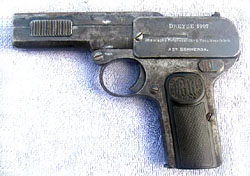
First Variant – Police Model
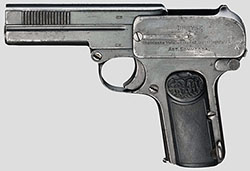
1907 Dreyse 1st Variant - Police Model
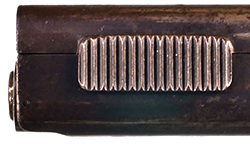
1907 Dreyse SN 21 Serrations
Early lockwork with no disconnector.
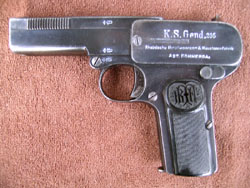
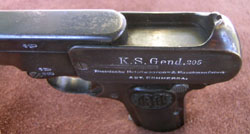
In early production, two different variations of the Model 1907 Dreyse were produced. Some pistols were especially made for the Königlich Sächsische Gendarmerie, the Royal Saxon Police
force, and are factory marked on the left side of the upper receiver housing with "K.S. Gend." followed by the serial number. They are not marked "Dreyse." A typical legend would be:
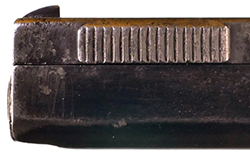
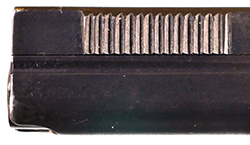
These Police Models have a thin flat-topped slide with a small integral front sight, and a U-shaped rear sight channel integral with the upper receiver housing. There are vertical triangular
-cut raised serrations at the front of the slide. Some of the "K.S. Gend" marked pistols with three-digit serial numbers have characteristics of later pistols, including crown-over-N proofs,
indicating they were manufactured later than the serial number might indicate.
Internally, all early Dreyse pistols are distinguished by having no disconnector. The transfer bar pushes the sear down and then moves past it, resetting when the trigger is released, but
there is no mechanism to prevent the gun from firing when the slide is out of battery.
The magazine is unmarked. Some early magazines have six viewing holes only on the right side, but most have six holes on each side.
Grip stocks for all early guns are made of checked horn with an oval cartouche at the top containing the RM&M monogram. The stocks are fitted into dovetails in the grip frame and retained by
a screw at the rear. The grip screw on the left side also serves to retain the sideplate. The other screw securing the sideplate, located just behind the trigger,
extends all the way through the right side of the frame. There is no lanyard ring on early pistols. A checked safety lever is positioned flat against the surface of the receiver on the left side. The
spring steel extractor in the bolt is approximately 2mm wide. The proof mark on slide, barrel housing, and frame is the crown-over-crown-over-U black powder proof, which was used until late 1911 or early 1912, after which it was replaced by the crown-over-N nitro proof.
Second Variant
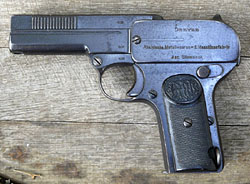
1907 Dreyse Second Variant
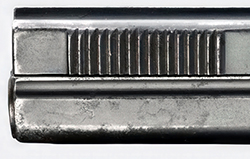
Second Variant - SN 996 - Serrations
The Second Variant is the one shown in the U.S. patent. This may have been considered the “commercial model” (though it was short-lived) and seems to have been made at the same time
as the Police Model, in the same serial number sequence, but in larger quantities. The Second Variant has a scalloped slide, the center portion of which is the same height as the flat slide of
the First Variant Police Model. The sides of the slide rise up to form a shallow U shape. The raised triangular-cut slide serrations extend below the slide and overlap the flat barrel
housing. Second Variant pistols are marked on the left side of the upper receiver housing:
In the Third Variant, by approximately serial number 3150, the slide serrations overlapping the barrel housing are discontinued. Raised triangular-cut vertical serrations are found on the slide
only. The barrel housing has a horizontal groove near the top.
By at least serial number 5584 (likely still in the first year of production) the model number “1907” was omitted from the legend on the upper receiver housing, reading simply:
A few scarce pistols have retailer markings instead of the RM&M company name and address.
1907 Dreyse Third Variant
Third Variant - SN 16147 - Serrations
The early Dreyse pistol is listed in both the 1910 Deutsche Waffenfabrik Georg Knaak catalogue and in the ALFA catalogue of 1911. The drawings show a gun with the grip
screw at the rear of the grip frame and the early three line inscription. The ALFA catalogue shows both the First and Second Variants but appears to have the police model confused with the commercial model.
The 1907 Dreyse continued to have no disconnector or lanyard ring through at least serial number 8047, but by serial number 9305 it featured both. A depression is milled in the bottom of
the breech block to accept the upper lobe of the disconnector. When the slide is out of battery the disconnector is depressed and the transfer bar is lifted out of contact with the sear.
A fixed U-shaped lanyard ring is added to the sideplate on the left side of the grip frame by at least serial number 8856.
A few four-digit serial numbers, falling in the Third Variant category, have been documented with concentric rings on the safety instead of checking (for example, serial numbers 6009, 6934, 7420,
8047, 9387). The narrow extractor continued in use through at least serial number 18825, when it was replaced with one about 3mm wide. Stocks with the screw at the rear continued in use at least
through serial number 32957, and possibly later.
Fourth Variant
1907 Dreyse Fourth Variant
Fourth Variant - SN 153708 - Serrations
With the Fourth Variant the grip screw is moved to the middle of the grip stock, starting around serial number 33000. The rear sideplate screw sits flush with the sideplate and is partially
covered by the left stock. As older grip stocks were used up, there was a transition period during which guns were made with a screw in the center of the left grip as well as at the rear
(between 23326 to 32014. Dovetailing of the grip frame and grips was eliminated. The Fourth Variant grip frame and sideplate have two circular cutouts for positioning the grip
stocks. The front side plate screw behind the trigger does not extend all the way through the frame on the other side.
The majority of Model 1907 Dreyse pistols produced fall in this Fourth Variant category and, once the grip screw was moved, the gun remained essentially the same for a long period
of time. The Fourth Variant continues to have vertical serrations at the front of the slide—not incised cuts but raised triangular-cut ridges.
There is a fixed U-shaped lanyard ring on the left side of the grip at the bottom rear. The spring steel extractor is approximately 3mm wide. Like the Third Variant, the Fourth Variant is marked on
the left side of the upper receiver as follows:
They are sometimes found stamped for export: “GERMANY.”
Fifth Variant
1907 Dreyse Fifth Variant
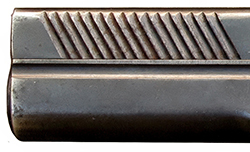
The contour of the upper receiver housing on the Fifth Variant is altered so that it rises to a point at the upper rear where the housing forms the rear sight. Most second variant guns have
slanted triangular-cut serrations at the front of the slide—early on, these are not raised ridges, as on the First Variant, but are actual incised cuts. This change simplified the machining of the
slide. Soon after the introduction of the Fifth Variant upper receiver housing, the safety lever was redesigned to have an offset for the checkered portion.
The highest Fourth Variant serial number the author has noted is 215661, while the lowest Fifth Variant serial number noted is 216158. Early Fifth variant legends were like that of Third and
Fourth Variants, but after the company began using the name Rheinmetall, they were marked on the left side of the upper receiver as follows:
DREYSE RHEINMETALL ABT. SÖMMERDA
Fifth Variant - SN 234028 - Serrations
Serial number 229962 still has the old legend and takedown cutout, but 234028 has neither. During this period of production, as old parts were used up, some earlier serial
numbers have been noted with new features and some later serial numbers with old features or with mixed features. For instance, serial number 226030 has the new features, whereas
249855 has vertical ridges at the front of the slide and the old slide legend, but no slide cutout.
Soon after the change in the legend, the takedown cutout beneath the front of the barrel was eliminated. Ortmeier & Hofmann state that the factory provided a special takedown tool. Hans
-Joachim Tillig says: “These pistols used to have a cup-like pressure piece, which tapered at the bottom of the cup into a long spike, on which a wooden handle was inserted. I once saw this tool
in a police armory. A suitable, short piece of tubing can be used...”
Sixth Variant
Sixth Variant - SN 249261 - Serrations
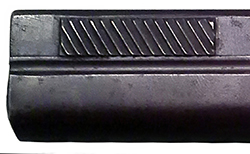
The last few thousand production guns returned to having raised ridges at the front of the slide, but they were angled and in a rectangular block. A few late guns have no manufacturer
markings. Some are stamped for export on the left side of the slide, just behind the serrations: “MADE IN GERMANY” or “GERMANY” in all capital sans-serif characters. Many of these late guns were likely assembled from parts after the war.
The author would be interested to receive serial number information, descriptions, and photographs from readers in order to determine at what point various changes were made to the gun*
Field Stripping
Remove the magazine and make sure the gun is unloaded.
Pull the trigger to release the striker.
Move the latch on the back of the gun to the right to open the action. The entire upper portion of the frame—barrel and slide included—hinges upward.
Wrap a hand around the upper portion of the frame. Holding a screwdriver or other tool with a half-moon cut in the end in the other hand, hook a thumb through the
trigger guard and use the tool to depress the recoil spring bushing. The baseplate of the magazine on early guns is designed for this purpose, but is not always sufficiently
strong. (Later models do not have the cutout beneath the barrel housing, so all one can do is slip a screwdriver or other tool between the housing and barrel to push the
bushing back. Armorers had a special tool for this purpose but an empty .44 Special, .44 Magnum, .45 Colt, or .45-70 shell casing will also serve.)
With the bushing depressed, lift up on the slide with one hand and very carefully ease the bushing out of the frame. Always point the gun toward
something that will not be damaged if the bushing should fly free, and also where the bushing will not be lost. (The author has rarely disassembled one of his Dreyse pistols without the
bushing flying loose, either during disassembly or reassembly.)
Quick Reference for 1907 Dreyse Variations
First Variant
S/N 1 - 700?: Police Model (Polizeimodell):
1907 Dreyse 1st Variant - Police Model
Flat top.
Elevated rear sight.
Raised (not incised) serrations on slide only.
“K.S. Gend.” inscription.
Rounded rear upper receiver housing.
Flat safety lever.
Grip stocks in dovetailed grooves w/ screw at rear.
Narrow extractor (2mm).
Takedown cutout beneath barrel.
No lanyard.
No disconnector.
Hook on slide rather than on front bushing.
Flat-sided barrel housing with no groove.
1907 Dreyse Second Variant
Second Variant
S/N 1 - 3132? (Commercial Model?):
Scalloped top on slide.
Flat-sided barrel housing w/ no groove.
Slide serrations overlap barrel housing and have rounded corners.
Rear sight with narrow notch.
“DREYSE 1907” inscription.
Third Variant
S/N 3150? - on:
1907 Dreyse Third Variant
Scalloped top on slide.
Barrel housing with narrow groove near top.
Rear sight with wide notch.
“DREYSE” inscription by S/N 5584.
Raised (not incised) vertical serrations on slide only.
No disconnector through at least S/N 8047
Lanyard added to sideplate by at least SN 8856
Disconnector added by S/N 9305 (some later guns may still not have one)
S/N 16000? - on:
Wide extractor
S/N 28000? - on”
Hook on barrel bushing instead of slide
1907 Dreyse - Fourth Variant
Fourth Variant
S/N 33,000? - 215,661?:
Grip screw in middle
Grip stocks are no longer dovetailed and have screw in middle. (There are some transitional guns with two grip screws, one in center and one at rear.)
Grip frame on right side and side plate on left have two circular cutouts for positioning grip stocks.
S/N 122,350? - on:
Front sideplate screw behind trigger no longer extends all the way through to the right side (but the earlier version may still be found in a few later guns)
1907 Dreyse - Fifth Variant
Fifth Variant
S/N 216,158? - on:
Rear upper receiver housing rises to a point where the rear sight is formed.
Offset safety lever.
Incised triangular-cut slide serrations, angled to the rear.
S/N 222,000? - on:
Takedown cutout beneath barrel omitted.
No notch on toe of magazine.
S/N 226,000? - on:
RHEINMETALL slide inscription begins to appear.
Sixth Variant
S/N 238,421? - on:
Raised (not incised) slide serrations angled to the rear in a square block. (There are a number of guns
after 238,421 that are clearly Fifth Variant, so there is considerable corssover between these variants.)
Note: Serial numbers given are estimates based on a limited sampling of known specimens. Please write to me* if
you can help make these numbers more accurate.