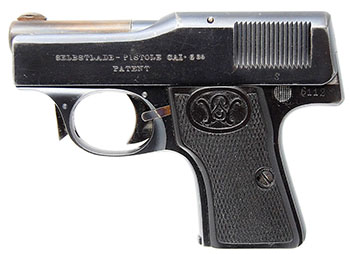
Walther Model 1 - 1st Variation Photograph by Stefan Klein
in his book German Pistols and Revolvers: 1871-1945, states that Carl Walther and his son Fritz first marketed their Selbstlade Pistole in 1906, which is a near impossibility given that
the 6.35mm Browning pistol cartridge and the first gun designed to fire it, the 1906 FN Browning, did not appear on the market until July
of 1906. Other sources (Boothroyd, Kersten, Rankin, and Smith) cite 1908 as the probable date for the introduction of the Model 1. An early advertising brochure for the gun refers to it
as the Model 1909, and James B. Stewart says that the original instruction manual for the gun refers to it as the Model 1910; however, the only manual I have located calls it the Model 1909.
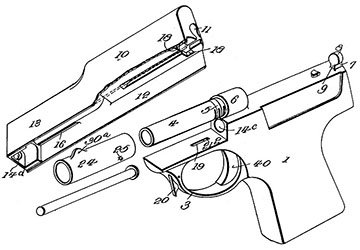
German patent number 235944 for an ”automatic firearm with a fixed barrel” was applied for on 8
August 1909 in the name of Carl Walther, and granted on 22 June 1911. The U.S patent (991398)
was applied for on 9 June 1910 granted on 2 May 1911.
U.S. Patent 991398
The Walther pistol appeared in the Adolf Frank (ALFA) catalogue in 1911. The first advertisement in the journal Der Waffenschmied is in November 1910.
Interestingly, the patent covers only the frame and slide design and the method of disassembly. The lockwork of the Model 1, which to my knowledge was unique in its era, was never
patented, though it may have been covered by a gebrauchsmuster (see below).
The gun was originally marketed as the “Deutsche Selbstlade Pistole Walther, Modell 1909, Kaliber 6,35.” In 1914, when the Walther Model 2 appeared, the original Walther pistol
was retroactively named the Model 1.
The Walther Model 1 has a fixed barrel and an open-top slide with sides that extend forward to
enclose a recoil spring located beneath the barrel. The gun is striker-fired and has a “doll’s head” backstop for the striker spring virtually identical with that on the 1906 FN Browning.
Unusual features
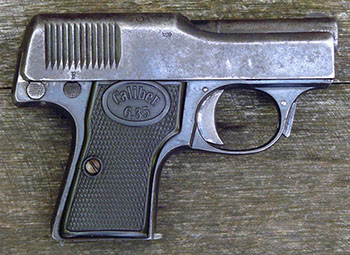
Walther Model 1 - 2nd Variation
of the gun include a nearly full-length barrel sleeve which serves as a take-down mechanism, a lever on front of the trigger guard that serves to lock the slide open, a piston
-shaped sear fitted into a hole drilled in the rear of the frame, and a cross-bolt safety that locks the sear. The transfer bar runs in a groove on the left side of the gun and beneath the left grip. The gun
has a top-mounted extractor and the firing pin serves as the ejector. The magazine release is of the early type which first appeared on the 1899 FN Browning, wherein the latch is squeezed toward the front of the gun to release the magazine. There is no magazine safety.
Variations
Gene Gangarosa distinguishes five variations of the Model 1, based on slide inscriptions, but Dieter Marschall, who has emerged as the current expert on Walther Pistols, only distinguishes
two, based on external buttons: one button (safety) or two buttons (safety and take-down button). I am going to go with Marschall’s terminology, and try to document the sub-variants. Corrections,
additional information, and more extensive photographs are most welcome.*
First Variation (One Button)
Early Lockwork
Early guns have only a single button, the cross-bolt safety button, visible on both sides of the gun; if it extends out the left side, the gun is “Safe
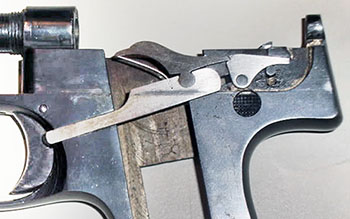
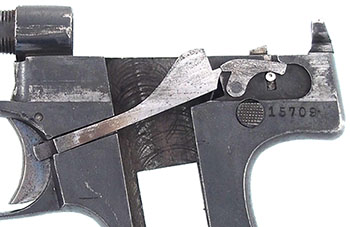
,” and if it extends out the right side, it is set to “Fire.” The original lockwork design features a separate disconnector with a circular lobe on the bottom which fits into a circular cut in the
transfer bar. The transfer bar has a small flat spring fitted to it which tensions the disconnector. The rear of the disconnector engages the sear lever when the slide is in battery. The piston
-shaped sear is held in place by a flat plate which is dovetailed into the frame; this plate has a U-shaped cut in it which retains the sear but allows it
to protrude through the frame. A thorn-shaped sear lever pivots on a pin staked to the frame and lowers the sear when the trigger is pressed.
The front crosspiece of the slide rests on the flat portion of the frame above the trigger guard bow,
and the integral breech block rests on the rear portion of the upper frame. There are no guide rails
on the frame of the Model 1. But it is carefully crafted and closely fitted. The “doll’s head” and
striker fit in a hole bored in the breech block. The “doll’s head,” the barrel sleeve, and the recoil
spring guide rod maintain the slide in position on the frame. There is a small stud on the left side of the barrel sleeve that runs in a groove in the the left arm of the slide. Disassembly of the First
Variation is accomplished by removing the barrel sleeve and drawing the slide back just enough for the “doll’s head” to fit through a cut in the bottom rear of the breech block, so the slide can be
lifted up and removed toward the front.
Walther Model 1 - Bottom of Slide - SN 4287
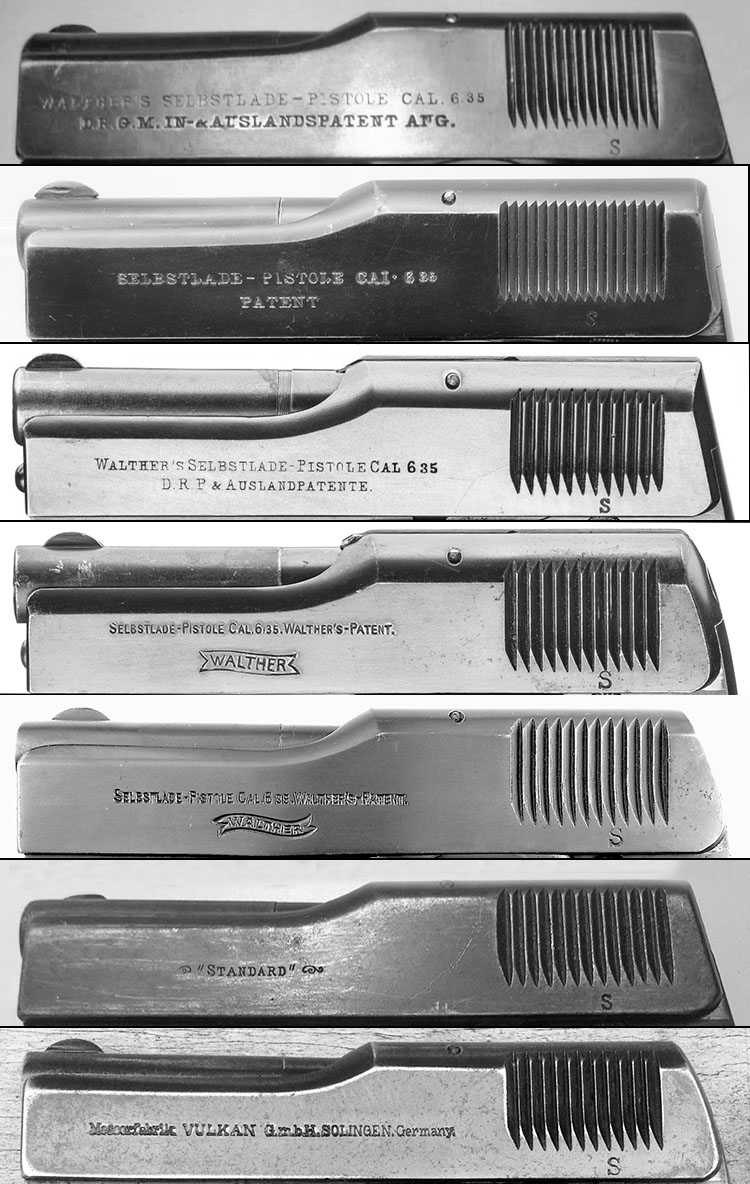
The earliest guns I have documented feature 15 triangular-cut slide serrations on either side, which do not extend all the way to the bottom of the slide, but there is considerable variation in early
guns, including guns with 13 coarse and 17 somewhat finer serrations. The earliest left side slide inscription I have documented is in all-capital serif characters as follows:
WALTHER’S SELBSTLADE-PISTOLE CAL. 6.35 D.R.G.M. IN-&AUSLANDSPATENT ANG.
The above inscription indicates that a gebrauchsmuster (a short-term utility patent) has been registered in Germany and patents have been applied for outside of the country. The only
gebrauchsmuster we have located for Walther in this period is dated 1912, for a handgun trigger device— this would be too late to apply to the Model 1. The above inscription soon gives way to
the following:
The above inscription indicates patents have been granted both in Germany and in other countries. Also noted is a much simpler inscription which omits the Walther name:
SELBSTLADE-PISTOLE CAL. 6.35 PATENT
Guns with this simplified inscription were likely intended to be sold by retailers who might wish to add their own brand name to the slide, or perhaps add their own grip plates. One such retailer
was August Stukenbrok, who advertised the Walther pistol in their 1912 catalog with an illustration featuring their tradename “Aste” on the grips. However, no such gun has ever been
located. A Bial & Freund advertisement of unknown date also shows a Walther Model I pistol with what appear to be grip plates with a “B&F” monogram though, again, no such gun has been
documented. I have documented a single specimen with only the word “STANDARD” on the slide, and also a couple of specimens lacking an inscription altogether.
Early guns proofed prior to 1 September 1911 have the double-crown-over-U proof mark on the right side of the slide in front of the chamber. After 1 September 1911 the crown-over-N nitro
proof mark is found. According to Marschall, the change from double-crown-over-U to crown-over-N took place around serial number 3500. Please contact me if you have a gun in this serial
number range.* I know that serial number 3502 has the crown-over-N proof but I also know that guns were not always proofed in serial number order. Grip plates are of checkered hard rubber
with the CW monogram in an oval at the top.
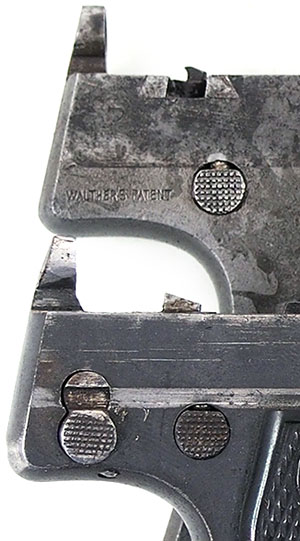
Guns in an uncertain range somewhere between 4000 and 6200 are marked on the right side of the frame, just behind the safety button in all-capital sans-serif characters:
WALTHER’S PATENT
Around serial number 7000 we find guns with 12 rather coarse triangular-cut slide serrations. Later still we find 13 coarse serrations.
Late Lockwork
From about serial number 10000 we find guns with a simplified lockwork. Please write if you have a Model 1 near this serial number and can verify what kind of lockwork it has.* The
separate disconnector is eliminated. Instead, the transfer bar connects directly to the sear lever, which is reshaped slightly. A bulge at the top of the transfer bar extends above the top of the
frame and serves as a disconnector. When the slide is out of battery it forces the transfer bar down and out of engagement with the sear lever. The plate holding the sear in place is eliminated
and the piston-shaped sear itself is redesigned so that the piston portion sits flush with the top of the frame and is held in place only by the L-shaped sear lever.
The one button variation was made through at least serial number 14506. Dieter Marschall states that the Second Variation begain around serial number 15500. Please contact me if you have a gun
in this range that would give us more precise information on when the First Variation ended.*
Second Variation (Two Button)
The early two-button guns display very few differences
1st & 2nd Variation Buttons
from the First Variation other than the addition of the button on the right side that enables removal of the slide. The button has a semi-circular tab
or lug which fits into a slot milled into the lower right side of the slide. Hence the Second Variation has the slot in the left front of the slide plus a slot in the right
rear. Disassembly is the same, except you have to press the button as you lift the slide.
Some grip plates have an oval at the top with “CALIBER 6,35” instead of the CW monogram. In my experience, these are much more scarce than the
monogram grip plates, and may have been intended for use by retailers marketing the gun under their own brand name. So far as I know, this was a practice only
allowed by Walther for their two earliest pistols, the Model 1 and the Model 3.
The slide inscription remains the same as the late First Variation guns, typically showing:
Somewhere between serial numbers 18150 and 19000 (please write if you can help clarify this change*) we begin to see guns that display the following one-line
slide inscription above the Walther banner:
SELBSTLADE-PISTOLE CAL.6,35 WALTHER’S-PATENT.
The banner is curved slightly, but not as much as the modern Walther banner, so it is known as the “flat” banner, even though it is not perfectly flat.
Sometime after serial number 23736 we begin to find a different inscription with no banner, as follows:
SELBSTLADE-PISTOLE CAL.635 PATENT
Gangarosa maintains that guns with the above inscription, with no banner, were sold only in Austria, and most guns I have documented with this inscription do bear Austrian proofs, however I
have observed guns with the late Walther banner that also bear Austrian proofs.
Then, in the 26000 range we begin to find a modern fully curved Walther banner with a one-line inscription above it in sans-serif characters:
SELBSTLADE-PISTOLE CAL.635.WALTHER’S-PATENT.
Early and Late Walther Banners
According to Manfred Kersten, “The Walther banner...was applied for on 8 October 1912 and registered as a protected trademark on 12 November 1912.” This indicates that the banner would
not have been seen on the Model 1, even in its early form, until very late in 1912.
Few Model 1 pistols were exported outside of Europe. I have observed only very late pistols in the 28000 to 29000 range that sometimes bear an export stamp on the right side of the slide:
MADE IN GERMANY
Marschall states that the Model 1 Second Variant serial numbers run from approximately 15500 to 31000. Please write to me if you can help make these figures more precise.*
Vulcan
Vulkan Tenson Photograph by Stefan Klein.
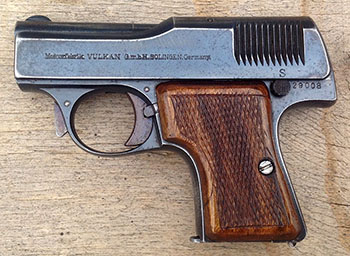
A few Model 1 guns are known to exist with a totally different slide inscription. The left side inscription is in upper and lower case serif characters as follows:
Messerfabrik VULKAN G.m.b.H. SOLINGEN. Germany
The right side reads:
TENSON registdtrade mark
Messerfabirk Vulkan G.m.b.H (The Vulkan Knife Factory) is listed in Die Werkzeugmaschine, Volume 8 (April 1904) as having previously been
named Vereinigte Messerfabriken G.m.b.H (United Knife Factory). Very little is known about these pistols. The numbers on these guns appear to be in the standard Walther series, but the only
ones I have observed are very high serial numbers. Walther Model 3 pistols are also found with identical markings.
Field Stripping
Walther Model Field Stripped
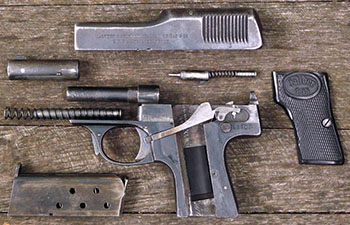
Remove the magazine and clear the chamber.
With the safety off, depress the catch on the front of the trigger guard and draw the slide all the way to the rear until it locks open.
Unscrew the barrel sleeve and remove it from the gun.
On early models, pull back on the slide to disengage the slide lock, and allow the slide to ease forward while lifting up on its rear. On later models, pull back on the slide to
disengage the slide lock, and allow the slide to ease forward while depressing the right-side take-down button and lifting up on the rear of the slide.
When the slide lifts up above the “doll’s head,” ease it off the front of the gun.
Note: On guns with the later lockwork, once the slide is removed the lever which operates the
sear can easily come off its pivot which will allow the sear and sear spring to launch from the rear of the frame. Take care not to lose these small parts.
* Please write to me if you can offer additional information on the Walther Model 1. Photographs are greatly appreciated.
Stewart, James B. “Sorting Out Walther’s 25s.” Guns Illustrated, 1973.
Special thanks to Dr. Stefan Klein for photographs, advertisements, and information about the Model 1.
Copyright 2010-2023 by Ed Buffaloe. All rights reserved. Click on most small photos to open a larger version in a new window & browse for additional photographs.