The Bergmann Pistols
by Ed Buffaloe
Historical Perspective
Theodor Bergmann (1850-1931) was from a family of brewmeisters and innkeepers in Spessartdorf, Germany. Early on he worked for a local stove manufactory, which awakened his interest in the metal working business. Michael Flürscheim (1844-1912) purchased the Eisenwerke Gaggenau (Gaggenau Ironworks), which was already several centuries old, in 1873; and in 1879 Theodor Bergmann, at the age of 29, became a managing partner in the firm. In the last quarter of the 19th century Eisenwerke Gaggenau manufactured structural steel, bridges, railings, lamp posts, railroad switches, signalling equipment, gas regulators, crushing mills, paint mills, enamel signs, household hardware, stoves, wrought iron fences, bicycles, rifles, and airguns. The company still exists today, making kitchen applicances, and calls itself simply Gaggenau.
Flürscheim received a German patent for an air pistol in 1878, two patents for improvements to the design in 1879, and was granted further air gun patents in the 1880’s. The Flürscheim air pistol was a close copy of the Haviland and Gunn design which had been patented in the U.S. in 1872. In 1884 Bergmann licensed rights to an airgun patent of Henry Quackenbush. By 1891 Eisenwerke Gaggenau was manufacturing hunting rifles, military rifles, gun barrels, and reloading tools, as well as air pistols, air rifles, pellets, and darts. Bergmann later manufactured a small number of airguns under his own name.
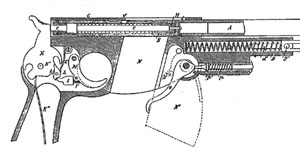
1892 Brauswetter Patent Drawing
According to Walter, “Bergmann left Eisenwerke Gaggenau in the early 1890’s to exploit Schmeisser’s automatic pistol patents.” The founding of Bergmann’s new company, Bergmanns Industriewerke, is variously dated between 1893 and 1895. Apparently, Bergmanns Industriewerke made many of the same items as Eisenwerke Gaggenau, including enamel signs, toilets, stoves, bicycles, guns, ammunition, and later automobiles. Bergmann received many patents over the years for items other than weapons.
Theodor Bergmann himself is often described in the literature as an inventor, though Ian Hogg in his later writings indicates that he was more a businessman and entrepreneur who exploited the inventions of others, citing in particular Louis Schmeisser, who worked for Bergmann for a number of years. Ezell also states that Bergmann was “...primarily an industrialist and entrepreneur....” Bergmann continued to take out patents on various machines and weapons right up to the time of his death, long after he had sold his automobile and weapons businesses.
Early Bergmann Automatic Pistols
Model of 1892. According to James B. Stewart, this was Brauswetter’s design, at least one prototype of which was tested by the Swiss against their 1882 revolver. The gun is described by Stewart as a long-recoil locked-breech design. It was chambered for the 7.5mm M1882 Swiss revolver cartridge. Brauswetter’s patent, however, clearly describes an unlocked breech design, “whose breech is opened by the recoil during firing and closed again by a spring compressed during firing.” Interestingly, Hogg and Ezell both state that a locked breech design was never manufactured and the gun tested by the Swiss was a delayed-blowback action which featured an inclined plane in the frame to delay recoil of the bolt. This comports with the patent, which simply describes a “stop” intended to “limit the backward movement of the bolt cylinder, or to better absorb its recoil.” The gun featured a clip-loaded magazine forward of the trigger with a pivoting side cover and a simple revolver-style single action lockwork mechanism, as shown in Brauswetter’s patent. According to Hogg, there are no known examples of the M1892 extant.
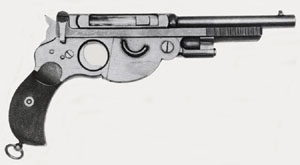
M1894 Bergmann-Schmeisser (No.1)
Model of 1896--the Bergmann
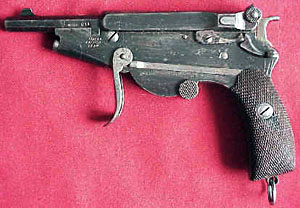
M1896 Bergmann No.2 with Folding Trigger
Barrels on the M1896 were easily removeable for cleaning.
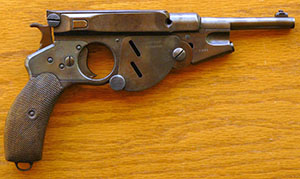
M1896 Bergmann No.3
R.K. Wilson reports that the early Bergmann pistols were available with a lot of special options, including heavy barrels, target sights, hair triggers, and fancy grips.
According to Boothroyd, DWM code No. 416 was the original 5mm rimless grooveless cartridge for the M1894 No.1 pistol, and was also used in the early M1896 No.2 pistol. When the cartridge was eventually given an extractor groove, it became DWM No. 416A. The early No.3 pistol fired the 6.5mm rimless grooveless DWM No.413. The updated cartridge with an extractor groove was DWM No.413A.
According to Stewart, the No.4 pistol was a variant of the No.3, chambered for a much more powerful straight sided 8mm rimless cartridge with an extractor groove, which of course was called the No.4 cartridge (DWM No.451). The No.4 pistol was made in limited quantities around 1897, and serial numbers fall in the range between 2300 and 3000.
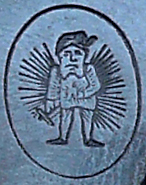
The later M1896 guns were manufactured by the Valentin Christoph Schilling Company of Suhl (often rendered V. Charles Schilling), because about this time Bergmanns Industriewerke had begun the manufacture of automobiles at their Gaggenau facility and presumably had insufficient space and/or manpower for the gun business. “Bergmann” means “mountain man” and by extension “miner.” The logo Bergmann used on his pistols was a miner. Pistols made by Schilling have “Gaggenau” added at the top of the logo and the letters “V.C.S.” and the word “Suhl” added at the bottom.
Field Stripping the Model 1896 Bergmann
- Make sure the chamber is empty.
- Remove the screw at the rear of the bolt on the right side.
- Cock the hammer and tip the gun backward--the firing pin should fall out.
- Remove the rectangular pin through the bolt (to either side) and catch the recoil spring as it exits the rear of the bolt.
- Remove the bolt.
- Remove the bolt cover by lifting at the rear.
Model of 1897, also known as the No.5, or the M1897 Military.
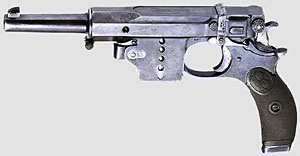
Bergmann Model 1897
Model of 1899 or No.6 Pistol. After failing to get a military contract for the M1897, Bergmann went through a period of experimentation, during which a number of pistols were made for testing, but only the M1897 continued to be produced commercially. The No.6 locked breech pistol may have been a hybrid of the No.4 and No.5 pistols, and was chambered originally for an 8mm rimless cartridge with an extractor groove, first known as the No.4S and later as the No.7 (DWM No.460). Two No.6 pistols were tested in Switzerland in 1900. The gun was redesigned in 1901 with some similarities to the M1897, and prototypes were made to shoot the 7.5mm No.7A cartridge (DWM No.460A) and the 7.65mm No.8 cartridge (DWM No.KK475).
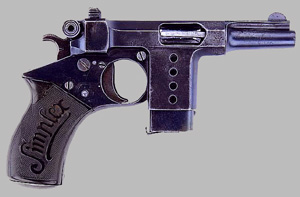
Bergmann Simplex
The Bergmann Mars of 1903
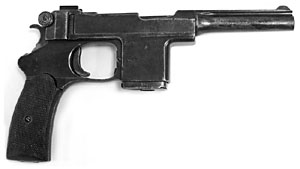
Bergmann Mars
Prototype Mars pistols were chambered for the 7.8mm No.5 cartridge (DWM No. 461), the 9mm No.6 cartridge (DWM No. 456), a new 10mm cartridge (never produced commercially), and a new 11.35mm cartridge (DWM No. 490). The British Chief Inspector of Small Arms tested the 9mm pistol, two versions of the 10mm pistol, and ultimately the 11.35mm pistol, but none was accepted for British use. Finally, however,on 5 September 1905 the Spanish government placed an order for 3000 of the 9mm Mars pistols for evaluation. Accorcing to Antaris, the Bergmann was never formally adopted by the Spanish military. However, Ezell states that the gun was recommended for adoption by the Spanish ordnance testing commission and that a royal decree of 5 September 1905 declared it to be the Pistola Bergmann 9 m/m Modelo 1903. Juan Calvo provides nearly identical information.
Bergmann managed to get his 11.35mm Mars to the U.S. Ordnance Department for testing in 1906, but the ammunition for it was impounded by U.S. Customs, so it was not tested. In 1907 he sent a Mars pistol specially chambered for the .45 ACP. Almost all the manufacturers involved in the tests had complained about the Frankford Arsenal .45 ammunition issued to them, which had widely varying tolerances. Bergmann had had some .45 ACP ammunition made in Germany, to the correct specifications, but once again U.S. Customs impounded it. Frankford Arsenal was instructed to provide some .45 ammunition meeting the tolerances specified by Bergmann for use in his gun, but when tested the force of the hammer blow from the Bergmann pistol was insufficient to ignite the primers, so the Bergmann was eliminated.
Bergmann’s in-house manufacturing facility for guns had always been small, and commercial manufacturing for his pistols had been routinely outsourced to the V.C. Schilling company of Suhl since 1896. But in 1904 Schilling was bought out by the Heinrich Krieghoff company, which had other plans for the Schilling factory. After completing work on outstanding contracts in early 1905 , Schilling’s cancelled its manufacturing agreement with Bergmanns Industriewerke. Bergmanns Industriewerke set up a small factory in Gaggenau which manufactured less than 1000 Mars pistols, but only delivered a small number to the Spanish between 1903 and 1908 for testing purposes.
The relatively small 3000 gun contract with the Spanish didn’t justify the tooling up necessary to manufacture them in quantity, and Bergmann failed to find another large customer for the Mars, so he sold his Spanish contract to Anciens Établissements Pieper (AEP) of Herstal, Belgium. AEP had been desperately seeking new business since they had lost their Belgian army contracts to Fabrique Nationale. Due to the expense of tooling up, AEP insisted that they should also have the right to manufacture and sell a commercial version of the Mars. At this point Bergmanns Industriewerke agreed to give up making military pistols altogether and turned its attention to machine guns.
The Bergmann Bayard of 1908
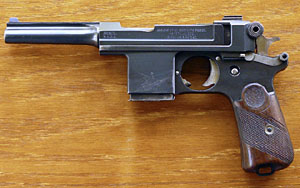
M1908 Bergmann Bayard
AEP fulfilled the Spanish contract before the end of 1909. The Spanish guns were stamped with the early Spanish acceptance proof mark (a circle divided into thirds) on the left side frame bridge and the top of the breech. Also on the left side frame bridge was a four-digit Spanish issue number . The M1908 was used by the Spanish army until it was replaced by the Campo Giro in 1916, and continued in use by the Spanish police through 1939.
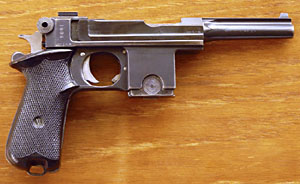
Danish M1910 Bergmann Bayard
AEP made holster stocks for some of their M1910 commercial production pistols. The guns had a slot cut in the rear grip strap to accept the stocks, which also attached to the lanyard on the bottom of the grip. Commercial guns were produced in the 12,000 and 13,000 serial number range which were of the M1908 design and featured the Bayard horse and rider trademark on the left side of the magazine well. AEP referred to these guns as the Model 1912.
Spanish contract and commercial production pistols were marked
ANCIENS ETABLISSEMENTS PIEPER.
HERSTAL-LIEGE.
BERGMANN’S PATENT
in sans-serif characters on the left side of the barrel extension behind the ejection port. The serial number is on the bottom of the frame just below the chamber of the barrel.
The German army overran Belgium in August of 1914 and took over all the arms manufactories in Liege and Herstal. Under German occupation, AEP was forced to continue manufacturing Bergman Bayard pistols, which by that time were in the 15,000 and 16,000 serial number ranges. These guns either had no proof marks, or featured a single small proof of a diamond with an apple in the center. Manufacture ceased after the war, but pistols in the 17,000 serial number range were assembled by AEP from existing parts.
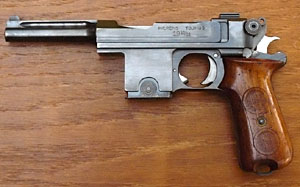
Danish M1910/21 Bergmann
R.K. Wilson sums up his opinion of the Bergmann Bayard by saying: “ The Bergmann-Bayard is a clumsy, unhandy weapon. The grip is too narrow for the average hand and the pistol, when the magazine is loaded, is very muzzle heavy.” The larger grips installed by the Danes improved the feel of the gun in the hand considerably. Dennis Adler, in his article in Guns & Ammo, reports that his test gun was reasonably accurate at ten yards.
Field Stripping the Bergmann Bayard
- Remove the magazine.
- Draw the bolt back to cock the hammer and make sure there is not a round in the chamber.
- Using a cleaning rod or drift punch, depress the firing pin and remove the retention pin from the right side of the gnurled retraction knob on the bolt.
- Withdraw the firing pin and firing return pin spring.
- Holding a finger over the hole in the bolt (to prevent the mainspring from flying out), press the rear sight forward and pull it up.
- Withdraw the mainspring from the bolt.
- Withdraw the bolt from the back of the barrel extension.
- Push the barrel/barrel extension forward and lift up at the front to free it from the frame.
- Note the orientation of the cubic locking block in the barrel extension--it must be oriented correctly. The later Danish-made guns have alignment marks on the block and the barrel extension.
Note: When reassembling, the broad end of the firing pin can be used (flat side up) to push the recoil spring in far enough to insert the rear sight in front of it. The locking block will only go in one way, so its orientation should be carefully noted.
Note: The author welcomes corrections and additional information from informed readers,
as well as additional photographs of any Bergmann pistol.
References
- Antaris, Leonardo M., Astra Automatic Pistols, by Leonardo M. Antaris. FIRAC, Sterling, CO: 1988.
- Beeman, Dr. R., Allen, J. & Fjestad, S. P., Blue Book of Airguns, Blue Book Publications, Minneapolis, MN: 2008.
- Boothroyd, Geoffrey. The Handgun, Bonanza, New York: 1970.
- Ezell, Edward C., Handguns of the World, Barnes & Noble, New York: 1981.
- Hackles, F.W. & Scranton, E.L., “Cal. .45 Revolver and Automatic Pistol Ammunition for the 1906-1907 Trials,” Woodin Laboratory. International Ammunition Association Journal, #395, May-June, 1997.
- Hogg, Ian V., German Handguns, Greenhill, London: 2001.
- Hogg, Ian V., German Pistols and Revolvers, Galahad Books, New York: 1971.
- Scarlatta, Paul. “The Military Pistols of Scandinavia,” Gun Digest, 2018.
- Stewart, James B., “Bergmann System Military Pistols,” Gun Digest, 1973.
- Walter, John, Dictionary of Guns and Gunmakers, Greenhill, London: 2001.
Horst Held Bergmann Collection
Pistols and Revolvers in the Spanish Armed Forces, 1855-1955, by Juan L. Calvo.
Copyright 2009-2025 by Ed Buffaloe. All rights reserved.
Click most photographs to open a larger version in a new window.