Introduction
The Thompson-LaGarde Report consists of 43 pages of typed, double-spaced text on standard 8-1/2 X 11 inch paper, accompanied by photographs and “skiagrams,” which we refer to today as x-rays. To the best of my knowledge the report has heretofore only been available in facsimile form in John Potocki’s book on the 1905 Colt. I do not have access to the photographs and x-rays that accompanied the report. While trying to keep the transcription as close as possible to the original, I have eliminated paragraph indentations, corrected a few typos, and transcribed Section 3 into an HTML chart. Peculiarities of punctuation and capitalization have not been altered.
I suspect that this is merely a copy of the preliminary report, which was rewritten when all the notes, photographs, and x-rays were gathered together in one place.
It occurs to me that I may be criticized for encouraging a morbid fascination with death and destruction in publishing this report, but I can assure the reader that my intent is simply to provide access to a historical document that is not readily available and that provides information that is very difficult to obtain today. I find it disturbing to read the portions involving the killing of live animals, and hope that other readers would as well. Such tests on horses are illegal today. I have heard rumors of similar tests on cadavers being carried out clandestinely by a government organization in recent years, but they are third-hand and unsubstantiated.
A contemporary book, entitled Handgun Stopping Power: The Definitive Study, by Evan P. Marshall and Edwin J. Sanow (Paladin Press, Boulder Colorado: 1992) says of the Thompson-LaGarde Report: “It was based on the assumption that the momentum of hanging bodies of various weights could somehow be correlated and measured, and that it actually meant something with regard to stopping power. What it actually did was extrapolate questionable data from questionable tests.”
The following report is graphic, involving tests of bullets on cadavers and live animals,
and is not recommended for reading by the squeamish.
The Thompson-LaGarde Report
Chicago, Illinois, March 18, 1904
1. Board met at Springfield Armory, Massachusetts, October 16, 1903, Present, both members. Letter of instruction from the Chief of Ordnance, dated Washington, October 8, 1903, herunto appended and marked “A” was then read and considered. The Board then prepared a program of the experiments and tests which it desired to make and of the visits considered necessary in the performance of its duty, see letter to the Chief of Ordnance, U.S. Army, dated Springfield Armory, october 17, 1903. This program was approved, see first endorsement dated office of the chief of Ordnance, Washington, D.C., October 20, 1903.
The Board, both members present, or Major LaGarde only, met at various times at the Philadelphia Polyclinic Hospital, 1818 Lombard St., Philadelphia, Pennsylvania, and at the New York University Medical Deparrment, corner 26th Street and First Avenue, New York City, New York, and made experiments upon cadavers. Upon completion of these tests, the Board proceeded to Chicago, Illinois, and made tests upon living animals.
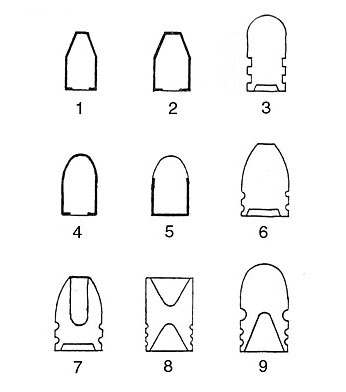
Bullets Tested
| Round | Type | Weight | Speed | Energy |
| of bullet | grains | ft./sec. | foot lbs. | |
| 1) .30 Luger | jacketed | 92.5 | 1420 | 415 |
| 2) 9 mm Luger | jacketed | 123.5 | 1048 | 301 |
| 3) .38 Long Colt | lead | 148 | 723 | 191 |
| 4) .38 ACP | jacketed | 130 | 1107 | 354 |
| 5) .38 ACP | soft point | 120 | 1048 | 293 |
| 6) .45 Colt | lead | 250 | 720 | 288 |
| 7) .45 Colt | hollow point | 220 | 700 | 239 |
| 8) .455 Webley | cupped | 218.5 | 801 | 288 |
| 9) .476 Eley | lead | 288 | 729 | 340 |
The Board sought to define for its guidance what constitutes shock effect or stopping power from projectiles. In the cadever this effect was considered coincident with the disturbance observed when a suspended limb was hit. The amount of shock effect here was usually estimated by the degree of motion given to the limb by the force of impact. A study of the condition of the tissues in all instances demonstrated that the amount of shock effects measured by this standard was always proportional (1) to the degree of resistance on impact, and (2) to the amount of destruction of tissue. The greatest amount of resistance was, as a rule, observed in those shots directed against the hard bones, like the long bones of the limbs, and the harder the bone the greater was the amount of destruction wrought.
In attempting to define shock effects or stopping power in living animals, the Board’s attention was directed to the immediate effects of projectiles when striking:
- Vital parts.
- Non-vital parts.
- The anatomy concerned in locomotion.
As a rule, to which there were no exceptions, when an animal was hit in a vital part by any of the projectiles tested, the shock effects were immediate or nearly so in all cases. When the animal was purposely shot in non-vital parts, like the internal organs, -- the lung, liver, stomach, intestines, exclusive of large vessels, the Board found the shock effects to vary with the sectional density, form and caliber of the projectile.
Relating to the stopping power upon animals when hit in that part of the anatomy concerned in locomation, the board was guided by the behavior of the bullets when colliding against the bony tissues of the body, as shown in the accompanying skiagrams from the cadaver and the horse. In those instances where the bullet causes fracture of the long resistant bones, the efficacy as to stopping power was considered as positive. When a bullet traversed the joint end of a bone, making a clean cut performation with no tendency to displacement of fragments, the efficacy as to stopping power was thought to be doubtful.
References
The Colt Model 1905 Automatic Pistol, by John Potocki. Andrew
Mobray, Lincoln, RI: 1998.
“The Holes in Stopping Power Theory,” by Leon Day. Gun Digest, 1983.
U.S. Military Automatic Pistols, 1894-1920, by Edward Scott
Meadows. Richard Ellis, Moline, IL: 1993.