The Sauer & Sohn (S&S) Model 1938 Pistol
by Ed Buffaloe
Note: The author is not an expert on these pistols. The vast majority of information in this article is taken from the book Sauer & Sohn, A Historical Study of Sauer Automatic Pistols, by Jim Cate and Nico Van Gijn, with some information taken from J. P. Sauer & Sohn, Volume II: Dein Waffenkamerad, by Jim Cate and Martin Krause. Please refer to these books for more detailed information than is available here. If you have questions, please address them to the appropriate community on the Jan. C. Still LugerForums, where Jim Cate is a moderator and many important collectors, including Martin Krause, visit regularly. Those guys are the real experts.
The Sauer & Sohn Model 1938 pistol was made from 1938 until 1945, with just over a quarter of a million produced in eight years.
The 1934 evaluation of the first S&S Model 36 pistol, the precursor of the Model 38, by Director Orth of the Prussian Proof House concluded: "In our opinion, this design represents a significant advance in the handling, readiness, and safety of automatic pistols." The April 1935 evaluation of the Model 36 pistol by the German Testing Institute for Small Arms is also pertinent: “We can definitely call this new design a step forward in the construction of self-loading pistols and only regret that such a weapon is not mass-produced.” In 1946 Walter H. B. Smith declared the Model 1938 “one of the most advanced forms of pocket automatic pistols.” In 1986 Jan C. Still called it “the most advanced pistol of its time.”
Historical Background
Revolvers regularly featured double-action mechanisms beginning in the 1870s. The first self-loading “automatic” pistol to have a double-action mechanism was the 1894 Mannlicher, but the first commercially successful one was the Little Tom, patented by Alois Tomiška in 1905. Production of the Little Tom began in 1914, though it was interrupted by World War I; hence the design did not become widely known until after the war.
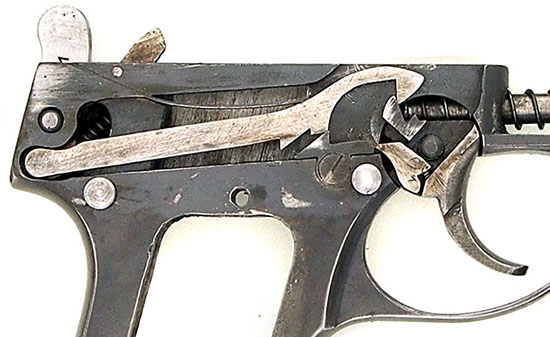
Little Tom Pistol - Transfer Bar and Trigger Mechanism
In revolvers, the trigger sits immediately in front of the hammer and the two are directly connected. However, in self-loading pistols, the hammer necessarily sits at the rear of the breech block, while the trigger is typically beneath the chamber of the barrel, and so some sort of connecting mechanism is required between the two. This connecting mechanism is usually referred to as the trigger bar, transfer bar, or connector. In single-action auto pistol mechanisms, the transfer bar either pushes or pulls on the sear to release the hammer. In a double-action auto pistol mechanism, the transfer bar is connected, either to the hammer itself (as on the Little Tom pistol) or to the trigger, while the other end must have some sort of hook or protrusion that connects with the opposite member. In either case, the transfer bar is pulled forward, and the hammer is drawn backward and then released at the end of the pull.
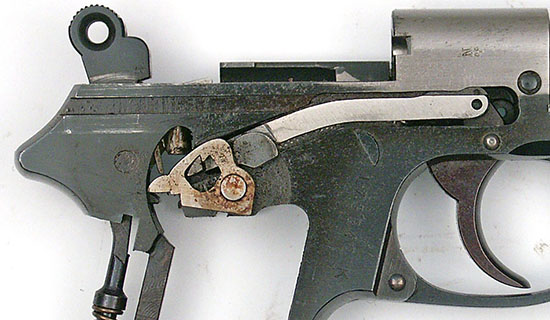
Walther PPK - Transfer Bar and Trigger Mechanism
In the mechanism of the Walther Polizei Pistole (PP), which appeared in 1929, the connector bar is attached to the trigger, which pulls it forward, while a hook on the end of the bar pulls the cocking piece, levering the hammer backward before releasing it. The PP hammer has a double-action sear nearly identical to that on most revolvers, but because the transfer bar runs on the right side only, it cannot pull evenly on the cocking piece, and so the gun has a long, creepy double-action trigger pull. When the first round is fired and the slide recoils, cocking the hammer, the hammer toe catches on the single-action notch of the cocking piece, thereafter providing a relatively crisp single-action trigger pull. The manual safety lever of the PP rotates down to cover the firing pin and at the same time releases the hammer, so the pistol can be safely carried with a cartridge in the chamber, but the first round fired is always double-action-only unless the hammer is manually cocked. The PP was a major innovation in its day. Other companies rushed to compete, but Walther already had the market sewn up.
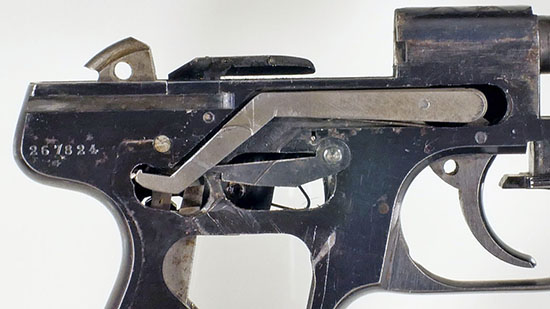
Sauer Model 1938 - Transfer Bar and Trigger Mechanism
Sauer & Sohn (S&S) was the oldest gun-making firm in Germany and, after World War I, the second-largest employer in the Waffenstadt Suhl after Simson Werke. Sauer & Sohn’s primary business had long been making high-quality shotguns, but in the late nineteenth century the company contracted to make the Reichs revolver in conjunction with C. G. Haenel and V. C. Schilling and, in 1909, they made the Bär-Pistol under license from Burkhard Behr. S&S also manufactured the Roth-Sauer self-loading pistol under license from Georg Roth (who patented the design with Karel Krnka in 1900), and purchased the patent from Roth in 1910. In 1913 they began making their own line of self-loading pistols.
The Sauer & Sohn Model 1938 Patents
| Number | Filing Date | Approval | Title |
| 612895 | 18 Nov 1932 | 11 Apr 1935 | Self-loading pistol with external cocking lever |
| 604176 | 30 Jun 1933 | 27 Sep 1934 | Magazine safety for self-loading pistols with cocking trigger |
| 613598 | 27 Oct 1933 | 2 May 1935 | Self-loading pistol with external cocking lever |
| 646106 | 31 Jul 1935 | 20 May 1937 | Self-loading pistol |
| 723900 | 17 Sep 1937 | 2 Jul 1942 | Magazine safety for self-loading pistol |
| 764260 | 26 Mar 1942 | 11 Jan 1945 | Hammer safety for pistols w/ internal hammer & cocking trigger |
Most of Fritz Zehner’s patents were filed in the S&S company name, rather than his own, despite his being the company’s chief design engineer for more than three decades. This was normal procedure in the nineteenth and early twentieth centuries; employee’s inventions belonged to their employer, who paid their wages and provided tools and equipment.
German patent № 612895, filed 18 November 1932, describes a cocking lever that cocks the internal hammer; in order to decock the hammer, the trigger is pulled to the rear slightly, and the lever is again depressed.
German patent № 604176, filed 30 June 1933, describes a magazine safety for a hammer-fired double-action pistol, consisting of a lever which moves into the magazine well and locks the trigger when the magazine is withdrawn. This design was superseded by patent № 723900.
German patent № 613598, filed 27 October 1933, describes a cocking/decocking lever that can be depressed to cock the internal hammer and depressed again to decock it. This patent was filed as an addendum to № 612895, and the two were approved less than a month apart.
German patent № 646106, filed 31 July 1935, describes a disconnect lever in the sear that positively prevents the gun from being fired by locking the transfer bar when the external lever is used to either cock or decock the pistol.
German patent № 723900, filed 17 September 1937, describes a magazine safety for a self -loading pistol that locks the transfer bar as soon as the magazine is lowered by only about one millimeter, positively preventing the gun from being fired in either single- or double-action mode.
German patent № 764260, filed 26 March 1942, describes an external hammer safety that prevents the uncocked hammer from being cocked or, if the hammer is already cocked, positively blocks it from falling. This safety was implemented in 1939 and, according to Cate & Van Gijn, it is shown in blueprints dated as early as April 1938. It is unknown why the patent was not filed until 1942.
The S&S “New Model” and the Walther PP
Rolf Kallmeyer relates that in 1932 Sauer & Sohn (S&S) was still trying to sell its Behördenmodell:
Towards the end of 1932, the Sauer & Sohn company offered its Behördenmodell to the Reich Minister of Finance in Berlin for use in equipping departments under his control. The price was calculated to the extreme... The response from Berlin was devastating: "that the advantages of the Walther Police Pistol 7.65, Model PP, over the improved Sauer & Sohn pistol were still so significant that they could not consider the Sauer company when awarding contracts."
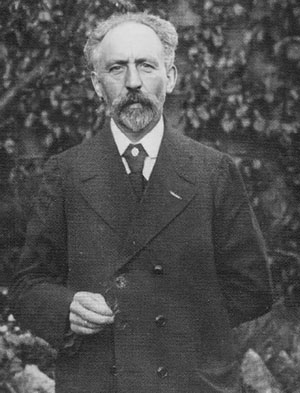
Fritz Zehner (1866-1946)
Zehner’s conundrum was to create a mechanism equal to or better than Fritz Walther’s PP/PPK design while not infringing any of his patents. Zehner’s patent for the loaded chamber indicator of the Behördenmodell pistol was filed on 1 July 1931, and it is likely that soon afterward he turned his attention to designing a double-action self-loading pistol that could compete with the Walther PP.
The new pistol evolved over about eight years. The design that emerged from Zehner’s workshop retained the distinctive ergonomic grip shape of the Models 1929, 1930, and Behördenmodell, was similar in size (only about a half inch longer), and had a magazine holding seven cartridges. Gone was the old tubular-profile slide S&S had utilized since 1913, replaced by a design with flat sides. The new gun was hammer-fired, whereas the earlier guns had all featured a spring-loaded striker. The hammer was internal, so there were no protrusions to catch on clothing. The earliest versions of the gun had differing methods for slide retention and removal. Eventually, the company settled on a slide block in the upper portion of the trigger guard which, when pulled down, blocked the trigger and allowed the slide to move far enough back to be lifted up for removal.
Because of the internal hammer the pistol was provided with both an external cocking and decocking lever and a loaded chamber indicator. The new gun could be safely carried uncocked with a round in the chamber. When the internal hammer was cocked the trigger moved to the rear to clearly indicate the condition of the gun, and the hammer could be lowered with the thumb on the cocking lever. There was no manual safety because the long double-action trigger seemed impossible to fire accidentally and the hammer could be easily decocked. The gun had a thumb operated button magazine release just behind the trigger guard, with two square guide posts that extended out the right side of the frame when the release was depressed. Front and rear grip straps were rounded, as was the bottom of the magazine.
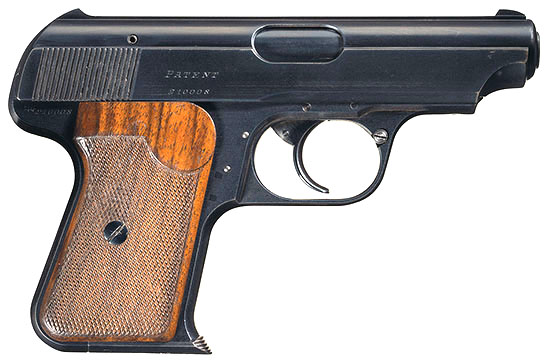
Sauer ”New Model” (Model 36) - SN 210008
w/ Pinned Magazine Release Button - Photograph courtesy Bill Chase
In 1928, a new restrictive gun law had gone into effect in Germany, requiring a permit to purchase a gun, a permit to carry a gun, and permits to manufacture or sell guns. This new law, plus the dire economic situation of the era, had the effect of reducing civilian gun sales. But it was Fritz Walther’s good fortune that in 1928 he had created the prototype for his new double-action pistol, intended for police and military use, known as the Polizei Pistole or PP. The PP was released in 1929, and was an immediate success. The smaller PPK was released in 1931.
Fritz Walther joined the Nazi party on 1 November 1931. His brother Carl Lothar also joined in 1931, but the date is not known. A third brother, Georg Carl Walther joined on 1 May 1933. The fourth brother, Erich Hans, joined in 1937. Fritz, Georg, and Carl Lothar were all enthusiastic shooters who competed regularly. In fact, Carl Lothar was a world-class pistol marksman who won many prizes in the mid to late 1930s. The Nazi party, and especially the S.A. (Sturmabteilung) or Brownshirts, encouraged shooting and shooting competitions, and the Walthers used their Nazi connections to make sure their very well made and accurate pistols were used regularly, and in fact almost exclusively, in these competitions. It becomes clear, from documentation in Cate & Krause’s book, J. P. Sauer & Sohn, Volume II, that by 1934 the Walther company had consolidated its hold on pistol sales in Germany, created a near monopoly, and was squeezing other companies out of the market in the difficult economic times. Fritz Walther helped usher Simson Werke out of business, and later August Menz as well. But Rolf Sauer was determined not to be squeezed out.
In February of 1934, Rolf Sauer offered to sell the N.S.D.A.P. (Nazi Party) the S&S Model 1930 or the Behördenmodell at discounted prices, and in March he announced his “new model” pistol which he hoped to show and demonstrate. He soon offered to provide the N.S.D.A.P. with Model 30 or Behördenmodell pistols, and exchange them for the “new model” when it was ready. (Cate & Krause note that at this early date the gun had no model designation and was still referred to as “the new model with double-action trigger and internal hammer.”) But the S&S pistol was rejected by the N.S.D.A.P. because the Walther PP had already become standardized, and likely also because of the Walther family’s Nazi connections.
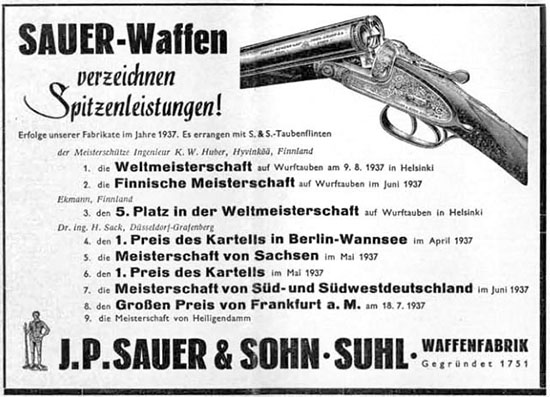
Period Advertisement from Waffenschmied Emphasizes the Company’s Shotguns
Early in March of 1934, Fritz Walther queried Rolf Sauer at S&S as to whether he might be interested in a contract to manufacture PPK slides. Walther did not have the production capacity necessary to fulfill its contracts and was therefore seeking to outsource work to other companies. According to Cate & Krause, Walther was working three shifts per day, whereas the S&S pistol division did not have enough work to keep one shift going full time, but Rolf Sauer declined the contract. His company, whose primary business was shotguns, was in good financial shape and his designer, Fritz Zehner, was nearing completion of the company’s new model pistol. Rolf Sauer did not want to become contractually obligated to Walther, which would tie up production capacity that he expected to need later. Zehner’s first prototype pistol, serial number 210001, was submitted to the Suhl proofhouse on 18 May 1934.
Rolf Sauer continued for two more years to try to get the new model Sauer pistol accepted by the Army or the SS or the Nazi Party or the Gestapo, but Walther’s PP or PPK had already been approved and accepted by all of them. Walther’s connections with the Nazis were rock solid. A few individuals at the proofhouse saw the potential of the Sauer pistol, and the German Testing Institute for Small Arms provided a very positive evaluation of it in April of 1935.
But Rolf Sauer and Fritz Zehner had an ace up their sleeves. Erich Krempel, the “Free Pistol” silver medalist at the 1936 Summer Olympics, was also an S&S employee who was closely involved in development of the new model S&S pistol. At the 1936 shooting competition held by the Sturmabteilung (S.A.), where everyone else was shooting the Walther pistol, Erich gave a shooting demonstration with an S&S Model 36 prototype while Fritz Walther looked on. Attendees were impressed by the extreme accuracy of the Sauer pistol in the hands of a master shooter, and this may have been the opening needed by S&S.
On 1 May 1937, Rolf Sauer joined the Nazi party. On 2 August the S.A. were sent two S&S pistols for testing, serial numbers 210014 in 7.65mm and 210016 in .22. Afterward, the Chief of Staff of the S.A. requested an expert opinion from the Army Ordnance Office, and on 16 August 1937 serial number 210007 was forwarded to the testing center in Kummersdorf, where the pistol was given a very positive evaluation. On 1 September 1937 the new model S&S pistol was chosen as the Sturmabteilung’s official sidearm; this was significant because the S.A. were expected to order about 50,000 pistols. The gun was referred to as the Model 38, even though the example tested was a Model 36, but Fritz and Hans Zehner were already working on the new larger version, which was expected to enter production in April of 1938, though this date proved optimistic. Conversion of equipment used for production of the Model 30 and the Behördenmodell would take time, and the necessary quantities of steel were not readily available.
Evolution of the Nomenclature for the Model 1938
An immediate question to be dealt with when writing about the Model 1938 S&S pistol is why it is sometimes referred to as the “Model 38,” sometimes as the “Model H,” and sometimes as the “Model 38H.” Jim Cate clearly states that: “...Sauer or the German military never referred to any Sauer variation as a Modell 38-H.” The earliest company brochure refers to the gun as the “Modell 38,” as do the earliest known advertisements; later production boxes are labeled “Modell H.”
J. Howard Matthews and Donald M. Simmons aver that the H stands for “Hahn” or “hammer,” and in one sense it does, since the gun is the first of Fritz Zehner’s designs to feature a hammer, albeit an internal one. However, this is not the whole story. The H may refer to “Heer” or “army” since the gun, like its predecessors, was intended for military use. The H also refers, not to “Hahn” but to “Hahnsicherung,” or “hammer safety,” because the manual safety lever on the Model 38 slide acts to block the hammer. Early Model 36 and 38 pistols lack the manual safety lever because Fritz and Hans Zehner firmly believed that it was unnecessary.
Rolf Kallmeyer provides the following anecdotal evidence:
Here are the recollections of Erich Krempel, Hans Zehner's right-hand man until 1942: "After the OKH [Oberkommando des Heeres, the German Army high command] implemented the mechanical safety, the Zehners decided, in a certain defiance, to designate this variant the 'Model Heer', abbreviated to Model H. For a time, they still expected to be able to sell the 'Model 38' without a safety alongside the targeted army deliveries. But that was an illusion. All other customers also demanded a safety device. ... So, away with the designation 'Model Heer'. Now it means: Model H = with hammer safety." In a still-extant report from October 31, 1939, the Sauer company first refers to the pistol, Mod. H. However, there remains some confusion over the model designations. From the beginning of 1940, only Mod. H is used when referring to the variant with the hammer safety.
Martin Krause believes the “Model H” usage was primarily driven by the German military’s official designations for pistols. The military already had a “Model 38” in the Walther P 38. They renamed the Czech CZ38 pistol to P 39(t) to distinguish it from the Walther P 38, but they also required a unique designation for the S&S pistol so they used “Model H.” Krause notes that “Model 38” continued to be used by S&S for a time after the standardization of the hammer safety, but the company eventually also switched to “Model H,” in keeping with military nomenclature.
In 1993 Cate and Van Gijn examined a document in the Suhl archive entitled “Bestand an Pistolen im Labortorium am 31. 12. 1942” (inventory of pistols in the laboratory on 31 December 1942). Twenty-five years later, in 2018, Manfred Kersten reproduced all three pages of the original document in his book Sauer & Sohn – Suhl – Kurzwaffen. The document is a list of pistols used for testing, measurement, and comparison by S&S engineers, and also includes guns made by other manufacturers. The list documents 63 S&S pistols, including Models 29, 30, and Behördenmodell, as well as early prototypes of the Model 36, Model 38, Model H, and a Model 41 (an experimental 9mm Parabellum). S&S appears to have reserved the first forty or more serial numbers of the 210000 series for prototypes and test pistols. By the document’s date in 1942, nomenclature for the new pistols had been standardized within the company, with “Model H” being used only for pistols with the hammer safety.
For clarity’s sake, this article will avoid the 38H designation and instead use the generic designation “Model 1938” and, following the S&S company convention, will refer to the gun without safety lever as the Model 38 and the gun with safety lever as the Model H.
The Model 1938
As may be evident, the gun referred to as the Model 38 is the version with the extended grip, holding eight cartridges in the magazine, but lacking a manual safety lever. Most sources state it was the O.K.H., the Oberkommando des Heeres, the German Army high command, that requested the magazine be extended to hold an additional cartridge, and this may well be so. However, Cate, Van Gijn, and Krause were unable to uncover a document in the Suhl archive that explicitly states this. Perhaps it became obvious the gun needed a larger magazine if it were to compete directly with the Walther, but Rolf Kallmeyer relates that Erich Krempel may have influenced the decision. As a competition shooter, Krempel recognized that a proper grip was critical. A man with large hands might only get a single finger around the shorter grip of the Model 36, with two fingers curled beneath. Extending the grip by about 8mm would allow two fingers of a large hand to fit on the grip, or even three fingers of a medium to small hand, providing much better control of the weapon. Such was the advantage the Walther PP had over the Model 36. Kallmeyer relates: “...the designers Fritz and Hans Zehner, were initially unenthusiastic and resisted his suggestions. But foreman Krempel persisted. After much back and forth, they finally agreed.”
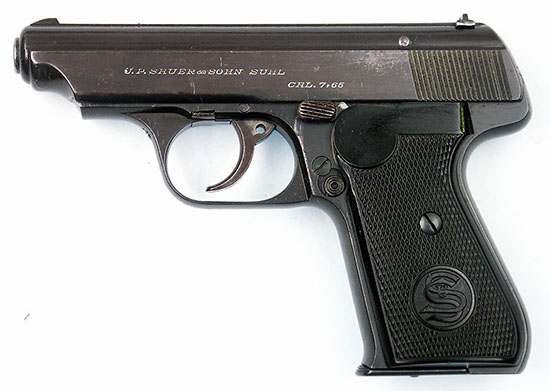
S&S Model 38 - SN 261578 - Photo courtesy Bill Chase.
Fritz and Hans Zehner were consistent in their belief that no additional safety was necessary beyond the long double-action trigger pull, but they were also realists. Even in the earliest correspondence and advertising, the company noted that an additional safety would be available upon request.
The earliest recorded Model 38 or Model H serial numbers appearing in the 1942 inventory of pistols are 210003, 210019, 210020, 210032 and 210036. These were hand made prototypes that likely date from late 1937. Like the Model 36 pistols, these early guns feature the pinned magazine release with square guide posts on the right side.
Production serial numbers for the Model 1938 are believed to start at 260001. Serial number 260017 appears to be the earliest production Model 38 pistol recorded. Serial number 260025 is shown on page 269 of Cate & Van Gijn, and is also listed in the 1942 inventory. These guns were likely made sometime in 1938. Serial number 260025’s markings are hand engraved, including a Sturmabteilung inscription which appears on the left side of the slide: “S.A. der N.S.D.A.P. Gruppe Thüringen.”
Mechanical Function of the Model 38
The Model 38 breaks down into four major components: (1) the receiver or frame, (2) the internal lockwork, (3) the slide, and (4) the magazine. The forged receiver contains the lockwork and includes the handle or grip, the trigger guard, and a mount for the barrel. The barrel is permanently pinned into its mount in the receiver, and serves as the guide for the concentric recoil spring. Grooves are machined at the rear of the receiver to accept slide rails.
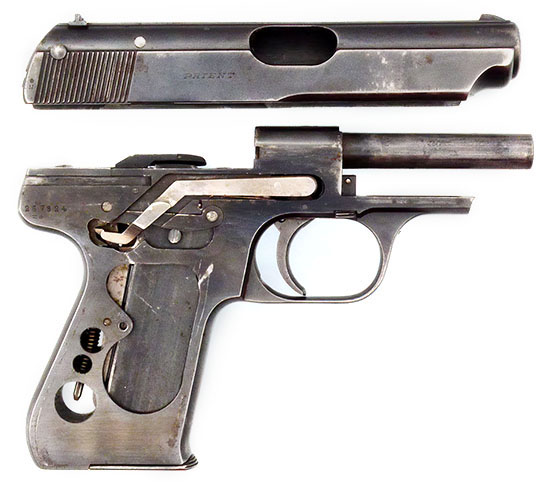
S&S Model H - SN 267824 - Hammer cocked
Two small internal rails at the rear of the slide engage with grooves in the rear of the receiver. The breechblock, containing the firing pin and extractor, is retained in the slide by a transverse pin which also retains the firing pin in the breechblock. A groove in the top of the breechblock accepts the signal pin which indicates when there is a cartridge in the chamber. The Model H slide contains a mechanical safety with a rotating lever on the left side that blocks the hammer to positively prevent the gun from being fired if it is cocked; if the hammer is uncocked, the safety blocks it.
The transfer bar is on the right side of the pistol, covered by the slide and the right grip plate. In double-action mode, the trigger pivots and pulls the transfer bar forward, and a spring forces it up to engage the hammer; a hook on the end of the transfer bar engages a notch on the bottom of the hammer to rotate it backward. The gun fires when the transfer bar slips out of the notch. A projection on the right side of the transfer bar serves as a disconnector. A small circular cut in the right wall of the slide provides room for this projection, allowing the transfer bar to rise up enough to engage the hammer when the trigger is pulled. If the slide is out of battery, the projection is overridden by the slide which presses the transfer bar down so it cannot engage hammer or sear. The magazine safety lever blocks the forward movement of the transfer bar when the magazine is removed. When the magazine is fully inserted, a small protrusion on its right side pushes the magazine safety lever up so it does not block the transfer bar.
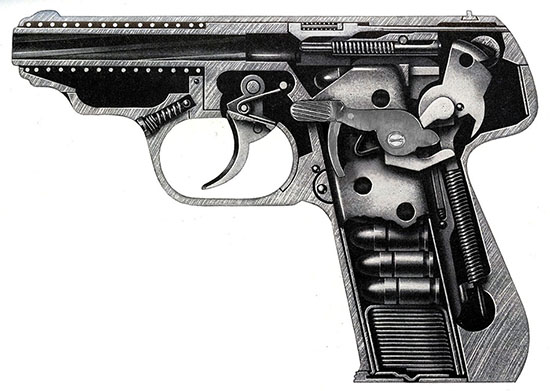
Sectional View of the S&S Model H Showing Cocking Lever
The sear is a pivoting lever in front of the hammer strut and mainspring which engages the notch in the hammer when it is at full cock. A dog-leg projection at the rear of the transfer bar pulls the sear forward to release the hammer during single-action fire. Built into the upper half of the sear is a lever which locks the transfer bar and prevents the gun from being fired when the cocking lever is being used to either cock or decock the hammer. The mechanism of the cocking lever itself defies a simple description, and reading the patents is not particularly helpful; suffice it to say that the functioning of the lever is positive, reliable, and safe.
A pinned filler plate covers a recess in the frame behind the trigger. Donald M. Simmons explains that a large milling cutter was necessary to mill the frame above the trigger guard to accept the trigger. This large cutter necessarily created a recess behind the trigger. The cover plate disguises the opening, mostly for aesthetic purposes but also to prevent the accumulation of dust, dirt, and fouling in the recess.
The only major failing of the Model 1938 is that it has no means of locking the slide open. The slide does not lock open after the last round is fired, nor can it be locked open for cleaning.
Variations of the Model 1938
The typology in this article will differ from that used by many collectors. In this author’s humble opinion, there are really only two “types” of the Model 1938 (with and without manual safety) but there are multiple variations and sub-variations.
The First Variant - Early Model 38
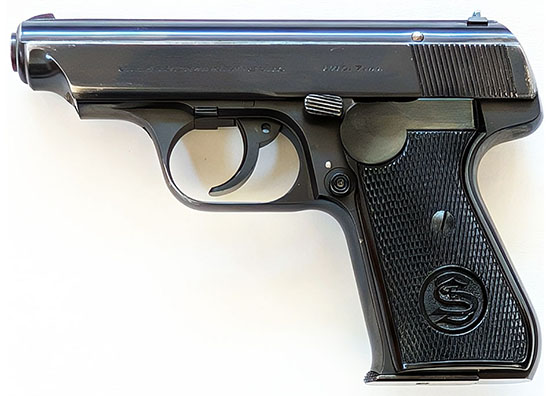
Early S&S Model 38 w/ Pinned Magazine release & No Manual Safety
Photo courtesy Doug Kingston.
The first variant consists of early Model 38 pistols with no manual safety. The inscription on the left side of the slide is in all capital italic serif characters on a single line:
J.P. SAUER & SOHN SUHL CAL. 7,65
After only a couple-hundred or so pistols, the caliber designation was moved down to a line of its own, centered over the cocking lever, usually referred to as a “two-line” inscription. Many collectors refer to the gun with a two-line inscription as a “Type 2.” Interestingly, the earliest known production gun, serial number 260017, actually has the two-line inscription.
The right side of the slide is usually marked “PATENT,” But some early guns are also found marked “D. R. P.” (Deutsches Reichs Patent). Early pistols have the pinned magazine release and a large head screw to retain the cocking lever. The magazine safety lever is unsecured, retained only by the right grip plate, and tensioned by a wire spring anchored in the right side of the frame. Barrels are rifled with six grooves. The transfer bar is tensioned upward by a wire spring, anchored in the frame, which fits into a longitudinal groove in its bottom edge. The front sight is milled as part of the slide, with the rear sight dovetailed and drift adjustable. The front sight is often found painted yellow and the rear sight painted red. The top of the slide is given a matte non-reflective finish. Most examples are highly polished and finished in salt blue, with a few rare examples in nickel.
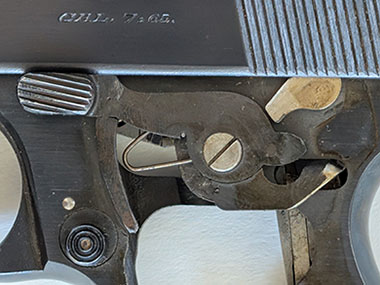
Early Model 38 with Pinned Magazine Release
Large Screw to Retain Cocking Lever
SN 260124 - Doug Kingston
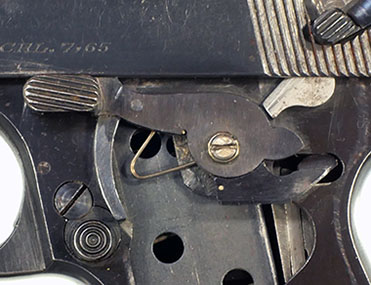
Model H with Screw-Retained Magazine Release
Screw Post and Spring Ring to Hold Cocking Lever
SN 267824 - Ed Buffaloe
Cocking levers were made in two parts, the curved extension possibly spot welded or press-fit to the lever; some early guns are found with the extension missing. The company quickly switched to a cocking lever which appears to have the extension riveted. The cocking lever shown in the patents (612895, 613598, & 646106) does not have the curved extension seen on production pistols. The curved extension was necessary to prevent dust and debris from getting under the left grip plate, which has an open space underneath to allow for movement of the cocking lever. The large head screw holding the cocking lever had a tendency to come loose, and so was replaced, in or around serial number 260716, with a smaller pivot screw with a groove which accepts a locking ring.
A few early guns are found lacking the signal pin loaded cartridge indicator. An early document (reproduced in Cate & Krause, pp. 316-321), dating from about 1937 states that the “S&S pistol can also be equipped with a reliable charge indicator (signal pin) on request,” so the signal pin was originally intended to be an option, though it very quickly became a standard feature. Today, any gun without the signal pin may be deemed scarce and collectible.
The first 1100 or so guns feature a magazine release that is pinned in the frame, with two square guide posts that extend out the right side when the button is pushed. The pin was soon replaced with a screw, visible on the left side only. The square guide posts on the right side remained for a short time, probably until existing parts were used up, but were soon eliminated to simplify production. Magazine release buttons retained with screws but also having the square guides on the right side are referred to as “transitional.”
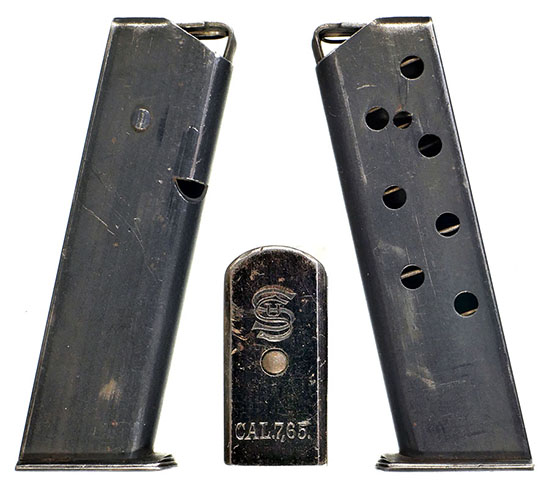
Typical Early S&S Model 38 Magazine.
A short article could be written about Sauer Model 1938 magazines and their variations. The reader should refer to Cate & Van Gijn and/or Donald M. Simmons for detailed information. The Model 1938 features a more or less standard box magazine with a U-shaped follower. Some early magazines only have six staggered witness holes on the left side, but the company quickly standardized on seven holes, with an additional hole in between the two rows that allowed for attachment of the rivet that engages the magazine safety on the right side. A few of the earliest guns had an unmarked baseplate, but most have the intertwined S&S monogram stamped on the baseplate, along with “CAL. 7,65.”
The serial number is on the right side grip tang of the frame, visible beneath the slide serrations. Many small parts (including the safety lever, trigger, hammer, and ejector) have the last two digits of the serial number stamped on them; and the last three digits are on the crossbar of the slide and the rear of the breechblock. All the first variant guns should have received the crown-over-N nitro proof mark. Production serial numbers for the first variant Sauer Model 38 are believed to begin at 261000 and end near 263700. Most of the early first variant guns were sold commercially.
The Second Variant - Model H
The second variant sees the addition of the hammer safety (Hahnsicherung). This required the hammer to be narrowed at the top to allow it to pass through a slot cut in the roller portion of the safety. The slide is lengthened by about 1 millimeter to allow additional room for the safety, and the frame is also lengthened by the same amount. This change probably took place in early 1939. There was a lag of a few months before S&S changed the model designation to “Model H.”
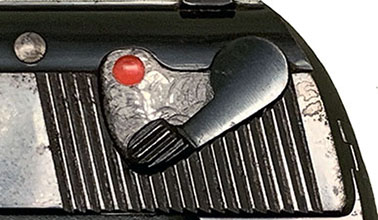
Early Milling for Safety Lever
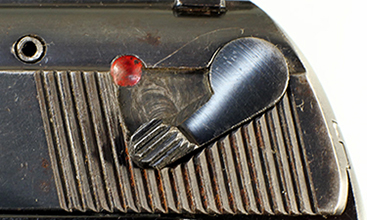
Late Milling for Safety Lever
Some guns with the hammer safety have a larger milled area in which the safety lever moves. These most likely represent slides that were modified after manufacture, in which the safety lever was retrofitted, a modification that was sometimes requested by police departments. In factory manufactured slides with safety levers, the milled area is reduced in size and the end of the safety lever is undercut, allowing it to extend slightly over the slide serrations, making for a cleaner look.
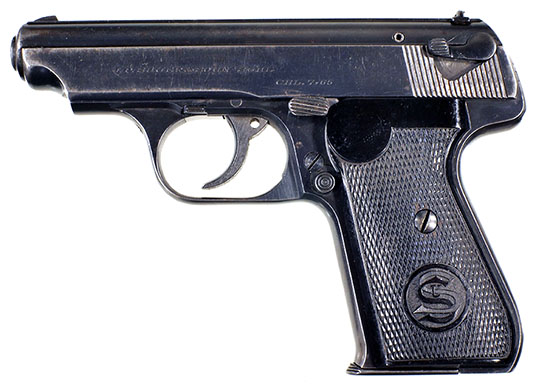
S&S Model H - SN 267824 - Ed Buffaloe
By the middle of 1939, Sauer was advertising the Model H (though still referring to it as the “Modell 38”) in the bi-monthly police publication, Die Deutsche Polizei (see Cate & Van Gijn, p. 288). Many of these guns continued to be sold commercially but, with the addition of the hammer safety, examples began to be purchased by police departments all over Germany.
A few rare examples of early Model H pistols, in the 264000 to 267000 serial number range, have frames made of Duralumin, a proprietary alloy of aluminum and copper, sometimes also referred to as Dural.
According to Cate & Van Gijn, the barrel rifling was switched from six grooves to four grooves in or around serial number 267000. This would have been mid to late 1939. At almost the same time, the axle pin for the magazine safety was changed. Donald M. Simmons describes the new pin as a riveted stud, but Cate & Van Gijn state that a metal cap was installed over the pin. (J. B. Wood says that to remove the pin or rivet it must be driven out from the inside; it cannot be pried out of the frame.)
Cate & Van Gijn state that between serial numbers 270150 and 270959 the transfer bar is redesigned slightly. The wire spring beneath it is eliminated, and the riveted stud on the back is made longer. The trigger spring is redesigned so that an arm reaches back to engage the elongated stud and tension the transfer bar upward.
Second variant guns continued to receive the crown-over-N nitro proof mark up until January of 1940, when the eagle-over-N proof came into use, in or around serial number 269001.
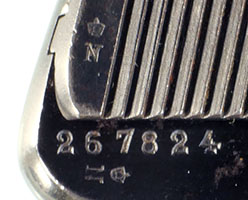
Crown over N
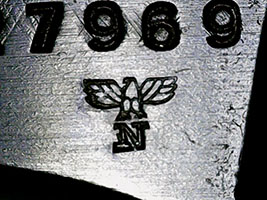
Eagle over N
World War II began in September of 1939. According to Cate & Van Gijn, the first military procurement of the Model H occurred in May to June of 1940. Commercial sales of the gun continued, but most S&S pistol production went to either military or police.
Small parts numbering ended sometime in 1940, in the 283000 serial number range.
A comma was added to the slide inscription in the vicinity of serial number 306000:
J.P. SAUER & SOHN, SUHL
Collectors often refer to the variant with the comma in the inscription as a “Type 3” but the author considers it a subvariant rather than a “type.”
Sometime late in 1942 S&S was forced to speed up production by reducing the time spent polishing out mill marks on the surface of the pistol. The unpolished surface became known as the late wartime finish, which began somewhere in the early 332000 series.
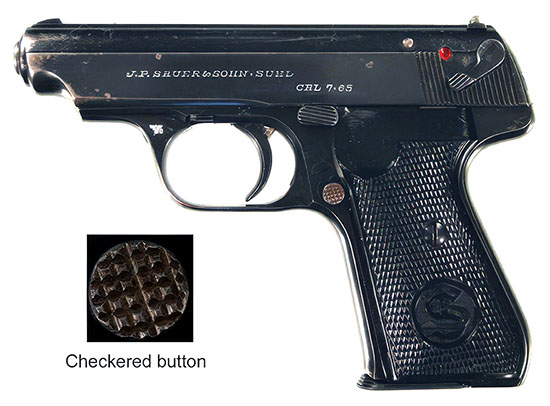
S&S Model H w/ Checkered Magazine Release - SN 343404 - Mark Castel
On 21 April 1943, a decree was issued to all police authorities by the Prussian Ministry of the Interior stating:
Modification of the Magazine Releases of Sauer u. Sohn M. 38
(1) To prevent accidental release of the magazine due to external influences such as pressure or impact on the holster, the magazine release button on newly manufactured
pistols will be made correspondingly lower.
(2) Any pistols with high magazine release buttons still in the possession of the departments are to be shortened to a height of 2.5 mm in the armory and provided with
checkering instead of the ring-shaped recesses.
Nothing could be more embarrassing, not to mention dangerous, than to draw your pistol only to have the magazine fall out, disabling the weapon.
In the early 352000 serial number range, the magazine safety lever was stamped rather than machined.
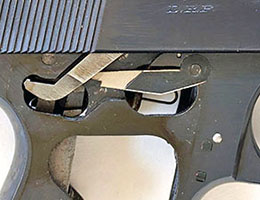
Early Magazine Safety Lever Re-
tained by Grip Plate - SN 260124
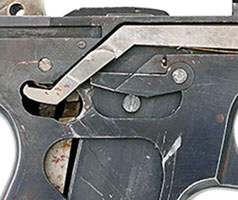
Riveted Magazine Safety Lever
SN 267324
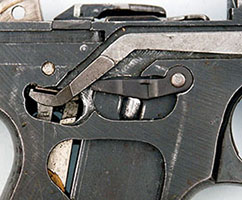
Stamped & Riveted Magazine Safety Lever - SN 504451
To reduce machining operations and speed up production, at or near serial number 383000, the number of lightening holes on each side of the grip frame was reduced from three to two.
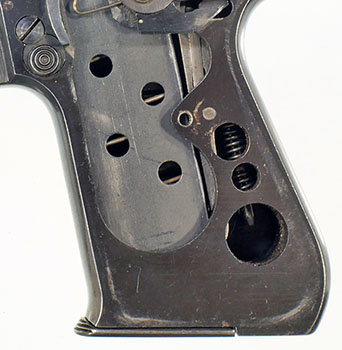
Three Lightening Holes - SN 267824
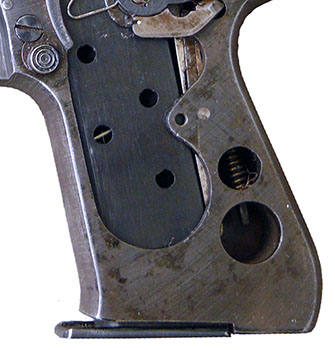
Two Lightening Holes - SN 509540
In or near serial number 390000, the rivet that engages the magazine safety lever on the right side of the magazine was omitted in favor of a punched protrusion. The left side of the magazine required a larger hole in the center to accept the punch, and so one of the regular viewing holes was omitted at the top left.
Sometime around serial number 395456, S&S began to deploy a die-cast zinc trigger, which was much faster to produce than a machined steel trigger. According to Jim Cate, the zinc floorplates were made by Karl Sauerbrey Stanzerei. S&S continued to use steel triggers until their stock was used up, so there is a period during which either trigger may be found. The first zinc trigger serial number listed by both Donald M. Simmons and Cate & Van Gijn is 396446.
Not long after the introduction of cast zinc triggers, S&S introduced cast zinc magazine floorplates. These floorplates were painted black, though they almost never retain the paint today. The floorplates were also made by Karl Sauerbrey Stanzerei.
At or near serial number 404000, the company name began to be omitted from the slide legend, so all that remained was the caliber designation, which was moved to above and just in front of the trigger, reading only:
CAL. 7,65
Guns with the abbreviated inscription are often referred to by collectors as the “Type 4” but, again, the author considers them a subvariant of the Model H, as there is really no substantial change to the gun itself. According to Cate & Van Gijn: “The majority of the remaining full legend slides appear to have been used on Police and Commercial pistols until they were gone, rather than being used on military pistols.” So clearly there was a period in which either slide legend may be found.
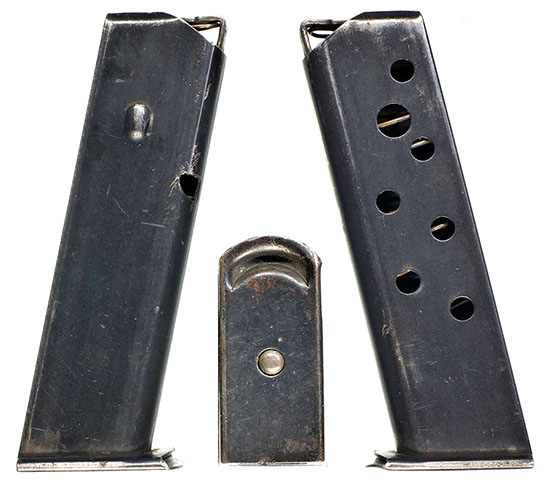
Typical Late S&S Model H or Model 38 Magazine w/ Stamped Baseplate
and Punched Protrusion on Right Side to Activate Magazine Safety Lever
Somewhere in the early 429000 serial number range, the company switched to a stamped magazine baseplate with a curved dimple at the front. These stamped baseplates were even cheaper and faster to manufacture than the cast zinc ones. The stamped baseplates were unmarked.
The Third Variant - Late Model 38
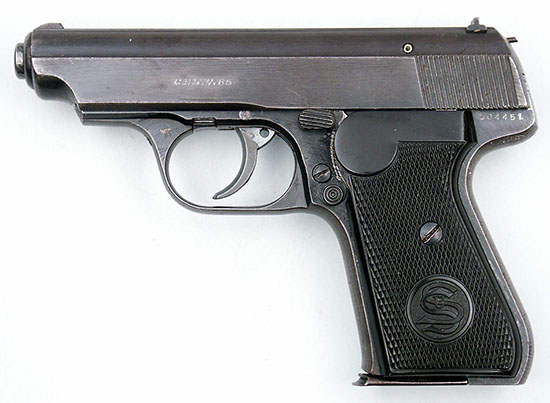
S&S Model 38 - SN 504451 - Bill Chase
Somewhere near serial number 470000, the hammer safety began to be omitted from the slide and the number of slide serrations were reduced from nineteen to eighteen. This change took place in late 1944. Cate & Van Gijn refer to this late variant as the “Type 4a.” There were still a lot of slides left that were milled for the safety lever, and examples with safeties are still found into the 488000 range.
On or about serial number 472000, the serial number was moved to the left side grip tang. Cate & Van Gijn refer to this variant as the “Type 4b.”
The hammer safety could be engaged whether the hammer were cocked or not but with the omission of the safety lever it became more important for soldiers to know the state of the hammer. This could be determined by the position of the trigger, since it moved to the rear when the hammer was cocked, but the military wanted a visual and tactile way to determine this and suggested a notch in the left side of the trigger guard at the rearmost trigger position. S&S suggested two notches, marking both possible positions of the trigger. This change was ordered on 16 November 1944, only six months before the war ended, and it is likely that guns with trigger guard notches never actually saw military service.
Production of the Model H continued into the 513000 serial number range, but proofing ended when Allied forces took over Suhl shortly before the end of the war. Starting just after the 507000 range, all examples noted by Cate & Van Gijn are unproofed.
After the war, Model 38 and Model H pistols were assembled from leftover and rejected parts, mostly unblued “in the white,” and given serial numbers from 1 to approximately 700. Cate & Van Gijn refer to these pistols as “Type 5a.” Another range, from the 3400s through almost 5000, were assembled. Cate & Van Gijn state these later guns may have been made during the Soviet occupation, and refer to them as “Type 5b.” A number of guns are found unproofed and with no serial numbers and it is presumed that these were also assembled from parts after the war.
Acceptance Marks
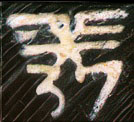
According to Donald M. Simmons, ‘[t]here were three primary markets for the Sauer 38H pistols: Commercial, Army, and Police.” Commercial pistols had only the normal commercial proofs, but no acceptance stamps, whereas the military and police both required acceptance stamps. The Army acceptance stamp for the city of Suhl, referred to as the Waffenamt stamp, was a stylized eagle over the number 37, stamped on the left side of the bow of the trigger guard. All of the earliest pistols accepted by the military have two of these stamps; these guns are scarce and collectible. Most army pistols have only a single eagle-over-37 stamp. Police acceptance stamps consist of a stylized eagle holding a swastika in a circle, with either a C or an F.
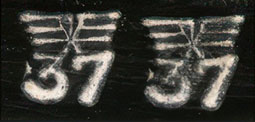
Early “Double Eagle” Waffenamt Army Acceptance Stamp
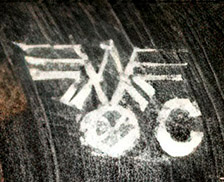
Eagle 37 Waffenamt
Acceptance Stamp
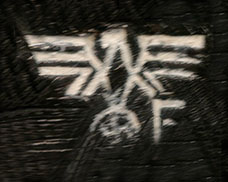
Eagle C and Eagle F Police Acceptance Stamps
Photographs courtesy Mark Castel
A Note on Sources
Jim Cate and his two European collaborators, the Dutch citizen Nico Van Gijn and the German citizen Martin Krause, in their two books, Sauer & Sohn, A Historical Study of Sauer Automatic Pistols and J. P. Sauer & Sohn, Volume II: Dein Waffenkamerad, have meticulously collected more raw data on Sauer pistols than is available in any other source. Their books offer the best historical information available at the time of this writing, and this article relies very heavily on them. Rolf Kallmeyer’s 2003 article in the Deutsches Waffen Journal also provides valuable insights. Mr. Kallmeyer interviewed many key individuals in the German firearms industry after the war. One of the clearest explanations of Sauer 38 variations remains Donald Simmons’ 1983 article in Gun Digest.
References
- Cate, Jim & Van Gijn, Nico. Sauer & Sohn, A Historical Study of Sauer Automatic Pistols, Walsworth Publishing, Marceline, Missouri: 1996.
- Cate, Jim & Martin Krause. J. P. Sauer & Sohn, Volume II: Dein Waffenkamerad, Walsworth Publishing, Marceline, Missouri: 2000.
- Kallmeyer, Rolf. “Die Geschichte der Selbstladepistole Sauer & Sohn, Modell 36/38/H,” Deutsches Waffen Journal, June-July 2003.
- Kersten, Manfred. Sauer & Sohn – Suhl – Kurzwaffen, Service K, Kleve, Germany: 2018.
- Mathews, H. J. Firearms Identification, Vols. I & II, Univ. of Wisconsin Press, Madison, Wisconsin: 1962.
- Murtz, Harold A. The Gun Digest Book of Exploded Firearms Drawings, Expanded 3rd Edition, DBI Books, Northfield Illinois: 1977.
- Olson, John, Editor. Famous Automatic Pistols and Revolvers: Volume 2, Jolex, Inc., Oakland, New Jersy: 1979.
- Roth, Wolf-Dietrich N. Fateful Years: Carl Walther, The World FamousThuringian Arms Factory, 1886-1945, Front Sight Post Publishing, Eddy, Texas: 2021.
- Simmons, Donald M. “The Sauer 38H Story,” Gun Digest, 1983. DBI Books, Northfield, Illinois: 1982.
- Smith, Walter H. B. Pistols and Revolvers, NRA and the Military Service Publishing Company, Harrisburg, Pennsylvania: 1946.
- Still, Jan C. Axis Pistols, Walsworth Publishing, Marceline, Missouri: 1986.
- Tillig, H. J., “The Pistols of J.P. Sauer & Sohn.” Gun Collector’s Digest, 3rd Edition, DBI Books, Northfield, Illinois: 1981
- Wood, J. B. The Gun Digest Book of Automatic Pistols Assembly/Disassembly, Krause Books, Iola, Wisconsin: 2007.
- Wood, J.B. Troubleshooting Your Handgun, Follett, Chicago: 1978.
Links
An outstanding collection of Sauer 1938 pistols.
Sauer Model 1913, 1919, 1926, 1930 and Behördenmodell
Sauer Model H Sectional View & Parts List
Acknowledgments
Special thanks to Jim Cate, Doug Kingston, Mark Castel, Bill Chase, and Stefan Klein for photographs, support, and assistance.
Copyright 2025 by Ed Buffaloe
Click on the pictures to open a larger version in a new window.