The Mann Pistol Model 1920/1921 in .25 ACP
by Dr. Stefan Klein
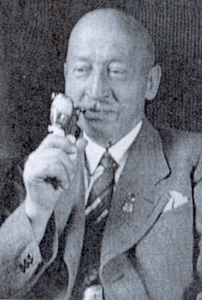
Figure 1: Fritz Mann (see: Peter Dannecker, Technikgeschichte der Firma Fritz Mann)
The Fritz Mann Feinmaschinen – Waffen – und Werkzeugfabrik (Machinery, Guns and Tools Factory) was founded 1896 in Suhlerneundorf, Thuringia. Later, in 1925, the company operated under the name of Fritz Mann Maschinenfabrik Suhl-Neundorf. The Mann family, the brothers Fritz and Otto Mann and one of Fritz’s sons Willi, were talented inventors and dealt not only with guns but also with other machinery: ski bindings, buzz saws, two-stroke engines, and crash-helmets. However, by the late 1930s the Manns were focused on other things besides their gun and machinery business, and in 1938 the company was liquidated.
What are the innovations of the .25 ACP Mann Pistol? It is simple physics that you need a certain mass of breech block in a blow-back operated gun. If you do not want to use a mechanical breech locking mechanism, you must slow the extraction of the empty case to control the point in time when the gun opens. Fritz Mann chose a circular chamber groove. Here the pressure of the discharged cartridge, for a short moment, forces the brass of the cartridge case to flow into the groove and thereby delays the opening of the breech. This groove allowed for the elimination of a heavy slide to contain the breech block. Instead, the breech block, or bolt, screws into the knob at the rear of the gun, as does the recoil spring guide rod. The recoil spring is located above the barrel.
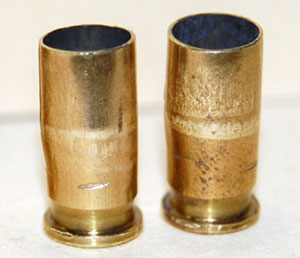
Cartridge Cases Fired from a Mann Pistol
The barrel retention method was very innovative (see figure 2). It made it very easy to disassemble the barrel for cleaning purposes. A 4 mm caliber barrel for indoor training ammunition was available. Additionally Peter Dannecker reports that a 150mm barrel was available for target shooting. Other than an advertisement in a Waffenschmied journal in 1920 there is no other proof of the existence of such a barrel--no reference sample is known.
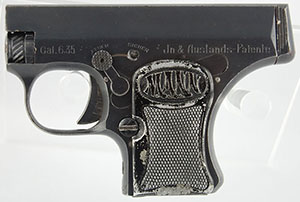
Model 1920 - First Variant
The Mann pistols Model 1920 and Model 1921 have a loaded chamber indicator on the left side of the gun. With a cartridge in the chamber, a pin on the exterior of the ejector, protrudes through the frame. If the manual safety is in the ‘Safe’ position the pin protrudes behind it and makes it more difficult to move to the ‘Fire’ position. If the manual safety is in the ‘Fire’ position, the pin can be felt to verify that the chamber is loaded. The Model 1920 has an additional loaded chamber indicator on the right side of the gun. It is a spring-loaded vertical bar of metal which stands out from the frame. When there is no cartridge in the chamber this bar can be pushed inside otherwise it is blocked and does not move. So by pushing that bar the operator could easily check if there is a cartridge in the chamber.
The magazine holds 5 rounds and the release button is at the front of the frame. This is not a very comfortable position but a logical consequence of the desire to keep the gun slim. The magazine has four holes drilled on each side which allow a visual check of the number of cartridges. The baseplate is held in position by flanges which are bent over from the sides, similar to the Ortgies magazine.
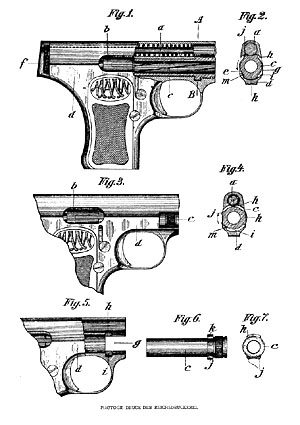
Figure 2: Method of barrel fixation, Deutsches Reichspatent 332281
- German Patent No. 334098 (4 March 1920) for a chamber groove to reduce breech weight.
- German Patent No. 332281 (17 March 1920) for the rotary bearing of the barrel.
- German Patent No. 345118 (30 March 1920) for an indirect safety which affects the trigger bar.
- German Patent No. 361248 (15 June 1921) for a combined ejector and loaded chamber indicator.
The Mann pistols Model 1920 and Model 1921 have only minor differences in the form and checkering of the safety lever, the cover plate and the position of the grip screw. The loaded chamber indicator on the right side of the Model 1920 was eliminated in the Model 1921.
I have three Mann pistols - a model 1920 (serial number 2800) with aluminium grips and two model 1921 (serial number 18768 and 32838) with rubber grips. The serial numbers are stamped on the front of the frame below the magazine release button. Behind the serial number you can find an additional number which are the last two digits of the model year. The milled frames have plain flanks which form a triangular area at the back of the gun. The size of that area differs on all pistols, but I can not assess if this can be used as a criterion for model determination.
We can at least assess that there have been aluminum and hard rubber grips and perhaps wood. Nearly all Model 1920 Manns I have found have aluminum grips excepting a very early gun which has wooden grips. Those wooden grips might be later replacements. The Model 1921 guns have hard rubber grips. Aluminium and rubber grips show the word “MANN” in an oval.
Hermann Historica, an auctioneer in Munich, is a great source for vest pocket pistols in excellent condition. They have a great archive of previous auctions which is always worth investigating. My three Mann pistols have slightly different inscriptions and in the Hermann Historica archive I found a very early nickel plated gun with SN 188 and wooden grip plates which should represent the very first style of inscription. The more guns I observed the more different inscriptions I found. As the guns do not differ very much, I arbitrarily named them as first, second, third variant and so on. By presenting the serial numbers which I found for each variant we can see that there are sometimes only a few hundred guns with certain inscriptions. If someone has a .25 ACP Mann pistol which has another inscription, I will gladly add more variants.*
First variant - Model 1920 (SN 188)
The first variant shows the following inscription on the left side in sans-serif characters:
Jn & Auslands-Patente
Fire and safe position are marked with the german words FEUER and SICHER in sans-serif characters.
Second variant - Model 1920 (SN 1268)
This variant shows the following inscription on the left side in italic serif capital letters:
JN & AUSLANDS-PATENTE
Fire and safe position are marked identical to the previous variant.
Third variant - Model 1920 (SN 2421, 2800, 3004)
This variant shows the following inscription on the left side in sans-serif capital letters:
MANN’S PATENT
Fire and safe position are marked identical to the first variant.
Fourth variant – Model 1921 (SN 18768, 18903, 24522)
The left side of the gun is marked with italic serif capital letters and shows the inscription
FRITZ MANN, SUHL – PATENTE
The safety is marked with capital letters S and F. In the back there is a stylized MA in a circle which is the trademark of the Fritz Mann company.
Fifth variant – Model 1921 (SN 21629, 25769, 32838, 33555, 35535)
The gun is marked with italic capital serif letters.
MANN’S – PATENTE
Safety marking and trademark are identical to the previous variant.
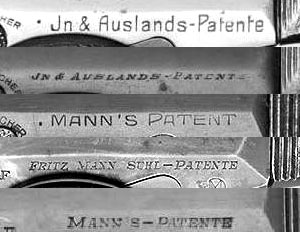
Figure 3: Slide Inscription variations.
In a nutshell, Fritz Mann produced a very interesting vest pocket pistol with unusual features. The idea of hampering the case extraction with a chamber groove was a milestone but it did not achieve acceptance – perhaps due to safety issues. Later his idea–slightly different and in combination with other features–proved to be reliable enough and was found especially in automatic guns (e.g. Heckler&Koch G3). The interesting fact is that this idea was “reinvented” several times, and Fritz Mann did not win any laurels for his patent.
Having read Rieger’s article about the exploded gun I was first dubious about taking my Mann pistols to the range. But I wanted to provide information about both the reliability and precision of
the Mann. So I test fired a few magazines out of one of my pistols. What should I say? The gun worked without mailfunctioning and although the barrel seems to be not the best I was able to hit a
rectangle of 1 foot by 1 foot at seven meters. Balance in the hand is okay, but the sights are terrible and no real help for aiming.
In conclusion, the Mann pistol is not perfect but adequate for self defense. Being not much bigger than a credit card they fit easily into your pocket. From the historical perspective they are nice tiny
pieces of steel which are continuing proof of the vagaries of the countless weapon manufacturers of the 1920s.
Stripping the Mann Pistol
Mann Pistol
Length: 104mm
Height: 69mm
Width: 18mm
Barrel: 45mm
Weight: 230g
- Check that the magazine and chamber are both empty.
- Pull the trigger to uncock the striker.
- Pull the breech half way back, turn barrel counterclockwise 90° and remove it
- Screw out spring bolt and remove breech block
- Remove firing pin and spring
- Remove grips and trigger bar with the safety lever in middle position
- Remove trigger assembly and magazine catch
- Remove indicator pin and ejector
- Pull out breech assembly through the front opening of the frame
* If you can provide photographs, serial number and model information, or any other information about the Mann pistol, please write to [email protected].
References
BOCK, Gerhard, Moderne Faustfeuerwaffen und ihr Gebrauch, J. Neumann, Neudamm, 1923
DANNECKER, Peter: Technikgeschichte der Firma Fritz Mann,
René Burkhardt Verlag Erfurt, 2011
KOENIG, Klaus-Peter; HUGO Martin: Taschenpistolen – Taschen- und Miniaturpistolen Eine Auswahl aus 100 Jahren, Motorbuch Verlag:
Stuttgart, 1985
MANN, Fritz: Users Manual Selbstlade-Pistole Mann, reprint, Journal Verlag Schwend GmbH, Schwäbisch Hall, Vertrieb durch DWJ-Verlags GmbH, Blaufelden,
2011
PFEIFFER, Klaus: “Die Pistole Mann Cal. 6,35 mm,” Waffenfreund No. 4-1987, Verband der Waffensammler e.V., Duesseldorf
RIEGER, Bendikt: “Mann Selbstladepistole 6,35 Br,” Deutschen Waffenjournal,
May, 1997
WAHLEN, Axel: “Westentaschenpistole Mann,” Waffenfreund No. 4-2008, Verband der Waffensammler e.V., Duesseldorf