MAB R22
The M.A.B. R22, or Le Chasseur, Pistol
by Ed Buffaloe
photographs of the R22 by Travis Frank
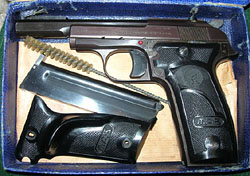
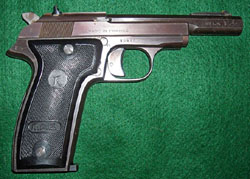
The R22 came with an extra left-side grip with a thumb rest. The grips were marked with an R in a circle at the top and MAB in an oval at the bottom.
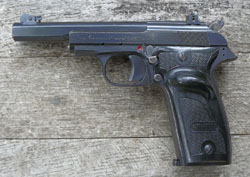
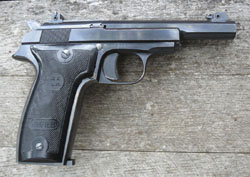
The Le Chasseur had “.22 L.R.” in the circle at the top of the grip, and “Winfield” in the oval at the bottom.
In 1950 MAB began manufacturing a new series of guns, called the R-series, distinguished from all their previous pistols by an external hammer. The first R- series gun issued was in the .32 French Long military caliber, followed by versions in .32 ACP, .380, and 9mm Parabellum. Production of the R22 in .22 short caliber, with a 185mm barrel, began on 26 July 1954, and a .22 long rifle version with a 110mm barrel appeared on 5 December 1954. On 31 January 1955 the .22 long rifle version with a 185mm barrel was released. According to Huon, production of the R22 ended in April of 1965.
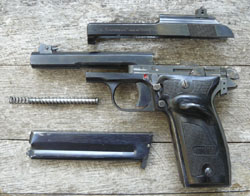
The R22 was built a similar frame to the R32, but differs from other R-series guns in that it has a fixed barrel, an open-top slide, and does not lock open after the last round is fired. It is somewhat like the Model F, but has an external hammer instead of an internal striker, and a less-radical grip angle.
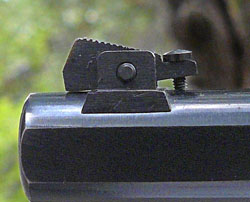
MABs were imported into the United States during the 1950s by the Western Arms Corporation of Los Angeles , and sold by its distributor, the Winfield Arms Corporation. They were usually labeled “Made in France for WAC” and had the letters WAC placed on the grips instead of MAB. Eventually the various guns were given names instead of letter designations, so the R22 became “Le Chasseur,” the hunter. My Le Chasseur with serial number 6352 has “WAC” on the slide and “Winfield” on the grips. My R-22 with serial number 30900 is simply marked “Made in France” and has only the MAB name on the slide and grips.The R22 models I have seen have an adjustable front sight with a thumb wheel and a fixed rear sight, whereas the Le Chasseur I own has a screw-adjustable front sight and a rear sight adjustable for both elevation and windage. A friend who owns an R-22 reports that with the front sight adjusted all the way up his gun shoots right on at 25 feet.
Like all the MABs, the R22 was extremely well made. Though not as highly polished or carefully finished as a Colt or a Smith & Wesson, the MABs were nonetheless manufactured with great precision and careful quality control. My Le Chasseur is extremely reliable and quite accurate. My only complaint about the gun is that, unlike the other R-series guns, there is no provision for locking the slide open when the last round is fired. This means you must count rounds if you do not wish to have the firing pin impact an empty chamber. Nominally, the magazine holds ten rounds. However, I find that the tenth round is difficult to load, so I usually only load nine rounds.
Field Stripping
The R22 has a latch on the left rear of the frame with two holes in it. The latch requires a special tool, which must be inserted into the lower hole, to open. A spring-loaded plunger in the bottom hole holds the latch in place. Field stripping is accomplished as follows:
- Pull the slide back about 1.5 cemtimeters and lock it open by moving the safety lever up into the middle detent on the slide.
- Insert the take-down tool into the bottom hole in the latch and pull the latch downward. The spring-loaded plunger beneath the latch will catch in the upper hole and hold the latch open.
- Grasp the slide, pull it to the rear, and lift it up out of the rail on the
frame. - Carefully ease the slide off the front of the gun.
My Le Chasseur did not come with the take-down tool. I made one from a brass end that came with a gun cleaning kit. The brass piece was for pushing cotton patches through gun barrels, and had a long point on the end. I ground the point down to the correct diameter, ground the length down to the same depth as the latch (about 9/64 inch) and rounded the end with a file. It isn’t perfect, but it suffices, and the brass will not scratch the gun.
References
Les Pistolets Automatiques Francais: 1890-1990, by
Jean Huon. Histoire & Collections, Paris: 1995.
Les Pistolets MAB, by Jean-Pierre Bastié & Daniel Casanova. Crépin-Leblond et Cie: 2015.
“The M.A.B. Pistols,” by Michel
H. Josserand. The American Handgunner, May/June 1979.
Copyright 2008-2015 by Ed Buffaloe. All rights reserved.
Click on the pictures to open a larger version in a new window.