The Haenel Schmeisser Pistol
by Ed Buffaloe
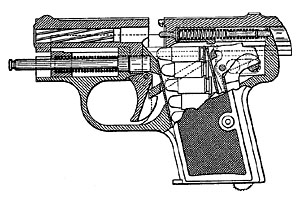
Patent Drawing from U.S. Patent 1486497
According to Norbert Moczarski, in his paper on the Schmeisser brothers, in 1922 the brothers formed a company under the name Gebrüder Schmeißer in order to protect their patent rights. It is significant, however, that the brothers were already filing a patent using this name in December of 1919. Moczarski also states that the brothers became shareholders in C.G. Haenel, as well as de facto managing partners.
The Patents
German patent № 326536 was filed on 17 May 1919 by Hans Schmeisser. This patent covers the method of barrel retention by a locking pin, the pin forming the rear of the recoil spring guide rod.
German patent № 337666 was filed by the Gebrüder Schmeißer (the Schmeisser brothers) on 16 December 1919.
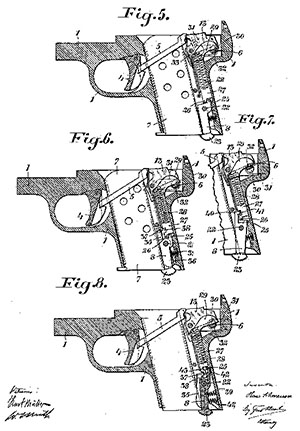
Patent Drawing from U.S. Patent 1486497
German patent № 342078 was filed by the Gebrüder Schmeißer on 7 February 1920. This patent covers further improvements on the safety mechanism described in the previous patent.
German patent № 361175 was filed by the Gebrüder Schmeißer on 3 July 1921. This patent covers the final design of the safety mechanism. Apparently, the previous designs had a flaw that allowed the magazine to be removed, under certain circumstances, before the safety was engaged. This new design rectified this issue, firmly locking the magazine release when the safety was off.
U.S. patent № 1486497 was filed 26 August 1921 by Hans Schmeisser, and included all of the mechanisms described in the German patents—the method of disassembly as well as the various safety mechanism designs.
The Modell I Schmeisser Pistol
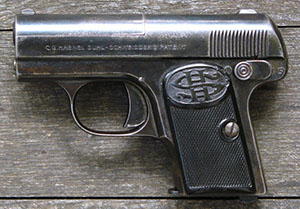
Schmiesserpistole - SN 154603
Like their father’s design, the “slide” is really just a breech block with two arms that extend beneath the barrel. The barrel is fixed in the frame by a locking pin at the rear of the recoil spring guide rod, which has a larger diameter than the guide rod itself. The barrel in turn retains the slide on the frame.
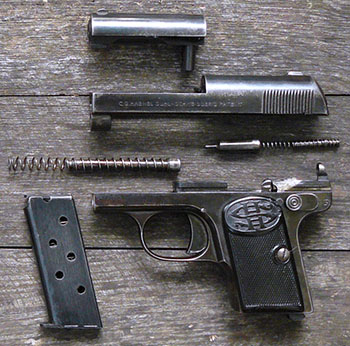
Schmiesserpistole - SN 154603 - Field Stripped
The extractor is mounted externally on the right side of the breech block, and there is no ejection port because the gun has an open-top slide. The rear of the striker spring guide rod protrudes through a hole in the back of the gun to indicate that the striker is cocked.
The gun did not receive its Model I designation until the Model II appeared in 1926. Before that, it was simply known as “die Schmeisserpistole.” The Schmeisserpistole was available in blue or nickel finish.
As is evident from the three Gebrüder Schmeißer patents, the magazine safety mechanism, which was intended to prevent removal or installation of the magazine when the safety was not engaged, went through three iterations. These are clearly illustrated in the U.S. patent, figures 5 through 8. Since a gun with the first design has not yet been located, we do not know exactly what issue it had . But in the second design, which is found in early Schmeisserpistoles, if the magazine is in the gun and the safety is moved to a position where the lever is pointing straight down, it is possible to remove the magazine, after which the safety can be moved to the Fire position. This was clearly not acceptable, so the Schmeisser brothers redesigned the magazine safety mechanism yet again.
Dr. Stefan Klein, in examining guns in his collection, was the first to recognize that there are at least two different magazine safety mechanisms in the production Haenel Schmeisser pistol, corresponding to the mechanisms illustrated in the second and third patents. It seems likely that the Schmeisser brothers may have recognized the limitations of their first design early enough in 1920 that they began production with their second magazine safety design. Dr. Klein tells the author, in private correspondence, that the change from the second to the third safety design took place somewhere between serial numbers 20236 and 25483.
The magazine safety, in its final iteration, is quite thoroughgoing. The magazine cannot be removed unless the safety is on. The safety cannot be released until the magazine is reinserted. Hence, if a live round is left in the chamber, it cannot be fired with the magazine removed. With the safety engaged, the gun cannot be cocked, but the slide can be retracted enough to eject a live round in the chamber. The Schmeisser pistol was touted as being safe even for people who are unfamiliar with guns.
Production Variations
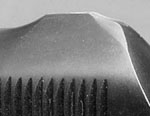
C.G. HAENEL SUHL, SCHMEISSER’S PATENT
According to Dr. Stefan Klein, various iterations of the Schmeisser pistol saw the comma in the inscription replaced by a period, or a space, and in very late guns by a dash.
In early production, guns intended for export were marked:
C.G. HAENEL SUHL, GERMANY, SCHMEISSER’S PATENT.
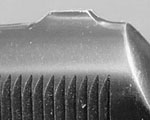
In later production, guns intended for export were simply stamped GERMANY or MADE IN GERMANY.
Late Schmeisser pistols are distinguished by a smaller rear sight. This change appears to have taken place at least by serial number 67819, though a few earlier examples have been noted.
The Modell II Schmeisser Pistol
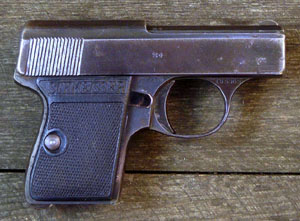
Haenel Schmeisser Modell II
The Model II Schmeisser pistol was already being marketed as early as January of 1926, so it is likely that production began in 1925. Production of the renamed Model I pistol continued at the same time. The Model II was given its own serial number sequence, beginning with 1, but only extended into the 1200 series when the company decided to number the Model II with the Model I, so the next series began with 100000. The highest serial number recorded thus far is 108804, so at the time of this writing, total production of the Model II appears to be just over 10,000.
The Model II is a miniaturized version of the Schmeisserpistole (now renamed the Model I) and was likely intended to compete with the Walther Model 9, which appeared in 1921 and at the time was the smallest 6.35 mm pistol in the world. Many companies began to market smaller pistols to compete with the Walther. The Model II retains the barrel with the post at the rear and the T -shaped lug at the front, as well as the method of barrel retention. Instead of a half-moon cutout at the rear of the magazine, as on the Model I, the Model II has a half-moon cutout at the front of the magazine baseplate to use in pulling the recoil spring guide rod forward.
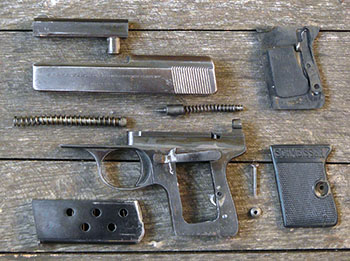
Haenel Schmeisser Mod. II - SN 105969 - Field Stripped
The extractor is on top of the slide, mounted externally. Like the Model I, the Model II has a pin on the rear of the striker spring guide rod that protrudes through a hole at the rear of the gun to indicate that the striker is cocked. The sear on the Model II was redesigned—instead of pivoting it moves straight up and down. The slide on the Model II has sixteen fine triangular-cut serrations at the rear, angled toward the front.
The slide inscription is on two lines on the left side in italic serif characters:
C.G. HAENEL SUHL, SCHMEISSER’S PATENT
MODELL II.
The serial number is on the bow of the trigger guard, on the right side of the gun. The first three digits are stamped on the bottom of the slide and the bottom of the barrel lug.
A number of very minor changes were made to the gun. Early guns had a magazine release that was 8.57 mm wide. After production of approximately 4500 gun, the magazine release width was reduced to about 6.5 mm. Most guns have a trigger that easily falls out if the right grip stock is removed because the trigger is held in place only by the post on the back of the transfer bar, which fits into a hole in back of the trigger. If the transfer bar is removed, or falls out, the trigger also immediately falls out of the gun. In the middle of production, somewhere in the 102400 series, a pin was added, which can be seen just above the safety lever and behind the trigger on the left side of the gun. This pin formed a backstop for the trigger, holding it in place when the gun was disassembled. But the pin was dropped after little more than 1400 or so guns were made with it.

| Zehna | Model I Schmeisser | Model II Schmeisser | |
| Length | 118 mm | 112 mm | 100 mm |
| Barrel Length | 60 mm | 54.2 mm | 52 mm |
| Height | 75 mm | 76 mm | 67 mm |
| Slide Width | 17.6 mm | 18.1 mm | 16.1 mm |
| Frame Width | 14 mm | 14 mm | 11.3 mm |
| Slide Height | 17 mm | 18.3 mm | 21 mm |
| Weight | 371 g | 380 g | 263 g |
Field Stripping
- Turn the safety on.
- Remove the magazine.
- Work the slide to make sure the chamber is empty.
- Draw the slide back about half an inch. On the Model I the slide can be locked open by pushing the safety up and into the cut in the slide. On the Model II you will have to hold the slide open with your thumb over the top.
- Using the notch in the magazine (or a tool such as a screwdriver), engage the cut in the recoil spring guide rod and pull it out about a half-inch and up or over to one side about one millimeter, locking it in the forward position.
- The barrel can now be removed straight up and out of the frame. The barrels are closely fitted. You may need to tap the gun with a plastic-tipped hammer or turn the gun upside down.
- Move the recoil spring guide rod back to center so it will spring back into place.
- Release the safety (on the Model I) and ease the slide off the front of the gun.
* Please send your serial number along with photographs or a description of your Schmeisser.
References
- Hogg, Ian V., German Handguns, Greenhill, London: 2001.
- Hogg, Ian V., German Pistols and Revolvers, 1871-1945, Galahad, New York: 1971.
- Hogg, Ian V. & Weeks, John, Pistols of the World, Arms & Armour Press, London: 1978.
- Hogg, Ian V. & Walter, John, Pistols of the World, Krause Publications, Iola, Wisconsin: 2004.
- Klein, Dr. Stefan, https://taschenpistolen.de/taschenpistole-des-monats/02-2022-c.g.-haenel-modell-i.
- Matthews, J. Howard. Firearms Identification, Charles C. Thomas, Springfield, IL: 1962.
- Moczarski, Norbert, “Die Ära der Gebrüder Schmeisser in der Waffenfabrik Fa. C. G. Haenel Suhl 1921-1948. Ein weitgehend unbekanntes Kapitel Suhler Industriegeschichte,” Jahrbuch des Hennebergisch-Fränkischen Geschichtsvereins 1999. Hildburghausen, S.
- Walter, John., Dictionary of Guns and Gunmakers, Greenhill, London: 2001.
- Weaver, W. Darren, An Encyclopedia of German Tradenames and Trademarks, 1900-1945, Schiffer, Atglen, Pennsylvania: 2011.
Special thanks to Vaclav Vriesen who created a database of Schmeisser Model II serial numbers on the Jan C. Still Luger forums, at: https://www.lugerforums.com/threads/haenel-schmeisser-model-2-serial-number-list.35940/.
Copyright 2010-2025 by Ed Buffaloe. All rights reserved.
Click on the pictures to open a larger version in a new window.