The 1935 French Service Pistols
by Ed Buffaloe
For many years, the French had been in the forefront of firearms design. They invented the first pinfire cartridge, the first rimfire cartridge, the first center-fire cartridge, and smokeless powder. But at the end of the Great War (World War I) their official sidearm was still the Model 1892 revolver.
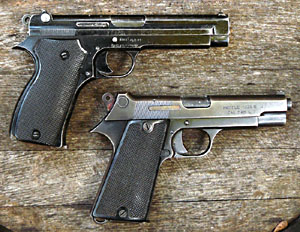
Top: M1935A. Bottom: M1935S.
Many sources, including Josserand and Kinard, state that MAS redesigned Petter’s 1935 design to make it easier and cheaper to manufacture, and that this gun then became the 1935S; but according to Medlin and Huon the 1935S was designed independently for the French military tests, though both guns were ultimately based on Browning’s 1911 Colt design via the Russian Tokarev. Medlin and Huon say, in regard to the 1935S: ‘First, the gun was submitted at the same time as the 1935A as a finished design; and second, any examination of the “S” shows it to be completely different from the “A” in a number of ways. A close comparison of the two provides no evidence that the “S” would be any cheaper to manufacture.’ Apparently, the similarities the two guns display are a result of both meeting the design specifications of the Commission d’Experiences Techniques de Versailles.
These specifications were as follows:
- The gun must fire the 7.65mm long round.
- The gun must be a single-action design with one spring for both the hammer and sear.
- The hammer, sear, and mainspring assembly must be constructed as a unit to facilitate replacement in the field.
- A magazine safety must be provided to disconnect the trigger bar from the sear.
- A manual safety must be provided to block the hammer from striking the firing pin.
- The gun must not require tools for field stripping.
The two guns have other similarities, which do not appear in the specifications, such as a captive recoil spring and guide rod assembly, and a loaded chamber indicator. The idea for the unitized hammer, sear, and mainspring assembly was almost certainly derived from the Russian Tula-Tokarev pistol of 1930.
The SACM 1935A
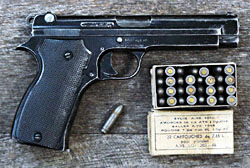
SACM 1935A
The Petter patent was clearly based on the Browning-designed Colt 1911. The French had been impressed by M1911’s performance during the Great War, but must have felt the gun was too large and heavy, and some French writers described its recoil as “brutal.” So the French were looking for a gun with the best features of the M1911, along with a few improvements. This might also describe the Tula-Tokarev TT-30 pistol, which was likewise a copy of the Browning design, with improvements. The Petter and Tokarev were both single action, short-recoil, dropping-barrel designs, with unitized lockwork. The Tokarev, however, utilized a much more powerful cartridge--the 7 .62x25mm Tokarev, virtually identical to the 7.63x25mm Mauser.
The Modèle 1935 was officially adopted early in 1937, and manufacture began almost immediately at the SACM factory in Alsace. (The suffix ‘A’ was added to the model designation in 1938, and stands for ‘Alsacienne’ in the company name.) Early deliveries took place in October of 1937. Production continued until the German invasion in mid-1940--German occupation forces took over the SACM factory and resumed fabrication of the pistol on 15 October 1940. Approximately 23,850 M1935A pistols were manufactured under German occupation. The German-made pistols received a Waffenamt acceptance stamp on the left side of the frame between the model designation and serial number--no other changes were made. French production was resumed as quickly as possible after liberation--the approximate date being 1 October 1944. The final M1935A was made on 10 February 1950. Total production was 84,950 pistols.
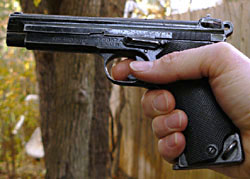
SACM 1935A
The M1935a features a loaded chamber indicator on top of the slide, but this feature is not found in any of Petter’s patents. I suspect it was requested by the French military at some point during the trials, even though it was not one of the original specifications.
The M1935A has a grey parkerized finish with an overlay of black enamel. The magazines were parkerized, with black enamel on the base only. Prior to the end of the war, the magazine bases were blank, but after the war they were marked “35_A”. The gun was not made with a lanyard, but many were retro-fitted with lanyards for use by French police. Typically, the U-shaped lanyard was staked to the lower left grip frame, and a corner of the grip plate was cut away to make room for it.
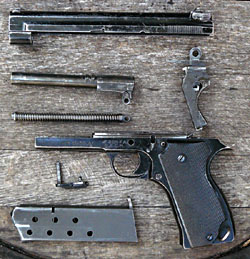
SACM 1935A Components
- Remove the magazine and make sure the chamber is empty.
- Draw the slide back approximately 5mm.
- Press the end of the slide lock from the right side and remove it from the left side of the gun.
- Draw the slide and barrel off the frame.
- Remove the spring and guide rod assembly and then the barrel from the slide.
In 1937 Schweizerische Industrie Gesellschaft (SIG) received a license from SACM to manufacture guns under the Petter patent. It was some years before anything other than prototypes were made, but eventually SIG produced the SP47/8, later renamed the P210, which was a 9mm pistol on the Petter design with a few significant improvements. The SIG P210 is considered by many to be the finest military pistol ever manufactured.
The MAS, MAC, or SAGEM 1935S
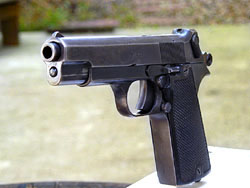
MAC 1935S
At this time, due to the exigencies of the French War in Indochina, MAS contracted with the firm Manufacture Française d’Armes et Cycles de Saint Étienne, commonly known as Manufrance, to produce the weapon. This firm produced approximately 8000 pistols with a parkerized finish. Manufrance pistols retain the M.A.S designation on the left side of the slide, but are also marked with the letters MF on the right side of the frame just in front of the trigger guard and have serial numbers with a G prefix.
By the end of 1945 MAS had contracted with yet another firm to produce the pistol. Manufacture Nationale d’Armes de Chatellerault (MAC) began production probably early in 1946. MAC pistols have 1935-S stamped on the base of the magazine (whereas MAS and MF magazines are marked MLE 1935-S), and show the initials M.A.C on the left side of the slide. MAC also changed the orientation of the safety on the 1935S. The early safeties had the safety lever forward for safe and down for fire. The MAC pistols were changed to conform to the safety positions of the 1935A pistols, with the lever pulled back and up for safe--this way the lever stuck out from the rear of the gun and was directly in the shooter’s line of vision if the gun was on safe. Most guns with the new safety are marked M1 after the model designation on the right side of the slide. The MAC pistols were blued rather than parkerized, though some guns were parkerized when they were refinished. There are a number of minor variations of the MAC pistols that I will not describe, but see Medlin and Huon’s book French Service Handguns, 1858-2004 for full details. MAC produced the 1935S pistol until 1956, with a total production run of 50,087.
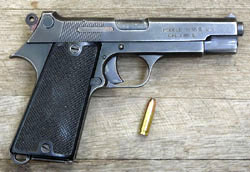
MAC 1935S
The gun saw military use primarily in the French Indochina War, though it was also widely used by French police. Total production, by all the various companies, was approximately 82,773.
The French 1935S pistol, like the 1935A and many other pistols of the 20th century, is a modified Browning design, strongly influenced by the Colt 1911. There is no barrel bushing at the front of the weapon, such as on the Colt. The guide rod and recoil spring are made as a unit, as is the hammer and sear assembly. The trigger pivots, and the connector runs on the left side of the gun, unlike the Colt and M1935A, which use a stirrup-shaped connector. The barrel has a Browning-style swinging link, but instead of the usual locking lugs on the barrel, the chamber has a sharp shoulder on its top front which engages a shallow cut in the roof of the slide. This locking method was later widely copied by SIG-Sauer, Glock, and Kel-Tec, among others.
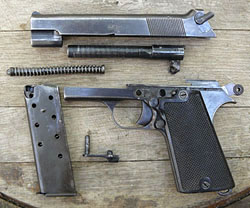
MAC 1935S Components
To fieldstrip the Model 1935S:
- Remove the magazine and make sure the chamber is empty.
- Lock the slide back and press in on the end of the slide lock on the right side of the gun.
- Remove the slide lock from the left side of the gun.
- Draw the slide and barrel off the frame.
- Remove the spring and guide rod assembly and then the barrel from the slide.
The 7.65 MAS (.32 French Long) Cartridge
The cartridge is variously known as the 7.65mm Long, 7.65mm French Long, 7.65mm MAS, 7.65x20, .30 Pedersen Long, .30-18, .30 Browning Automatic Rifle, and the 7.65L Pistolet-Mitrailleur Model 1938.
The only explanation I have ever read as to why the French military adopted this cartridge is, I believe, incorrect: they wanted it to shoot the same ammunition as their MAS-38 submachine gun. True, the French military wanted a pistol and submachine gun that shot the same cartridge, but the MAS-38 submachine gun was developed in parallel with the SACM 1935A and the MAS 1935S pistols, and the specification for the cartridge to be used by both was made well before either the pistol or the submachine gun were designed.
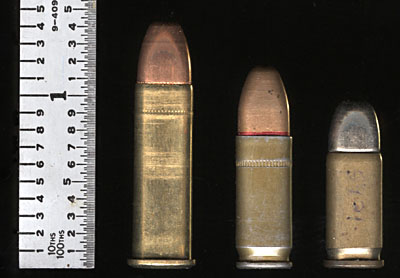
Left: 8mm French Ordnance Revolver
Center: 7.65mm French Long
Right: 7.65mm Browning (.32 ACP)
The brass for the .32 long cartridge is about 2mm longer than the .32 ACP (7.65mm Browning), and the bevel of the head groove is longer. The bullet weighs 88 grains. Medlin and Huon give the case length at 0.78 inches, and the overall cartridge length at 1.19 inches. Most references state that the .32 Long developed a muzzle velocity of about 1100 feet per second, whereas virtually every source on the Pedersen Device states that the .30-18 cartridge developed 1300 fps, but this was from a rifle barrel. White & Munhall give the muzzle velocity of the .30-18 cartridge in an M1935A as 1114 fps, and that of the 7.65mm French Long at 1175 fps.
| Cartridge | Bullet Weight | Muzzle Velocity | Muzzle Energy | |
| 7.62mm Tokarev | 85 grains | 1647 feet/sec. | 511 foot-pounds | |
| 8mm French Ordnance | 8mm Lebel | 120 grains | 716 feet/sec | 137 foot-pounds |
| 7.65mm French Long | .32 French Long | 88 grains | 1175 feet/sec. | 270 foot-pounds |
| 7.65mm Browning | .32 ACP | 73 grains | 1043 feet/sec | 177 foot-pounds |
| 9mm Browning Short | .380 ACP | 92 grains | 955 feet/sec | 187 foot-pounds |
| 9mm Parabellum | 115 grains | 1280 feet/sec | 420 foot-pounds | |
| All figures are from the current (2009) Sellier & Bellot website, except for the 8mm French Ordnance and 7.65mm French Long, which are calculated from data found in White and Munhall’s book Pistol and Revolver Cartridges. The 8mm data is for a black powder load. | ||||
Interestingly, Ian Hogg is of the opinion that the French Long was not derived from the cartridge for the Pedersen Device. “It seems more likely that it was a French arsenal draughtsman’s attempt to provide a 7.65mm cartridge as powerful as possible and different to that of anyone else.” However, I feel the near identical characteristics of the two cartridges cannot be ignored.
Another consideration in the choice of the 7.65mm long round may have been that the 8mm French Ordnance revolver cartridge had been in use by the French military since 1887 and was considered an adequate military round. The primary reason the Model 1892 French service revolver was replaced was that it was regarded as inadequate by comparison with self-loading pistols which held more rounds and could be fired and reloaded much more quickly.
Only four production guns were ever chambered for the .32 Long (if we discount the Pedersen Device, which never saw use): the MAS Model 38 submachine gun, the French Model 1935A service pistol, the French Model 1935S service pistol, and the MAB Model R (which is very scarce). FN produced a “Browning Model 1936” in .32 long, an adaptation of the Hi-Power, which is shown in Huon’s book, but no more than a few prototypes were ever manufactured since it was not chosen for production by the French Military.
Copyright 2008-2009 by Ed Buffaloe. All rights reserved.
Click on the pictures to open a larger version in a new window.
References
- Barnes, Frank C. Cartridges of the World, 10th Edition, by Frank C. Barnes. Krause, Iola, WI: 2003.
- Edwards, William B. “The Secret Pistol of World War I,” Gun Digest, 1968.
- Hogg, Ian. Handguns & Rifles. Gramercy, New York: 1999.
- Huon, Jean. Les Pistolets Automatiques Francais: 1890-1990. Histoire & Collections, Paris: 1995.
- Josserand, Michel H. “The M.A.B. Pistols,” The American Handgunner, May/June 1979.
- Josserand, Michel H. Pistols, Revolvers, and Ammunition, Bonanza, New York: 1972.
- Kinard, Jeff. Pistols, An Illustrated History of Their Impact, ABC CLIO, Santa Barbara, CA: 2003.
- Medlin, Eugene and Huon, Jean. French Service Handguns, 1858-2004, Tommy Gun Publications, St. Louis: 2004.
- White, Henry P. and Munhall, BurtonD. Pistol and Revolver Cartridges, Thomas Yoseloff, London: 1967.