Print Solarization: Controlling the Sabatier Effect
by Ed Buffaloe
I. The History and Nature of the Sabatier Effect

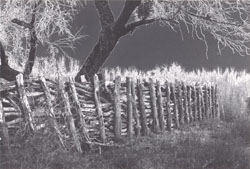
Dragonslayer
The first page of this article is primarily concerned with theory.
For practical information on how to solarize prints please proceed to Page 2.
The Sabatier Effect is not true solarization, which is an entirely different reversal phenomenon. True solarization (sometimes referred to as classic or reversal solarization) is the reversal of a portion of a
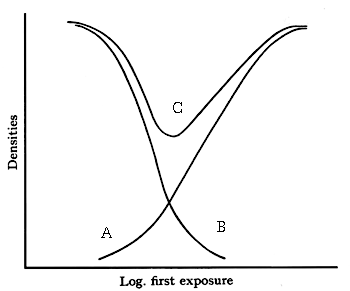
This diagram is after one from Stevens' and Norrish's first paper Border Effects Associated with Photographic Reversal Processes (1937).
(A) represents a normal characteristic curve after development.
(B) represents the hypothetical curve if a second exposure were to cause complete reversal.
(C) represents the sum of A and B, which is very nearly the curve that results when an emulsion is "solarized."
Since the time of Man Ray the Sabatier Effect has been popularly referred to as solarization. Occasionally the knowledgeable have more correctly referred to it as pseudo-solarization, but the appellation "solarization" has continued to gain usage. I find it easier to speak in terms of “solarizing” a print than of "Sabatiering" it; and, since fogging of the high values (of the print), diffusion halation, and Sabatier edge effects are also produced by the so-called "solarization" exposure, we may consider it legitimate to speak of print solarization as a phenomenon which is inclusive of the Sabatier Effect, among others.
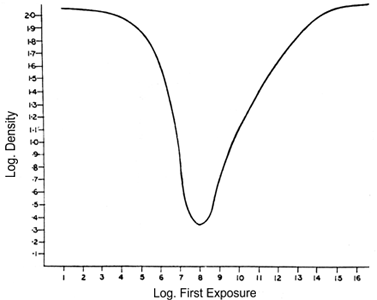
A typical curve for Luminos Classic grade 4 when solarized. After Clarence Rainwater, The Road to R77 (1997).
The papers that "solarize" well seem to be largely bromide emulsions, though there are notable exceptions. William L. Jolly, et al., have proven experimentally that papers with good Sabatier emulsions contain silver halide grains with primarily surface sensitivity centers. Papers which do not solarize well seem to contain a much higher proportion of internal sensitivity centers. The silver halide grains in any emulsion will, however, have some internal sensitivity centers, and these (according to William L. Jolly, et al) lie at the heart of the Sabatier effect.
Various portions of a photographic paper’s emulsion receive differing amounts of exposure, corresponding to various density values of the negative. Some areas receive no exposure or virtually none (high values of the print), other areas receive moderate amounts of exposure (middle values of the print), while yet others receive very large amounts of exposure (low or shadow values of the print). Each of these areas responds differently to the solarization exposure.
 Those halide grains in the emulsion which have received a very high initial exposure will immediately form latent image specks
on their surfaces and will be reduced to pure silver during the first development period. They become the low, or shadow, values of the print. Once converted to pure silver, these grains
are not affected by the solarization exposure or by the second development.
Those grains in the emulsion which have received a moderate initial exposure will not yet have formed latent image specks, but instead will have formed latent subimage specks, primarily on their surfaces. All halide grains contain some internal sensitivity centers and (whether due to their conformation, their relative position in the emulsion, or the length or intensity of the exposure they receive) they also form latent subimage specks in their interiors. W.L. Jolly theorizes that an electronic pressure is created by the adsorbed developing agent ions on the surface of the halide grains, which first causes free electrons to migrate to the internal subimage specks, which in turn attract silver ions from surface subimage specks, thus leaving the halide grains with one or more internal latent image specks but no surface latent image specks. These silver halide grains are not developable by low-solvent developing solutions. When these grains receive the second, or solarization, exposure, their internal latent image specks grow in size, but surface latent image specks are unable to form due to the migration of electrons and positively charged silver ions to their interior. These grains are therefore not reduced to pure silver during the second development. However, if the second development time is extended (generally well above 90 seconds) the solvent action of the sulfite will eventually allow the developing agent to get at the latent image specks in the interior of the grain and reduction will commence.
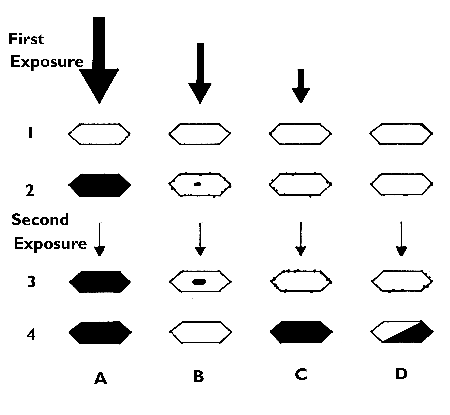
(1) Represents grains of silver halide at the first exposure, (2) the first development, (3) the second exposure, and (4)
the second development.
Column A shows that grains receiving large amounts of initial exposure are completely developed during the first development and
are not affected by the second exposure and development.
Column B shows that grains receiving a moderate amount of initial exposure may form an
internal latent subimage speck which attracts electrons and silver ions to the center of the grain. The second exposure only serves to create an internal latent image speck,
which is not reducible by a brief second development.
Column C shows grains which receive a small amount of initial exposure. During the first
development these grains form surface (but not internal) latent subimage specks, which during the second exposure become surface latent image specks, allowing the entire grain to be
reduced to silver during the second development.
Column D shows grains which receive no initial exposure. They remain unaffected by the first
development. During the second exposure these grains form surface latent subimage specks or latent image specks, depending upon whether they receive a very weak second exposure
or a very strong one, respectively. If the second exposure is weak, these grains will not be reduced to silver. However, if the second exposure is strong, these grains
will be reduced.
 Those silver halide grains in the emulsion which have received no
initial exposure whatever will have formed no latent subimage specks whatever. If they receive a second exposure with a low intensity light, developer anions adsorbed to the surface sensitivity centers effectively
repel the photoelectrons so that surface latent image specks cannot form. If the grains contain internal sensitivity centers, they may form internal
latent image specks, but are typically too deep to be reducible during the second development. So, in the case of a low intensity second exposure, no development takes place in grains which have had no initial
exposure. This explains why sometimes very bright high values of a print are not affected by the solarization exposure. However, if such
grains receive a second exposure with a very high intensity light, the quantity of photoelectrons is so great that it overcomes the electronic repulsion of the developer anions, causing the formation
of surface latent image specks, thereby allowing the chemical reduction of the halide to take place. Hence, if the light is bright enough, or the exposure long enough, these very high print values will become fogged.
Only the seeming reversal (it is really a lack of development), which takes place somewhere in the
middle values of the print, may be legitimately referred to as the Sabatier Effect. This is not a reversal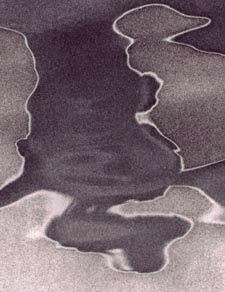 one sees as it occurs, but rather a desensitization, which inhibits development, in what
would normally become the middle values of the print. There is however a genuine reversal that may sometimes take place as a result of bromides released by intense development after the second
exposure. Bromides diffuse over into adjacent areas of lesser density and reduce them considerably. One can often see developed-out areas reversing in the developing tray after the solarization
exposure. The Sabatier edge effects, which appear as white lines between areas of distinctly different densities, were proven (by Stevens and Norrish in 1937) to be the result of diffusion halation.
However, their experiments were conducted entirely with films and they state clearly that bromide reduction may also play a part in the phenomenon. (Click here for a detailed discussion of border effects.) There is likewise a fogging effect which takes place in areas of
low initial exposure, as described above, which is controllable by varying the length and intensity of the second exposure. This fogging is not strictly the Sabatier Effect (which involves
desensitization of the emulsion), but is nevertheless a phenomenon associated with what I refer to as print solarization.
To sum up, print solarization may be concisely defined as a complete or partial reversal of tones in an exposed and partially developed paper emulsion when given a uniform second exposure and developed to completion. The value of this definition is that it manages to include most of the important variables which must be taken into consideration when making a solarized print. Through the manipulation and control of these and other variables a variety of effects can be produced, from mere traces of tone in print highlights to posterization-like reversals.