Testing Pyrocat-HD
Tests and Photographs by Clay Harmon
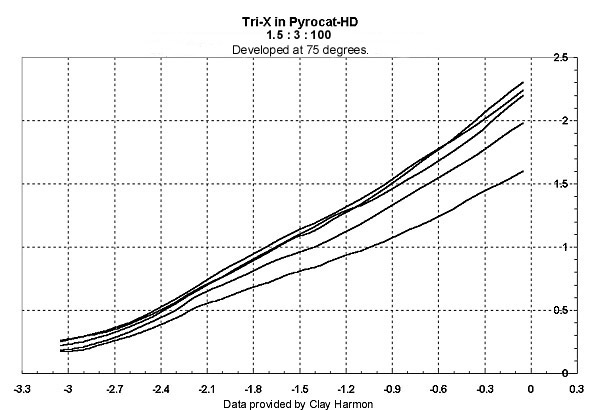
The data here suggest that the relative concentration of solution A versus B may be more critical than the absolute dilution of A and B to the distilled water. With the two films for which I have run tests with both dilutions (TMY and FP-4), the development time recommendations are remarkably similar. The performance of the various films suggest a strategy borrowed from Kerik Kouklis: carry both a high contrast film and a low contrast film, and use the appropriate film for the appropriate subject brightness range. Naturally low contrast films such as HP-5 and Fortepan 400 would be ideal for very high brightness range subjects. In fact, the tests I have run indicate that Fortepan could in theory handle a subject brightness range of 18 stops! Low contrast subjects that need expansion are best suited for higher contrast films such as FP-4 and Tmax 400. In terms of overall zonal flexibility, Tmax 400 and FP-4 at the 1:2:100 dilution are the clear winners: they can handle subject brightness ranges from 5 to 11 with ease. Since Tmax is not available in ultra large format sizes, FP-4 is probably the best bet, with Tri-X also a possibility.
| Pyrocat-HD (1.5 : 3 : 100) at 75º F - Jobo Expert Drums | ||||||||||
| Target Density Range: 1.4 - Palladium | ||||||||||
| SBR | 6 Stops | 7 Stops | 9 Stops | 11 Stops | 13 Stops | |||||
| Time | Speed | Time | Speed | Time | Speed | Time | Speed | Time | Speed | |
| HP-5 | NA | NA | NA | NA | 9 | 250 | 7 | 200 | 5.5 | 160 |
| FP-4 | 15 | 125 | 9.5 | 125 | 8 | 125 | 5.5 | 125 | NA | NA |
| T-Max 400 | 16 | 400 | 10 | 400 | 8 | 400 | 5.5 | 400 | NA | NA |
| Tri-X | 22 | 320 | 14 | 320 | 6.5 | 320 | NA | NA | NA | NA |
| Fortepan 400 | NA | NA | NA | NA | NA | NA | 15 | 200 | 11 | 200 |
BZTS Gradient Data |
|||||
Dev Time |
5.5 |
8 |
11 |
16 |
22 |
| HP-5 | 0.38 | 0.49 | 0.58 | 0.58 | 0.59 |
| FP-4 | 0.46 | 0.8 | 0.8 | 0.8 | |
| T-Max 400 | 0.44 | 0.58 | 0.73 | 0.76 | 0.76 |
| Tri-X | 0.51 | 0.61 | 0.65 | 0.68 | 0.68 |
| Fortepan 400 | 0.2 | 0.25 | 0.37 | 0.44 | 0.44 |
All of these tests were made with an eye toward alt-process type printing techniques that demand a high effective density range negative. The stain inherent in pyrocat HD allows me to make a negative with a target density range of 1.4 that will print well in pure palladium, as well as print well with Azo/Amidol. This, in my mind, may be the one of the key benefits to pyrocat : dual use negatives. One of the other benefits is that it is extremely difficult to blow out the highlights with pyrocat, which is something that cannot be said about D-76 or DD-23. I have found that Pyrocat is very forgiving of small development time variations. I often will process two 7x17s in the same drum when one indicated time is 11 minutes and the other 13 minutes. Processing both for 12 minutes still gives me two great negatives.
| Pyrocat-HD (1 : 2 : 100) at 75º F - Jobo Expert Drums | ||||||||||
| Target Density Range: 1.0 - Silver | ||||||||||
| SBR | 5 Stops | 6 Stops | 7 Stops | 8 Stops | 9 Stops | |||||
| Time | Speed | Time | Speed | Time | Speed | Time | Speed | Time | Speed | |
| FP-4 | 11 | 125 | 6.5 | 64 | 4 | 45 | NA | NA | NA | NA |
| T-Max 400 | 13.5 | 400 | 10 | 400 | 7 | 400 | 5.5 | 400 | 4.5 | 250 |
| Pyrocat-HD (1 : 2 : 100) at 75º F - Jobo Expert Drums | ||||||||||||||
| Target Density Range: 1.4 - Palladium | ||||||||||||||
| SBR | 5 Stops | 6 Stops | 7 Stops | 8 Stops | 9 Stops | 11 Stops | 13 Stops | |||||||
| Time | Speed | Time | Speed | Time | Speed | Time | Speed | Time | Speed | Time | Speed | Time | Speed | |
| FP-4 | 22 | 125 | 15 | 125 | 9 | 100 | 6.5 | 64 | 5 | 50 | 4 | 32 | NA | NA |
| T-Max 400 | 18 | 400 | 16 | 400 | 13 | 400 | 10 | 400 | 7.5 | 400 | 5 | 250 | 4 | 200 |
BZTS Gradient Data |
|||||
Dev Time |
4 |
5.5 |
8 |
12 |
18 |
| FP-4 | 0.46 | 0.58 | 0.63 | 0.76 | 0.8 |
| T-Max 400 | 0.34 | 0.45 | 0.54 | 0.75 | 0.86 |
Pyrocat-HD |
|
Stock Solution A |
|
| Distilled Water | 75 ml |
| Sodium Metabisulfite | 1.0 g |
| Pyrocatechin | 5.0 g |
| Phenidone | 0 .2 g* |
| Potassium Bromide | 0 .2 g |
| Distilled water to make | 100 ml |
Stock Solution B |
|
| Distilled Water | 70 ml |
| Potassium Carbonate | 75 g |
| Distilled water to make | 100 ml |
|
To make a standard working solution mix 1 part A with 1 part B * Or substitute 2.5 grams of metol (with a slight loss in film speed). |
|
Images copyright 2002 by Clay Harmon. All rights reserved.
For more information see the article Pyrocat-HD.