The MAB Model G and GZ are essentially the same pistol, except that the Model G is of all steel construction, whereas the Model GZ frame is made of aluminum. Most information about the Model G
applies equally to the Model GZ. A chart in the back of Bastié and Casanova’s book Les Pistolets MAB indicates the MAB Model G was first manufactured on 7 January 1957. Huon gives this
date for the manufacture of the Model GZ and does not mention the Model G at all. Bastié and Casanova state that the GZ followed the G. A French collector tells me that the GZ did not appear
in the 1958 MAB catalogue (he could not say about later catalogues), and the first advertisements I have located for the GZ in the U.S. appeared in 1962. I suggest that the earliest date of GZ production may
not have been until 1960 or 1961.
In 1962, MAB licensed production of the Model GZ to the Echave y Arizmendi firm in Eibar, Spain, which became known as Echasa. They produced the
gun under the Echasa GZ designation, with the grips marked “MAB ESPANOLA.” Some design
components were simplified, and the French-made guns are considered to be of superior manufacture. Nearly identical guns were also made under the brand names Echasa Fast, Basque,
Dickson Special Agent, and Liberty Arms. If French production ended in 1962 when Spanish production began, then the French GZ may have been manufactured for only a year, or two at the
most, which would account for its scarcity.
Bastié and Casanova link the origin of the Model G with the popularity of the Manurhin version of
the Walther PPK in the 1950’s and, echoing Huon, state that the Model G “is in the form of a small Model R.” The G has been described as a single-action version of the PPK. The Model G has the
same external hammer as the Model R as well as a magazine release behind the trigger, and the
safety is identical with that of the R-22 (the .22 caliber version of the Model R). While the Model G has a fixed barrel like the R-22, its slide is enclosed rather than open-top like the R-22, and the
internal lockwork is quite different. The Model G has a lockwork mechanism and trigger more like that of the Model F, with the trigger pivoting from the top and pulling the connector bar forward rather than pushing it back, generally making for a much smoother trigger pull than on the
Model R pistols. The Model G is very similar in size to the Model C.
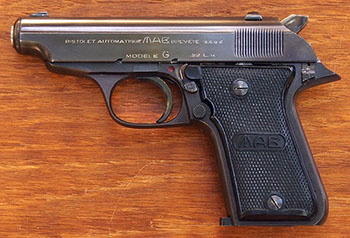
The MAB Model G is marked on the left side of the slide as follows in all capital sans-serif characters:
PISTOLET AUTOMATIQUE MAB BREVETE -S.G.D.G. MODELE G .22 L.R.
The MAB Model GZ is marked on the left side of the slide as follows in all capital sans-serif characters:
PISTOLET AUTOMATIQUE MAB BREVETE -S.G.D.G. MODELE GZ 7.65 (32)
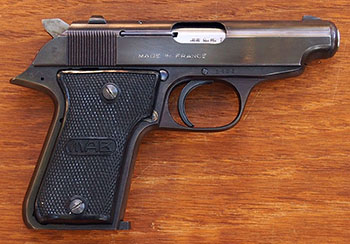
The right side of the slide is marked MADE IN FRANCE. The slide of the Model G features ninteen fine, vertical, triangular-cut
serrations on each side--those on the right side extend through the bottom edge of the slide, whereas on the left side they stop a millimeter or two above the bottom edge. The slide of the
Model GZ features five broad, angled, flat-bottomed serrations on each side. The serial number is on the right side of the frame, just above the trigger. The Model G in my collection is stamped
on the barrel and on the right rear of the slide and frame with the Paris proof--a crown over a shield. The grips are of checkered plastic with the MAB monogram centered in an oval cartouche.
The fixed barrel on the Model G is held to the frame by two transverse pins. The trigger is single-action only. The manual safety locks the slide and the connector bar but does not
immobilize the sear. Like the Model R, there is no grip safety, but unlike the Model R there is no half-cock position for the external hammer. A magazine safety prevents the gun from being fired when the magazine is
removed. Like the Model R-22, disassembly is accomplished via a small latch at the rear of the frame on the left side, and there is no mechanism to hold the slide open after the last round has been fired.
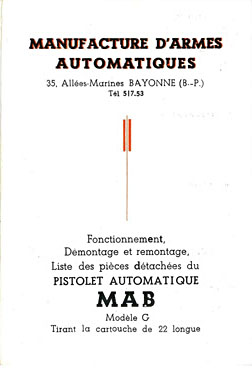
The sole manual I have seen for the Model G lists only the .22 Long Rifle cartridge. I have documented only a single Model G in a caliber other than .22 Long Rifle--a gun in 7.65mm
Browning (.32 ACP), which interestingly enough has an aluminum frame. Bastié and Casanova list the Model G in .22 Long Rifle, 6.35mm Browning, and 7.65mm Browning. I also possess a 1960
advertisement that appears to show a Model G and lists it as available in .22, .32, and .380. I would appreciate hearing from anyone who has one in a caliber other than .22.* The Model GZ
was chambered for the .22 Long Rifle, the 6.35mm Browning (.25 ACP) and 7.65mm Browning (.32 ACP) cartridges, and I have photographs of, or advertisements for, all versions.
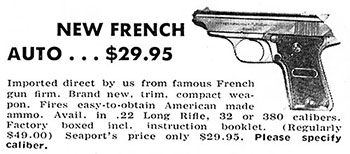
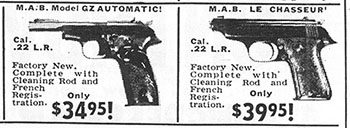
Model G Advertisement from Seaport Traders Guns & Ammo Magazine, July 1960
Model GZ Advertisement from Hunter’s Lodge Guns & Ammo Magazine, April 1964 (the labels for the two guns are reversed)
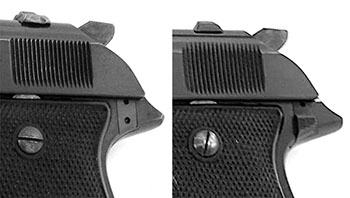
MAB Model G Take-down Latch Variants
The Model G appears to have been aimed primarily at the U.S. market, based on the fact that most of the low serial numbers I have documented are marked “Made in France for W.A.C.” “W.A.C.” is the Western Arms Corporation or its subsidiary, the Winfield
Arms Corporation of Los Angeles, California. Western Arms imported the gun into the U.S., and Winfield distributed and sold it. French collectors tell me the Model G is very rarely seen in France,
whereas the French-made Model GZ is rarely seen here in the U.S.
In the (admittedly) small sample of serial numbers I have collected, Model G pistols run from 44 up to 5772, while GZ serial numbers run from 5565 to
7091; both models may be in the same serial number sequence and at least a few G and GZ pistols may have been manufactured at the same time. However, the sample is far too small to say this with certainty.
I often try to derive information about production dates from advertisements. The MAB R-22, under the name Le Chasseur, was still being marketed by
Winfield as late as late as September of 1958 but I have been unable to find any Winfield advertisements for the Model G, even though they were the original importer/distributor. Winfield
seems to have stopped selling MAB pistols by 1960 though they continued in business at least until 1963. In the July 1960 issue of Guns and Ammo magazine there is an advertisement from Seaport Traders of
Los Angeles, California that includes a “New French Auto” that has the vertical slide serrations of a Model G. In 1962, Hunter’s Lodge, a
company owned by Sam Cummings (of Interarms fame) began advertising the Model GZ, available in .22 Long Rifle only. By 1963 Hunter’s Lodge was selling both the Le Chasseur R-22 and the
GZ; advertisements for both guns continued into early 1964, but are not seen later than that. In 1964, MAB went through a crisis that forced it into liquidation. The company was sold and the
manufacture of many of its pistols, including the Model R, the Model G, and the Model GZ, was never resumed.
There are two minor variants of the Model G. The first variant has two holes in the take-down
latch on the left rear of the frame and requires a small tool to operate. In the second variant the bottom hole of the latch is replaced with a raised, serrated area that can be pressed down without the use of a tool.
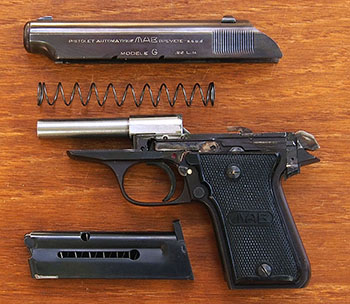
Field Stripping the MAB Model G
MAB Model G Field Stripped
Pull the slide back about 2 centimeters and lock it open by moving the safety lever up into the front detent on the bottom edge of the slide.
If you have the early variant, insert the take-down tool into the bottom hole of the take-down latch and pull the latch downward. If you have the second variant, simply push down
on the raised, serrated portion of the latch.
Release the safety lever. Grasp the slide, pull it to the rear, and lift it up from the frame.
Carefully ease the slide off the front of the gun.
Most used guns will not come with the take-down tool. I made one from a brass piece that came with a gun cleaning kit. The brass piece was for pushing
cotton patches through gun barrels, and had a long point on the end. I ground the point down to the correct diameter, ground the length down to the same depth as the latch (about 3mm) and rounded
the end with a file. It isn’t perfect but it suffices, and the brass will not scratch the gun.
* Please contact me with information about Model G or GZ pistols at [email protected]. Photographs are welcome.
References
Les Pistolets Automatiques Francais: 1890-1990, by Jean Huon.
Histoire & Collections, Paris: 1995. Les Pistolets MAB, by Jean-Pierre Bastié & Daniel Casanova. Crépin-Leblond et Cie: 2015.
Copyright 2016 by Ed Buffaloe. All rights reserved. Click on the pictures to open a larger version in a new window.