The Model 1910 Mauser
The Model 1910 Mauser Pocket Pistol
A Summary of Available Data
Adapted 2017-2020
from the original work by John LaCroix, c. 1997
by Ed Dittus.
[email protected]
John LaCroix was a major contributor to the literature on Mauser pocket pistols during the 1990's. As can be seen from what follows, his exposure to examples and the knowledge he gained was encyclopedic. Sadly, his published work has been lost or is at the very least difficult to obtain. I think we would all benefit from making his work more widely available. To this end, I obtained an original copy of the John LaCroix data. I found it a bit difficult to follow as he arranged it, but hugely informative, so I decided to reformat/proof/rewrite as needed for my own use. As time went on, I added graphical representations of data contained in John's writings, as well as other information gleaned from my own research. This has been a useful road map of the swirling world of Mauser Pocket Pistols, and I have referred to it regularly. I hope my readers will find it equally useful. Please let me know of any additions, corrections, etc. I take full responsibility for any mistakes contained herein. And thanks to John LaCroix, wherever you are.
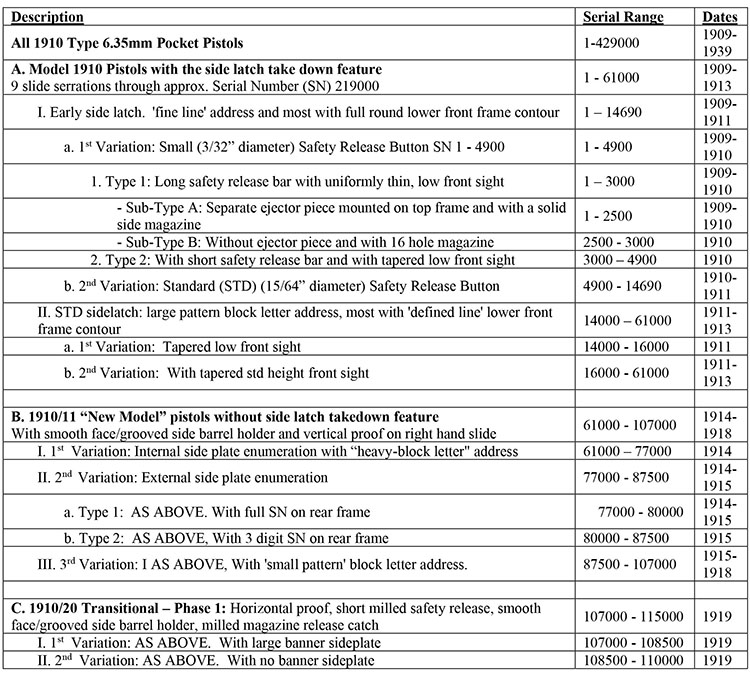
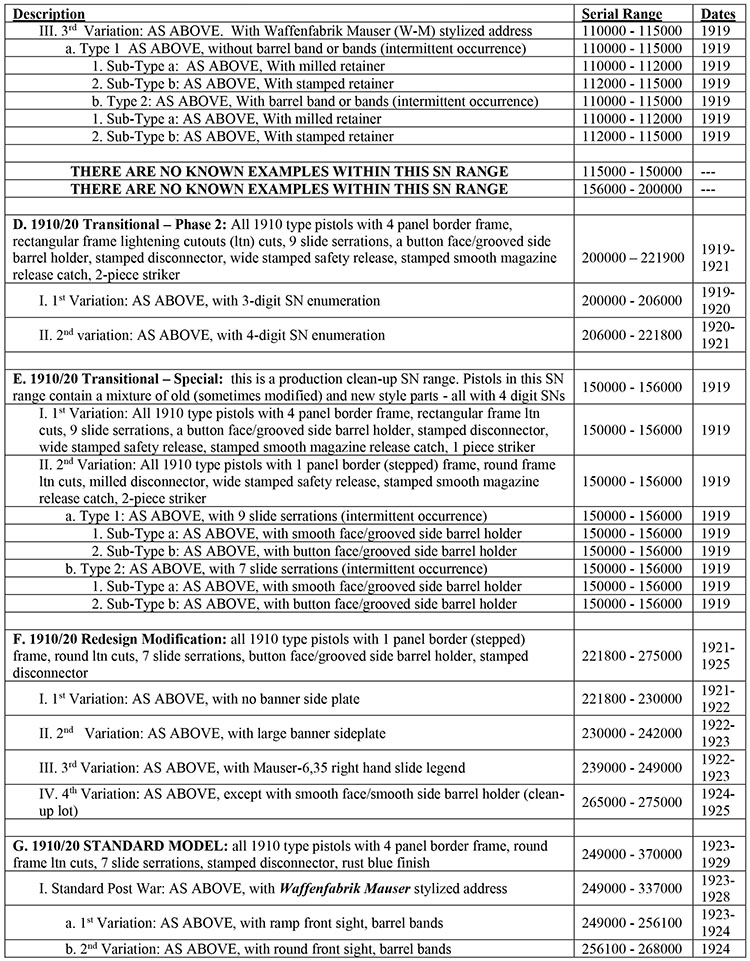
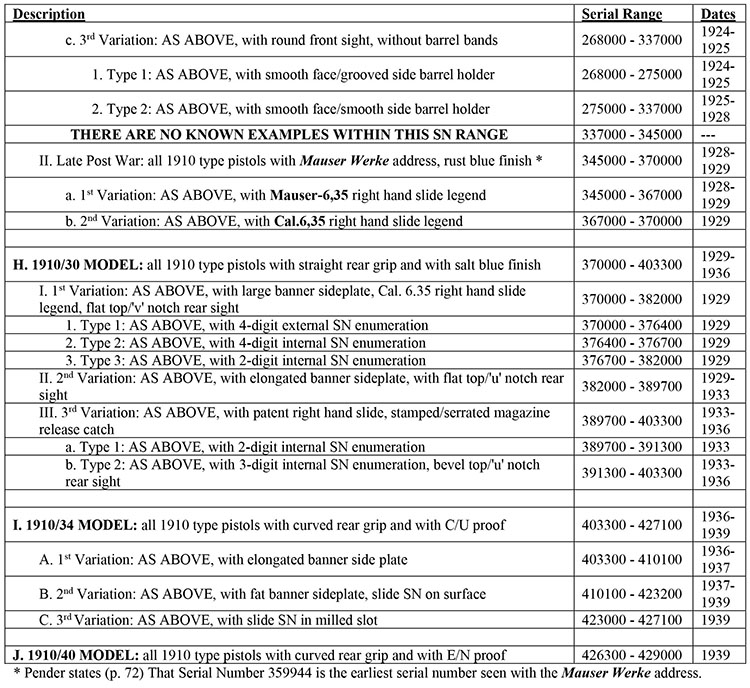
Summary of Basic Characteristics
- SERIAL NUMBERS (SN): Lowest Recorded SN 198 Highest Recorded SN 428622
- FRAME NUMBERS (FN): Highest Early Prod Without a FN: Pistol SN 649
- Lowest 1st Series: FN 1199 (Pistol SN 1199)
- Highest 1st Series: FN 105814 (Pistol SN 106894)
- Lowest 2nd Series: FN 9 (Pistol SN 107197)
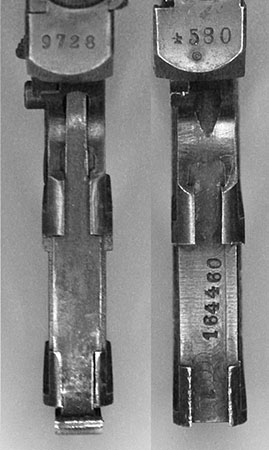
Mauser 1910 Frame Number
- Highest 2nd Series: FN (1)94466 (Pistol SN 374792)
Serial numbers (SN) appear on Mauser M1910 pistols in a number of places depending on when the weapon was manufactured. Generally, the full serial number is found on the left front of the slide. The final 4 characters are sometimes repeated on the rear of the weapon, just below the "cocked" indicator. Three or four digits may also appear on the retaining catch and the barrel locking lug. Early production might have different placement. For example, some 3 digit SN pistols have 2 digits on the trigger.
What are Frame Numbers?
Mention is made of "Frame Numbers" (abbreviated FN) through this paper. These appear on earlier Mauser 1910 pistols (serials under 150000 approximately). They were the same as the serial numbers for some interval and then something happened—from then on, though they were directionally similar, they no longer matched the serial number. Their location has mitigated against a comprehensive analysis inasmuch as they are under the magazine release spring whose removal can be somewhat problematic.
The photo shows the rear of two model 1910 pistols, the left example with the flat mainspring in place, the right with it removed and the "hidden" Frame Number revealed.
I recently obtained a curious 1910 frame with such a number and wondered as to their nature and whether or not there was a relationship between them and the actual serial number of the weapon in question. LaCroix suggested that the relationship between these numbers and serials is obscure. This is not absolutely true as we shall see. To address this issue I scoured the research materials at my disposal and put out a call for data on the Jan Still Luger site. Removing the retention spring to see the number is difficult and not something the typical Mauser owner will ordinarily do, nonetheless, through these efforts I was able to assemble a data base of 73 Frame/Serial pairs. This section summarizes the results of my examination of them.
Why “Frame Numbers” in the first place? I have come across a variety of rationales for the use of a numbering scheme on receivers that is independent of the final serialization. To me, the following makes the most sense.
You have a casting for a frame. You do a couple of operations and produce a nice flat surface that you stamp a number on. This number allows you to follow the entire manufacturing process for this piece.
At every station the machinist/fabricator has a clipboard with a sheet. Down one side are the frame numbers. A frame appears on the bench, the machinist finds the number on his list and enters the date. When he is done with his operations he enters a second date and passes the thing off to the next station.
In a nice orderly universe the frames are handled sequentially, not because it is mandated but because that is what naturally follows from the process.
At the end a serial number is stamped on the frame. The number follows the frame number in a more or less orderly progression.
After serial 100000 or so, the Great War wound down/ended, madness ensued, the numerical relationships got flakier.
The point is that the inevitable wastage due to machining mistakes resulted in frames that were unusable for tolerance or other reasons and caused a discontinuity between the progression of frame numbers and the associated serials. And, indeed, the correspondence is not perfect. The only issue, to me at least, is why not simply use the frame number as the serial number. The only reason that I can see is that there will, inevitably, be gaps and that might present some sort of administrative problem. Another conundrum whose solution is lost in the mists of time.
The Data: The initial plotting of the data suggested that there are clearly two relationships present.
The frame marks associated with serial numbers of up to approximately 100000 bear an almost perfect relationship. That is to say that the Frame Number is simply the Serial Number plus ~208. There are no reversals, in other words, the numbers increase monotonically. Does this mean that every pistol in this range must have a frame number? No. In fact, it appears that a number of early pistols might well not be marked. The data from LaCroix begins at serial number 1199. At least one very early pistol (SN 198) is devoid of a frame number. It only means that, based on the data, there are discontinuities for reasons that are not clear.
There is a second sequence that shows a strong but reduced relationship beginning at about Serial Number 200000. Here the relationship is a bit shaky.
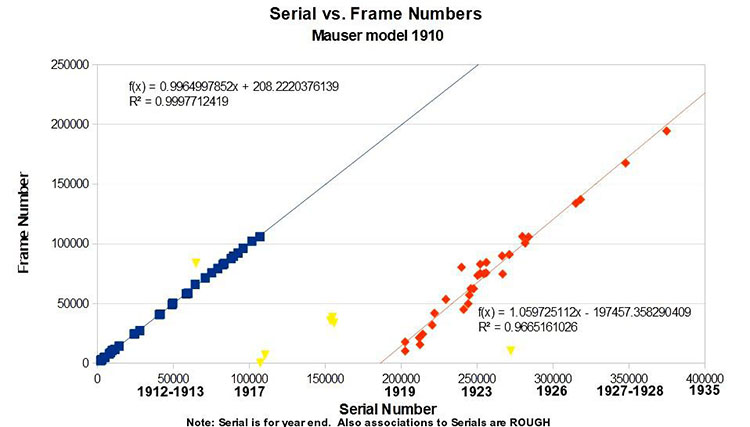
There are eight observations where I have made the heroic decision to declare them “Outliers”. Clearly their handling vis a vis the numbering process resulted in an enumeration that put them on a different continuum than their fellows. I might note that the six cases (in yellow) in the serial range 100000 to ~150000 might represent another cohesive grouping. I hesitate to make anything of this inasmuch I as I am well aware that numbers can act as a Rorschach as well as an ink blot does.
Interpretation: In examining the two main trend lines, and ignoring the outliers, it is apparent that a change in the underlying numbering scheme occurred between serials 100000 and 200000 which corresponds, roughly, to the period bounded by 1917 and 1919. Depending on how the data are interpreted, this period might be even more tightly centered on 1919. A treatment of dates based on LaCroix's work can be found in the tables at the beginning of this paper. The interesting thing is that if we take LaCroix's observation that there was something of a manufacturing hiatus associated with the serial ranges 115000-150000 and 156000-200000 (which represent 79,000 pistols out of a possible total of 100,000) and examine his production history, we can envision a level of chaos at Mauser during those troubled times. LaCroix identifies 11 different Sub-types and Types of this model pistol during that brief stretch. Why, though, they would have changed the basis for assigning frame numbers is rather unclear.
Basic Configuration
- Highest Sidelatch: SN 60470, (FN not reported)
- Lowest 1910/14 New Model: SN 61079, (FN not reported)
- Highest 1910/14 New Model: SN 106894, FN 105814
Rear Frame Markings
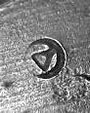
Triangle in Circle
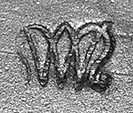
Intertwined WM
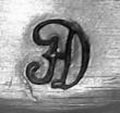
Intertwined HD
- Intertwined SK: One Example Known SN 89670, FN 89434 (We have no positive documentation of this stamp, and no photo of the one observed example.)
- Triangle in Circle: Lowest SN 150876, FN 37068, Highest SN 374792, *FN 94466
*NOTE: Somewhere above FN 167640, (which corresponds to pistol SN 347741), the first numeral (1) of the FN was omitted - (probably to conserve marking labor). - Intertwined WM: Lowest SN 241180, FN 45009, Highest SN 268882, FN 76579
- Intertwined HD: Lowest SN 356947 (No HD marked Pistols have been reported with Frame Numbers). Highest SN 377848 (378454)
- Note 1: Somewhere above FN 167640, (which corresponds to pistol SN 347741), the first numeral (1) of the FN was omitted - (probably to conserve marking labor).
- Note 2: While the lowest SN for the Triangle in Circle mark on the rear frame is correct, it also appears on the side of the slide on SN 319. The meaning of this mark remains obscure.
Finish and Grip Profile
- FACTORY NICKEL FINISH: SNs 20939, 56617, 58847, 401815, 421711, 423094, 424636, 425615, 425634
- HIGHEST RUST BLUE FINISH: SN 374792 (Triangle/Circle Marked)
- LOWEST SALT BLUE FINISH: SN 370430 (Intertwined HD Marked)
- HIGHEST STRAIGHT REAR GRIP: SN 403264 (Salt Blue Finish)
- LOWEST CURVED (1934 Style) REAR GRIP: SN 401815 (Nickel Finish), SN 403361 (Salt Blue Finish)
Dateable Examples
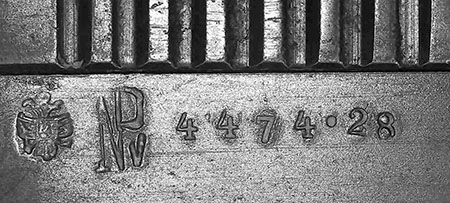
Mauser 1910 - SN 35944 - w/ 1928 Austrian Proof
This gun is referenced in Pender’s book, pp. 72-73.
- SN 19861 with 1912 Dated Austrian Proofs
- SN 411558 with 1937 Dated Czech Proofs
- SN 359944 with 1928 Dated Austrian Proofs
- SN 415532 with 1938 Dated Czech Proofs
- SN 364186 with 1928 Dated Austrian Proofs
Major and Otherwise Significant Serial Number Ranges
with No Known Examples
- SN 60500 to 61000 (Extremes Known: SN 60470 and SN 61079)
- SN 115000 to 150000 (Extremes Known: SN 114198 and SN 150670)
- SN 156000 to 200000 (Extremes Known: SN 155770 and SN 202573)
- SN 337000 to 345000 (Extremes Known: SN 336418 and SN 345977)
- SN 365000 to 369000 (Extremes Known: SN 364405 and SN 369436)
Observation: Based on their features, characteristics, FNs and small parts SN enumeration, pistols in the SN range 150000 thru 156000 appear to have been produced concurrent with pistols in the SN range 205xxx thru 223xxx.
Dealer Markings
- VON LENGERKE & DETMOLD. NEW YORK dealer marking (Right side of slide). Documented examples include serial numbers 5473, 5476, 5482, 5489, 9534, 9544, 9575, 9583, 9601, 9621, 9624, 9631, 10017, 10019, 10025, 10027, 10032, 10054, 10063, 14628, 14629, 14633, 14644, 14652, 14663, 14669, 14676, 14681, 14683, 14693, 14724, 14755.
- L. CHOBERT ARQR, 16. R. LAFAYETTE PARIS- French dealer at 16 Rue Lafayette in Paris. His mark is found on a Mauser M1910, SN 19612.
- ALLEMEGNE- marked on the barrel, visible in the ejection port. Found on M1910 SN 397108
- FAURÉ LE PAGE: French retailer marking on barrel, M1910 SN 64578
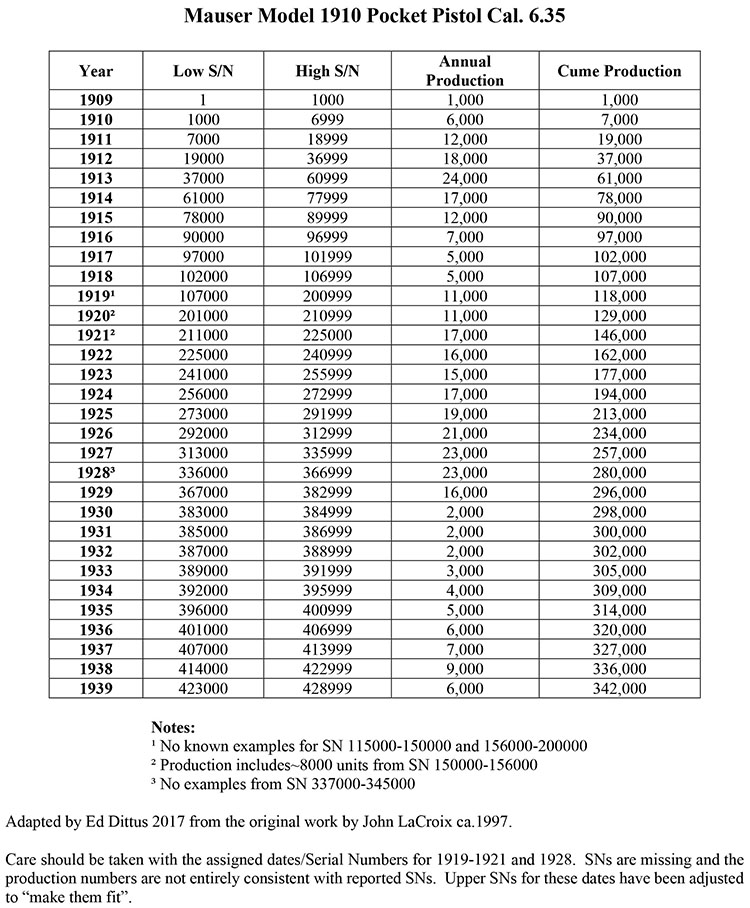
- The table below shows the serials of the Model 1910 imported by VL&D through at least 1911. See references for fuller discussion.
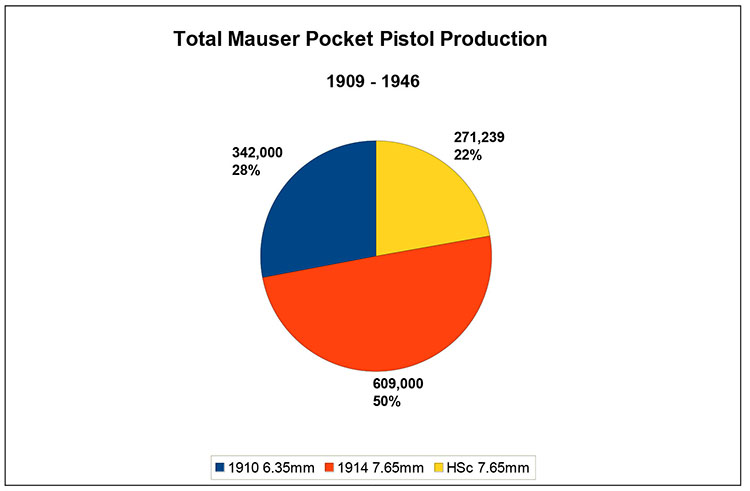
Production Graphs
Notes:
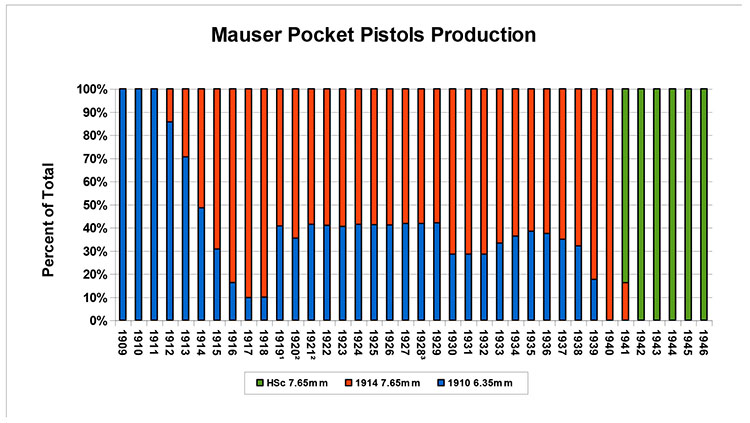
There are no known examples for the SN ranges 11500-150000 and 156000-200000 and 337000-345000. Production includes approximately 8000 units between SN 150000-156000.
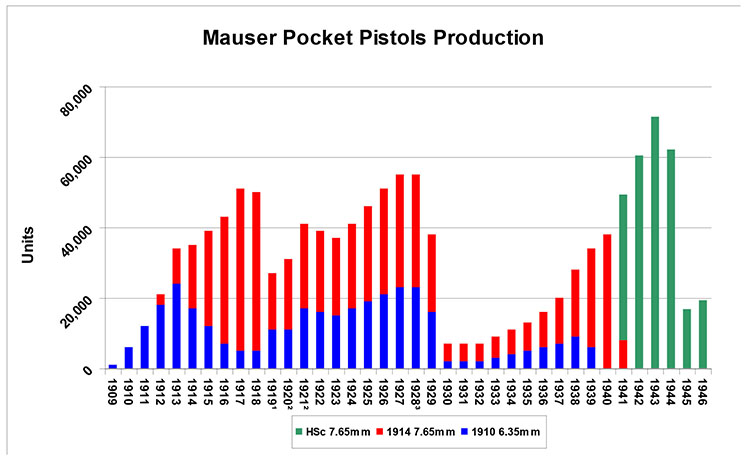
1. There are no known examples for the SN ranges 11500-150000 and 156000-200000.
2. Production includes approximately 8000 units between SN 150000-156000.
3. No examples are found between SN 337000-345000.
References
Pender, Roy G. III. Mauser Pocket Pistols: 1910-1946, Collectors Press, Houston, Texas: 1971.
1. This serial is referenced here: https://www.lugerforums.com/threads/early-mauser-m1910-serial-264.128447/?post_id=1006389#post-1006389
2. Von Lengerke and Detmold: The First Model 1910 Mauser Pistols in the USA by Ed Dittus
https://unblinkingeye.com/Guns/VLD/vld.html
I have drawn from various Internet resources, primarily Jan Still's Luger Gunboards. I would like to thank Alexander Stucki who provided me with data that I have used here. The originator of some data was John LaCroix though the original place of publication is unknown. I suspect it was the NAPCA journal.
Links
Mauser Model 1910 Sidelatch Early SN 145 Parts Diagram
Mauser New Model 1910/14 SN 356803 Parts Diagram
Copyright 2025 by Ed Dittus. All rights reserved.