|
|
|
|
|
|
|
|
|
|
|
|
|
|
|
|
||||||||||||||||||||||||||||||||||||||||||||||||||||||||||||||||||||||||||||||||||||||||||||||||||||||||||||||||||||||||||||||
 |
|||||||||||||||||||||||||||||||||||||||||||||||||||||||||||||||||||||||||||||||||||||||||||||||||||||||||||||||||||||||||||||||||||||||||||||
 |
|||||||||||||||||||||||||||||||||||||||||||||||||||||||||||||||||||||||||||||||||||||||||||||||||||||||||||||||||||||||||||||||||||||||||||||
|
Mini Revolvers by Ed Buffaloe History I have demonstrated my
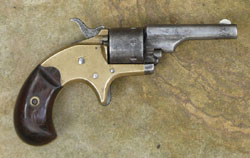
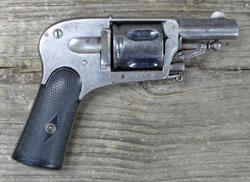
The small .22 revolvers were followed by larger models in .32, .38, and .41 caliber-- cheap rimfire versions of which have since become known as suicide specials. Soon after American pocket revolvers began to appear, the Webley Bulldog came on the market (1872-1873). It was originally chambered for larger self defense rounds such as the .45 Webley, the .442, and the .380 centerfire, but was also made in .44 rimfire, .45 Webley, .320 and many other calibers. American companies quickly began to imitate the very successful Bulldog, and it wasn’t long before the Belgian arms industry took a piece of the action as well. By the 1890’s there were literally hundreds of different pocket revolvers of
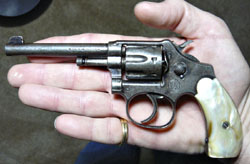
With the advent of the bicycle, the Bicycle Gun came into vogue--typically a pocket revolver in a small caliber suitable for discouraging dogs from chasing bicyclists. Such guns already existed, but hadn’t been named Bicycle Gun yet. One such was the Hopkins and Allen 7-shot .22 solid frame double action revolver, made between 1875 and 1907, known as the XL No. 3 Double Action small frame. The .32 Smith & Wesson Safety Hammerless of 1888 to 1892 with the 2 inch barrel became known as a “Bicycle” gun at some point, and the First Model Ladysmith (the 1902 M Frame Model .22 Hand Ejector), was often referred to as a “Bicycle” gun. Iver Johnson made a similar gun--the Model 1900 Double Action small frame, a 7-shot .22, which appeared in 1900 and remained in production for 41 years.
Modern Mini Revolvers In my lifetime, so far as I know, the first mini revolver to show up on the market was the Rocky Mountain Arms Corporation (RMAC) .22 short. According to an interview with the current owner of North American Arms, Sandy
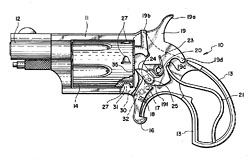
Casull later redesigned his gun to have the locking mechanism on the bottom, eliminating the lever attached to the hammer. His patents were filed in 1978 and granted in 1980. U.S. Patent 4228606 was granted to Casull on 21 October 1980 for the means of mounting the cylinder to the frame, and U.S. Patent 4228608 was granted on the same date for the cylinder locking mechanism. U.S. Patent 4385463 was granted to Casull on 31 May 1983 for a floating firing pin for small revolvers and U.S. Patent 4450992 was granted 29 May 1984 for a belt buckle that would hold a .22 short mini revolver.
According to Sandy Chisolm, North American Arms was founded “a couple of years [after the founding of Rocky Mountain Arms] to continue the development and manufacture of several firearms designed originally for RMA by the legendary Dick Casull.” Chisolm also states: “In the early 80s, NAA became a subsidiary of Talley Manufacturing, an aerospace manufacturing company.” I’m not sure exactly when North American Arms began producing their pistols, but I know they were listed in the 1984 issue of Gun Digest, though the name of the company was North American Manufacturing Corporation at that time. In 1988 both Freedom Arms and North American Arms were producing their guns at the same time, but sometime around 1990 Freedom Arms dropped the mini revolvers. Talley Manufacturing sold North American Arms to Sandy Chisolm in November of 1991. The company has continued in business ever since.
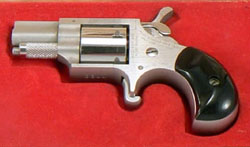
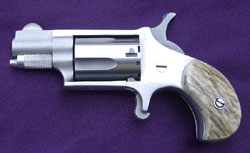
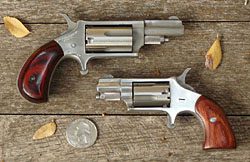
Shooting Mini Revolvers I own a North American Arms .22 LR Mini Revolver and an NAA .22 magnum, and I was able to borrow a Freedom Arms .22 LR Boot Gun from a friend for comparison purposes. My NAA long rifle mini revolver came with the standard tiny “birds head” grips, which I took an instant dislike to. I simply couldn’t find a comfortable position in which to hold the gun. Eventually I made myself a pair of deer antler grips for the gun, and purposely made the left-side grip with a slim top and swollen bottom so I could get my thumb over it.
The NAA .22 magnum revolver has somewhat larger grips than the long rifle version, which feel better in my hand, but the more powerful cartridge prevents me from hanging onto it any better than the smaller revolver. If anything, I’m even less accurate with the .22 magnum. For practical self-defense purposes, these guns are limited to an arms-length range. A sharp knife is probably a more dangerous up-close weapon. However, the little revolvers do make a lot of noise and shoot flames out the front in the dark, so they might have a certain deterrent effect on amateur assailants.
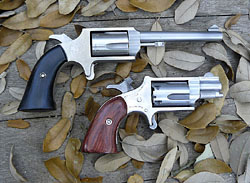
Unfortunately, I found that even with better sights, a longer sight radius, and a larger grip, I still wasn’t very accurate shooting one-handed with the Freedom Arms Boot Gun. My friend told me it was a very accurate gun, and he could hit quite well with it, but he has powerful hands and obviously can control the recoil. Then I came across an article in the 1984 edition of Gun Digest entitled “Handling Mini-Revolvers” by Dave Reynolds. Dave claimed he could shoot 2-inch groups at 50 feet with the Boot Gun (and had a picture to prove it). His techniques are worth repeating.
I feel the mini revolvers have a place as deep concealment and backup guns, but those who carry them should practice with them regularly if they expect to defend themselves effectively. Dave Reynolds reports that rapid fire is quite possible with a little practice. He recommends keeping the arms tight against the body, holding the trigger back with one hand and thumbing the hammer with the other. He says he can put 5 shots in an area the size of a basketball at 10 feet in about 2 seconds. Not bad! |
|||||||||||||||||||||||||||||||||||||||||||||||||||||||||||||||||||||||||||||||||||||||||||||||||||||||||||||||||||||||||||||||||||||||||||||
|
Copyright 2008-2013 by Ed Buffaloe. All rights reserved. |
|||||||||||||||||||||||||||||||||||||||||||||||||||||||||||||||||||||||||||||||||||||||||||||||||||||||||||||||||||||||||||||||||||||||||||||
|
|||||||||||||||||||||||||||||||||||||||||||||||||||||||||||||||||||||||||||||||||||||||||||||||||||||||||||||||||||||||||||||||||||||||||||||
|
|
|||||||||||||||||||||||||||||||||||||||||||||||||||||||||||||||||||||||||||||||||||||||||||||||||||||||||||||||||||||||||||||||||||||||||||||